//******************************************************************************
//
// File: TimeFit.java
// Package: ---
// Unit: Class TimeFit
//
// This Java source file is copyright (C) 2008 by Alan Kaminsky. All rights
// reserved. For further information, contact the author, Alan Kaminsky, at
// ark@cs.rit.edu.
//
// This Java source file is part of the Parallel Java Library ("PJ"). PJ is free
// software; you can redistribute it and/or modify it under the terms of the GNU
// General Public License as published by the Free Software Foundation; either
// version 3 of the License, or (at your option) any later version.
//
// PJ is distributed in the hope that it will be useful, but WITHOUT ANY
// WARRANTY; without even the implied warranty of MERCHANTABILITY or FITNESS FOR
// A PARTICULAR PURPOSE. See the GNU General Public License for more details.
//
// Linking this library statically or dynamically with other modules is making a
// combined work based on this library. Thus, the terms and conditions of the
// GNU General Public License cover the whole combination.
//
// As a special exception, the copyright holders of this library give you
// permission to link this library with independent modules to produce an
// executable, regardless of the license terms of these independent modules, and
// to copy and distribute the resulting executable under terms of your choice,
// provided that you also meet, for each linked independent module, the terms
// and conditions of the license of that module. An independent module is a
// module which is not derived from or based on this library. If you modify this
// library, you may extend this exception to your version of the library, but
// you are not obligated to do so. If you do not wish to do so, delete this
// exception statement from your version.
//
// A copy of the GNU General Public License is provided in the file gpl.txt. You
// may also obtain a copy of the GNU General Public License on the World Wide
// Web at http://www.gnu.org/licenses/gpl.html.
//
//******************************************************************************
import edu.rit.numeric.AggregateXYSeries;
import edu.rit.numeric.ListSeries;
import edu.rit.numeric.NonNegativeLeastSquares;
import edu.rit.numeric.plot.Dots;
import edu.rit.numeric.plot.Plot;
import java.awt.Color;
import java.io.File;
import java.text.DecimalFormat;
import java.util.ArrayList;
import java.util.TreeMap;
import java.util.Map;
import java.util.Scanner;
import java.util.regex.Matcher;
import java.util.regex.Pattern;
/**
* Class TimeFit is a main program that analyzes running time measurements and
* fits them to a running time model for a parallel program.
*
* Usage: java TimeFit inputfile nplot f1
* [ f2 . . . ]
*
* The input file, a plain text file, is the same as for class {@linkplain
* Speedup}. For a detailed description of the input file format, see class
* {@linkplain Speedup}.
*
* The input file begins with running time data. Each line contains an n
* value, a K value, and one or more T values. The n value,
* an integer, is the problem size parameter. The K value, an integer
* >= 0, is the number of parallel processors; K = 0 signifies the
* running times are for a sequential version of the program, K > 0
* signifies the running times are for a parallel version of the program. Each
* T value, a long integer, is a running time measurement in
* milliseconds. Each line of running time data, then, contains one experimental
* data point with two independent variables, n and K, and one
* dependent variable, T (the smallest of the running time values).
*
* The nplot command line argument specifies one of the n values
* in the running time data section of the input file. The TimeFit program will
* generate plots of the data and the model for this value of n, as
* described below.
*
* The running time model is composed of P basis functions,
* f1(n,K), f2(n,K), . . . ,
* fP(n,K). For each basis function there is
* also a model parameter c1, c2, . . . ,
* cP. The model is:
*
*
*
* | |
* P |
* |
*
*
* | T(n,K) = |
* Σ |
* ci fi(n,K) |
*
*
* | |
* i=1 |
* |
*
*
*
* The basis functions are specified on the command line in symbolic form. Each
* basis function consists of either an n term, a K term, or an
* n term followed by a K term. The n term may be one of
* the following:
*
1
*
n
*
n^a (a is an
* integer exponent >= 0)
*
lgn (base-2 logarithm of n)
*
2^n
*
* The K term may be one of the following:
*
K
*
/K
*
* For example, the command:
*
* java TimeFit inputfile nplot 1 n nK
*
* specifies the model:
*
* T(n,K) = c1 + c2n +
* c3nK
*
* The command (note that quotes may be necessary):
*
* java TimeFit inputfile nplot 1 n K 'n^2/K' 'n^3/K'
*
* specifies the model:
*
* T(n,K) = c1 + c2n +
* c3K +
* c4n2/K +
* c5n3/K
*
* The TimeFit program finds the model parameter values that are nonnegative and
* that minimize χ2, the sum of the squares of the differences
* between the measured T values and the model T values. That is,
* the TimeFit program does a nonnegative least squares curve fit. When fitting
* the model, the TimeFit program uses only the running time measurements for
* the parallel version of the program (K >= 1). The TimeFit program
* prints out the fitted model parameter values and the value of
* χ2.
*
* The TimeFit program prints, for the problem size nplot specified on
* the command line, a table of the measured n, K, T,
* Speedup, Eff, and EDSF values as well as a table of
* those values calculated from the fitted model. The speedup and efficiency are
* calculated with respect to the parallel version of the program on one
* processor.
*
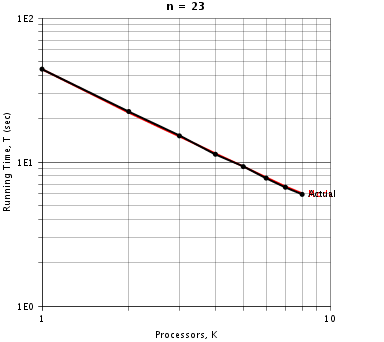
* The TimeFit program displays, for the problem size nplot specified on
* the command line, plots of the running time, speedup, efficiency, and EDSF
* series, each in its own window. The measured data is plotted in black, the
* data from the fitted model is plotted in red. Each plot window has menu
* options for saving the plot to a PNG image file, saving the plot to a
* PostScript file, and zooming the display.
*
* Here is an example of an input file:
* times.txt
*
*
 * 20 0 5718 5773 5777 5822 5864 5886 5891
 * 20 1 5798 5809 5817 5823 5849 5865 5897
 * 20 2 2971 2986 2988 3003 3014 3017 3034
 * 20 3 2056 2077 2092 2112 2114 2135 2165
 * 20 4 1579 1591 1595 1603 1604 1605 1610
 * 20 5 1302 1304 1307 1311 1314 1316 1319
 * 20 6 1091 1099 1110 1112 1114 1135 1145
 * 20 7 973 974 979 1007 1027 1027 1105
 * 20 8 867 870 881 883 895 913 1019
 * 21 0 11169 11176 11180 11298 11408 11416 11576
 * 21 1 11334 11390 11415 11430 11432 11445 11458
 * 21 2 5753 5758 5801 5802 5812 5838 5866
 * 21 3 3921 3933 3981 3993 4002 4056 4086
 * 21 4 3006 3011 3012 3016 3033 3052 3058
 * 21 5 2393 2425 2426 2449 2452 2458 2490
 * 21 6 2059 2064 2076 2080 2081 2442 2733
 * 21 7 1776 1781 1783 1785 1799 1802 1825
 * 21 8 1611 1616 1619 1625 1642 1643 1771
 * 22 0 22138 22279 22282 22376 22416 22506 22670
 * 22 1 22216 22290 22316 22549 22575 22637 22662
 * 22 2 11220 11359 11361 11369 11385 11387 11426
 * 22 3 7604 7631 7633 7771 7808 7905 7914
 * 22 4 5780 5814 5817 5863 5886 5886 6807
 * 22 5 4704 4704 4713 4725 4727 4753 4757
 * 22 6 3930 3944 3953 3956 3967 3972 3984
 * 22 7 3405 3426 3431 3444 3446 3455 3687
 * 22 8 3023 3041 3042 3048 3068 3091 3123
 * 23 0 43995 44306 44441 44543 44718 44847 45234
 * 23 1 44170 44209 44331 44345 44364 44702 44767
 * 23 2 22430 22444 22460 22558 22560 22942 22983
 * 23 3 15190 15213 15396 15516 15683 15689 15910
 * 23 4 11325 11552 11558 11560 11579 11595 11610
 * 23 5 9281 9289 9289 9309 9361 9418 9423
 * 23 6 7730 7773 7775 7830 7877 7955 7956
 * 23 7 6675 6700 6705 6706 6715 6727 6737
 * 23 8 5961 5972 5989 6003 6016 6094 6609
 * 24 0 88101 88457 89067 89250 89323 89917 90187
 * 24 1 87694 87924 88072 88353 88466 88540 88894
 * 24 2 44196 44681 44857 44887 44939 45039 45166
 * 24 3 29859 30159 30270 30484 30486 30775 30814
 * 24 4 22551 22670 22724 22794 23156 23262 25503
 * 24 5 18063 18331 18477 18592 18767 19364 19453
 * 24 6 15179 15340 15445 15498 15678 16906 18453
 * 24 7 13180 13249 13260 13314 13327 13406 13904
 * 24 8 11716 11770 11805 11934 11951 12059 12991
 * 25 0 175108 175302 175680 176496 177071 178365 181651
 * 25 1 175452 175623 175670 175926 176410 176607 178560
 * 25 2 88185 89112 89178 89241 89432 89777 89921
 * 25 3 60031 60145 60161 61135 61647 61659 61727
 * 25 4 44941 45368 45618 45751 45934 46339 53115
 * 25 5 36443 36481 36586 36588 36671 36772 36775
 * 25 6 30270 30461 30518 30688 30720 30993 31282
 * 25 7 26076 26368 26405 26556 26616 26721 26770
 * 25 8 23287 23288 23350 23441 23616 23827 23965
 * 26 0 351583 357215 357360 357711 358596 362653 363086
 * 26 1 348706 351180 351643 351936 351987 352264 352354
 * 26 2 176925 179100 179388 179638 181486 182045 196086
 * 26 3 119701 119715 120342 120793 121305 122482 122774
 * 26 4 89095 89182 90051 90113 90240 92107 98899
 * 26 5 71888 72280 72356 72611 73266 73785 74389
 * 26 6 61077 61097 61108 61156 61382 61396 61620
 * 26 7 51485 52184 52282 52733 52906 53168 53238
 * 26 8 46279 46543 46683 46851 48792 49126 51304
 * 27 0 705776 706487 713025 713236 713634 714578 716011
 * 27 1 696826 700121 703033 705225 709731 712779 713126
 * 27 2 351242 354433 354523 355175 355433 355831 357476
 * 27 3 237912 238336 238485 238900 239785 241458 241914
 * 27 4 178166 178444 178677 178688 181724 182888 183997
 * 27 5 144231 145245 146223 146378 146829 147605 147956
 * 27 6 120829 120894 121618 121637 121664 121835 122048
 * 27 7 103471 103706 104441 104913 105210 106320 113690
 * 27 8 92259 93030 93253 94102 94126 94317 103790
 * n 20 1048576 "N = 1M"
 * n 21 2097152 "N = 2M"
 * n 22 4194304 "N = 4M"
 * n 23 8388608 "N = 8M"
 * n 24 16777216 "N = 16M"
 * n 25 33554432 "N = 32M"
 * n 26 67108864 "N = 64M"
 * n 27 134217728 "N = 128M"
 * time rightMargin 54
 * speedup rightMargin 54
 * speedup xAxisEnd 8
 * speedup xAxisMajorDivisions 8
 * speedup yAxisEnd 8
 * speedup yAxisMajorDivisions 8
 * eff rightMargin 54
 * eff xAxisEnd 8
 * eff xAxisMajorDivisions 8
 * eff yAxisEnd 1.1
 * eff yAxisMajorDivisions 11
 * edsf rightMargin 54
 * edsf xAxisEnd 8
 * edsf xAxisMajorDivisions 8
 * edsf yAxisEnd 0.05
 * edsf yAxisMajorDivisions 10
 *
*
*
* Here is the output the TimeFit program printed for the above input file:
* timefit.txt
*
*
 * $ java TimeFit times.txt 23 1 '2^n' '2^nK' '2^n/K'
 * Actual
 * n	K	T	Spdup	Effic	EDSF
 * 23	1	44170	1.000	1.000
 * 23	2	22430	1.969	0.985	0.016
 * 23	3	15190	2.908	0.969	0.016
 * 23	4	11325	3.900	0.975	0.009
 * 23	5	9281	4.759	0.952	0.013
 * 23	6	7730	5.714	0.952	0.010
 * 23	7	6675	6.617	0.945	0.010
 * 23	8	5961	7.410	0.926	0.011
 * Model
 * n	K	T	Spdup	Effic	EDSF
 * 23	1	43864	1.000	1.000
 * 23	2	22244	1.972	0.986	0.014
 * 23	3	15037	2.917	0.972	0.014
 * 23	4	11434	3.836	0.959	0.014
 * 23	5	9272	4.731	0.946	0.014
 * 23	6	7830	5.602	0.934	0.014
 * 23	7	6801	6.450	0.921	0.014
 * 23	8	6029	7.276	0.909	0.014
 * T(n,K) = 286.3702556157946 + 4.0206527835534166E-5 (2^n) + 0.0 (2^n) K + 0.0051546938471946505 (2^n) / K
 * chi^2 = 1.0941942674402043E7
 *
*
*
* Rounding the model parameters to three significant figures, the fitted model
* is as follows. Note that the coefficient for the basis function
* 2nK is 0, meaning that the model does not include
* that basis function.
*
* T(n,K) = 286 + 4.02x10⁻⁵ 2n +
* 5.15x10⁻³ 2n/K msec
*
* Here are the plots the TimeFit program generated for the above input file:
*
 *
*

 *
*
* The TimeFit program's error handling is rudimentary. The first error in the
* input file terminates the program. The error may cause an exception stack
* trace to be printed.
*
* @author Alan Kaminsky
* @version 06-Aug-2008
*/
public class TimeFit
{
// Prevent construction.
private TimeFit()
{
}
// Hidden helper classes.
/**
* Class Data is a record of data associated with a certain size parameter
* n.
*
* @author Alan Kaminsky
* @version 15-Jun-2007
*/
private static class Data
{
// Size parameter n.
public int n;
// Smallest running time for sequential version, or 0.0 if not
// specified.
public double T_seq;
// Largest running time for sequential version, or 0.0 if not specified.
public double T_max_seq;
// T deviation value for sequential version, or 0.0 if not specified.
public double Dev_seq;
// Smallest running time for parallel version K=1, or 0.0 if not
// specified.
public double T_par_1;
// Series of K values, K >= 1 (K = number of processors).
public ListSeries K_series = new ListSeries();
// Series of T values, K >= 1 (T = smallest running time measurement).
public ListSeries T_series = new ListSeries();
// Series of T_max values, K >= 1 (T_max = largest running time
// measurement).
public ListSeries T_max_series = new ListSeries();
// Series of Speedup values, K >= 1.
public ListSeries Speedup_series = new ListSeries();
// Series of Eff values, K >= 1.
public ListSeries Eff_series = new ListSeries();
// Series of T deviation values, K >= 1.
public ListSeries Dev_series = new ListSeries();
// Series of K values, K >= 2 (K = number of processors).
public ListSeries K_series_2 = new ListSeries();
// Series of EDSF values, K >= 2 (K = number of processors).
public ListSeries EDSF_series_2 = new ListSeries();
// Problem size N.
public double N;
// Label text.
public String labelText;
// Constructor.
public Data
(int n)
{
this.n = n;
this.N = n;
this.labelText = "N = " + n;
}
}
/**
* Class BasisFunction is the abstract base class for a basis function.
*
* @author Alan Kaminsky
* @version 15-Jun-2007
*/
private static abstract class BasisFunction
{
public abstract double f (double n, double K);
public abstract String toString (double c);
}
// Global variables.
// For parsing basis functions.
private static Pattern N_POWER_PATTERN =
Pattern.compile ("n\\^([0-9]+)");
private static Pattern N_POWER_TIMES_K_PATTERN =
Pattern.compile ("n\\^([0-9]+)K");
private static Pattern N_POWER_OVER_K_PATTERN =
Pattern.compile ("n\\^([0-9]+)/K");
// For parsing input file.
private static Pattern QUOTED_STRING_PATTERN =
Pattern.compile ("\"[^\"]*\"");
// For printing metrics.
private static DecimalFormat FMT_0 = new DecimalFormat ("0");
private static DecimalFormat FMT_0E = new DecimalFormat ("0E0");
private static DecimalFormat FMT_1 = new DecimalFormat ("0.0");
private static DecimalFormat FMT_2 = new DecimalFormat ("0.00");
private static DecimalFormat FMT_3 = new DecimalFormat ("0.000");
// Mapping from size parameter n (type Integer) to data for n (type Data).
private static Map dataMap = new TreeMap();
// Maximum K value.
private static double K_max = Double.NEGATIVE_INFINITY;
// Plot objects.
private static Plot T_plot = new Plot();
private static Plot Speedup_plot = new Plot();
private static Plot Eff_plot = new Plot();
private static Plot EDSF_plot = new Plot();
// Command line arguments.
private static File inputfile;
private static int nplot;
private static ArrayList basis =
new ArrayList();
// Main program.
/**
* Main program.
*/
public static void main
(String[] args)
throws Exception
{
// Parse command line arguments.
if (args.length < 3) usage();
inputfile = new File (args[0]);
nplot = Integer.parseInt (args[1]);
for (int i = 2; i < args.length; ++ i)
{
basis.add (parseBasisFunction (args[i]));
}
// Set up plots with default attributes.
T_plot
.plotTitle ("n = " + nplot)
.rightMargin (72)
.minorGridLines (true)
.xAxisKind (Plot.LOGARITHMIC)
.xAxisMinorDivisions (10)
.xAxisTitle ("Processors, K")
.yAxisKind (Plot.LOGARITHMIC)
.yAxisMinorDivisions (10)
.yAxisTickFormat (FMT_0E)
.yAxisTickScale (1000)
.yAxisTitle ("Running Time, T (sec)")
.labelPosition (Plot.RIGHT)
.labelOffset (6);
Speedup_plot
.plotTitle ("n = " + nplot)
.rightMargin (72)
.xAxisStart (0)
.xAxisTitle ("Processors, K")
.yAxisStart (0)
.yAxisTitle ("Speedup")
.labelPosition (Plot.RIGHT)
.labelOffset (6);
Eff_plot
.plotTitle ("n = " + nplot)
.rightMargin (72)
.xAxisStart (0)
.xAxisTitle ("Processors, K")
.yAxisStart (0)
.yAxisTickFormat (FMT_1)
.yAxisTitle ("Efficiency")
.labelPosition (Plot.RIGHT)
.labelOffset (6);
EDSF_plot
.plotTitle ("n = " + nplot)
.rightMargin (72)
.xAxisStart (0)
.xAxisTitle ("Processors, K")
.yAxisStart (0)
.yAxisTickFormat (FMT_0)
.yAxisTickScale (0.001)
.yAxisTitle ("Sequential Fraction, F (/1000)")
.labelPosition (Plot.RIGHT)
.labelOffset (6);
// Parse the input file.
Scanner scanner = new Scanner (inputfile);
int linenum = 1;
while (scanner.hasNextLine())
{
String line = scanner.nextLine();
int i = line.indexOf ('#');
if (i >= 0) line = line.substring (0, i);
line = line.trim();
if (line.length() > 0) parseLine (line, linenum);
++ linenum;
}
// Validate data.
for (Data data: dataMap.values())
{
validateData (data);
}
// Set up and solve nonnegative least squares problem.
ListSeries n_series = new ListSeries();
ListSeries K_series = new ListSeries();
ListSeries T_series = new ListSeries();
for (Data data : dataMap.values())
{
double n = data.n;
for (int i = 0; i < data.K_series.length(); ++ i)
{
double K = data.K_series.x(i);
double T = data.T_series.x(i);
if (K >= 1)
{
n_series.add (n);
K_series.add (K);
T_series.add (T);
}
}
}
int M = n_series.length();
int P = basis.size();
NonNegativeLeastSquares nnls = new NonNegativeLeastSquares (M, P);
for (int i = 0; i < M; ++ i)
{
double n = n_series.x(i);
double K = K_series.x(i);
double T = T_series.x(i);
for (int j = 0; j < P; ++ j)
{
nnls.a[i][j] = basis.get(j).f (n, K);
}
nnls.b[i] = T;
}
nnls.solve();
// Get actual data for n = nplot.
Data actualData = dataMap.get (nplot);
if (actualData == null)
{
System.err.println ("No data for n = " + nplot);
System.exit (1);
}
// Set up model data for n = nplot.
Data modelData = new Data (nplot);
for (int i = 0; i < actualData.K_series.length(); ++ i)
{
double K = actualData.K_series.x(i);
double T = modelFunction (nplot, K, nnls.x);
if (K == 1) modelData.T_par_1 = T;
double Speedup = modelData.T_par_1 / T;
double Eff = Speedup / K;
modelData.K_series.add (K);
modelData.T_series.add (T);
modelData.Speedup_series.add (Speedup);
modelData.Eff_series.add (Eff);
if (K >= 2)
{
double EDSF =
(K * T - modelData.T_par_1) / modelData.T_par_1 / (K-1);
modelData.K_series_2.add (K);
modelData.EDSF_series_2.add (EDSF);
}
}
// Print data.
System.out.println ("Actual");
printData (actualData);
System.out.println ("Model");
printData (modelData);
// Print model function and chi^2.
System.out.print ("T(n,K)");
for (int i = 0; i < P; ++ i)
{
System.out.print (i == 0 ? " = " : " + ");
System.out.print (basis.get(i).toString (nnls.x[i]));
}
System.out.println();
System.out.println ("chi^2 = " + nnls.normsqr);
// Add ideal performance lines to plots.
Speedup_plot
.seriesDots (null)
.seriesColor (new Color (0.7f, 0.7f, 0.7f))
.xySeries (new double[] {0, K_max}, new double[] {0, K_max});
Eff_plot
.seriesDots (null)
.seriesColor (new Color (0.7f, 0.7f, 0.7f))
.xySeries (new double[] {0, K_max}, new double[] {1, 1});
// Add model data to plots.
T_plot
.seriesDots (null)
.seriesColor (Color.RED)
.labelColor (Color.RED);
Speedup_plot
.seriesDots (null)
.seriesColor (Color.RED)
.labelColor (Color.RED);
Eff_plot
.seriesDots (null)
.seriesColor (Color.RED)
.labelColor (Color.RED);
EDSF_plot
.seriesDots (null)
.seriesColor (Color.RED)
.labelColor (Color.RED);
plotData (modelData, "Model");
// Add actual data to plots.
T_plot
.seriesDots (Dots.circle (5))
.seriesColor (Color.BLACK)
.labelColor (Color.BLACK);
Speedup_plot
.seriesDots (Dots.circle (5))
.seriesColor (Color.BLACK)
.labelColor (Color.BLACK);
Eff_plot
.seriesDots (Dots.circle (5))
.seriesColor (Color.BLACK)
.labelColor (Color.BLACK);
EDSF_plot
.seriesDots (Dots.circle (5))
.seriesColor (Color.BLACK)
.labelColor (Color.BLACK);
plotData (actualData, "Actual");
// Display plots.
T_plot.getFrame().setVisible (true);
Speedup_plot.getFrame().setVisible (true);
Eff_plot.getFrame().setVisible (true);
EDSF_plot.getFrame().setVisible (true);
}
// Hidden operations.
/**
* Parse the given basis function.
*/
private static BasisFunction parseBasisFunction
(String function)
{
Matcher matcher;
if (function.equals ("1"))
{
return new BasisFunction()
{
public double f (double n, double K)
{
return 1.0;
}
public String toString (double c)
{
return c + "";
}
};
}
else if (function.equals ("K"))
{
return new BasisFunction()
{
public double f (double n, double K)
{
return K;
}
public String toString (double c)
{
return c + " K";
}
};
}
else if (function.equals ("1/K"))
{
return new BasisFunction()
{
public double f (double n, double K)
{
return 1.0 / K;
}
public String toString (double c)
{
return c + " / K";
}
};
}
else if (function.equals ("n"))
{
return new BasisFunction()
{
public double f (double n, double K)
{
return n;
}
public String toString (double c)
{
return c + " n";
}
};
}
else if (function.equals ("nK"))
{
return new BasisFunction()
{
public double f (double n, double K)
{
return n * K;
}
public String toString (double c)
{
return c + " n K";
}
};
}
else if (function.equals ("n/K"))
{
return new BasisFunction()
{
public double f (double n, double K)
{
return n / K;
}
public String toString (double c)
{
return c + " n / K";
}
};
}
else if ((matcher = N_POWER_PATTERN.matcher (function))
.matches())
{
final int exp = Integer.parseInt (matcher.group (1));
return new BasisFunction()
{
public double f (double n, double K)
{
return Math.pow (n, exp);
}
public String toString (double c)
{
return c + " n^" + exp;
}
};
}
else if ((matcher = N_POWER_TIMES_K_PATTERN.matcher (function))
.matches())
{
final int exp = Integer.parseInt (matcher.group (1));
return new BasisFunction()
{
public double f (double n, double K)
{
return Math.pow (n, exp) * K;
}
public String toString (double c)
{
return c + " n^" + exp + " K";
}
};
}
else if ((matcher = N_POWER_OVER_K_PATTERN.matcher (function))
.matches())
{
final int exp = Integer.parseInt (matcher.group (1));
return new BasisFunction()
{
public double f (double n, double K)
{
return Math.pow (n, exp) / K;
}
public String toString (double c)
{
return c + " n^" + exp + " / K";
}
};
}
else if (function.equals ("lgn"))
{
return new BasisFunction()
{
public double f (double n, double K)
{
return Math.log (n) / LOG_2;
}
public String toString (double c)
{
return c + " lg n";
}
};
}
else if (function.equals ("lgnK"))
{
return new BasisFunction()
{
public double f (double n, double K)
{
return Math.log (n) / LOG_2 * K;
}
public String toString (double c)
{
return c + " (lg n) K";
}
};
}
else if (function.equals ("lgn/K"))
{
return new BasisFunction()
{
public double f (double n, double K)
{
return Math.log (n) / LOG_2 / K;
}
public String toString (double c)
{
return c + " (lg n) / K";
}
};
}
else if (function.equals ("2^n"))
{
return new BasisFunction()
{
public double f (double n, double K)
{
return Math.pow (2.0, n);
}
public String toString (double c)
{
return c + " (2^n)";
}
};
}
else if (function.equals ("2^nK"))
{
return new BasisFunction()
{
public double f (double n, double K)
{
return Math.pow (2.0, n) * K;
}
public String toString (double c)
{
return c + " (2^n) K";
}
};
}
else if (function.equals ("2^n/K"))
{
return new BasisFunction()
{
public double f (double n, double K)
{
return Math.pow (2.0, n) / K;
}
public String toString (double c)
{
return c + " (2^n) / K";
}
};
}
else
{
System.err.println ("Illegal basis function: " + function);
System.exit (1);
return null;
}
}
private static final double LOG_2 = Math.log (2.0);
/**
* Parse the given line of input.
*/
private static void parseLine
(String line,
int linenum)
{
Scanner scanner = new Scanner (line);
if (scanner.hasNextInt())
{
// A running time data line. Parse contents.
int n = scanner.nextInt();
if (! scanner.hasNextInt()) error ("K invalid", linenum);
int K = scanner.nextInt();
if (K < 0) error ("K < 0", linenum);
if (K == 0) return; // Ignore T_seq
K_max = Math.max (K_max, K);
double T_min = Double.POSITIVE_INFINITY;
double T_max = Double.NEGATIVE_INFINITY;
while (scanner.hasNextLong())
{
double T = (double) scanner.nextLong();
if (T <= 0.0) error ("T invalid", linenum);
T_min = Math.min (T_min, T);
T_max = Math.max (T_max, T);
}
if (T_min == Double.POSITIVE_INFINITY)
{
error ("T values missing", linenum);
}
// Record data.
Data data = getData (n);
if (K == 0)
{
data.T_seq = T_min;
data.T_max_seq = T_max;
data.Dev_seq = (T_max - T_min) / T_min;
}
else if (K == 1)
{
double Speedup =
data.T_seq == 0.0 ?
1.0 :
data.T_seq / T_min;
double Eff = Speedup;
double Dev = (T_max - T_min) / T_min;
data.T_par_1 = T_min;
data.K_series.add (K);
data.T_series.add (T_min);
data.T_max_series.add (T_max);
data.Speedup_series.add (Speedup);
data.Eff_series.add (Eff);
data.Dev_series.add (Dev);
}
else
{
double Speedup =
data.T_seq == 0.0 ?
data.T_par_1 / T_min :
data.T_seq / T_min;
double Eff = Speedup / K;
double Dev = (T_max - T_min) / T_min;
double EDSF = (K*T_min - data.T_par_1) / data.T_par_1 / (K-1);
data.K_series.add (K);
data.T_series.add (T_min);
data.T_max_series.add (T_max);
data.Speedup_series.add (Speedup);
data.Eff_series.add (Eff);
data.Dev_series.add (Dev);
data.K_series_2.add (K);
data.EDSF_series_2.add (EDSF);
}
}
else
{
// A problem size specification line or plot specification line.
String keyword = scanner.next();
if (keyword.equals ("n"))
{
// A problem size specification line. Parse contents.
if (! scanner.hasNextInt())
error ("Missing n value", linenum);
int n = scanner.nextInt();
if (! scanner.hasNextDouble())
error ("Missing N value", linenum);
double N = scanner.nextDouble();
String labelText = scanner.findInLine (QUOTED_STRING_PATTERN);
if (labelText == null)
error ("Missing quoted label text", linenum);
labelText = labelText.substring (1, labelText.length()-1);
// Record contents.
Data data = getData (n);
data.N = N;
data.labelText = labelText;
}
else if (keyword.equals ("time"))
{
parsePlotSpecification (T_plot, scanner, linenum);
}
else if (keyword.equals ("speedup"))
{
parsePlotSpecification (Speedup_plot, scanner, linenum);
}
else if (keyword.equals ("eff"))
{
parsePlotSpecification (Eff_plot, scanner, linenum);
}
else if (keyword.equals ("edsf"))
{
parsePlotSpecification (EDSF_plot, scanner, linenum);
}
else
{
error ("Unknown command", linenum);
}
}
}
/**
* Parse a plot specification line.
*/
private static void parsePlotSpecification
(Plot plot,
Scanner scanner,
int linenum)
{
if (! scanner.hasNext()) error ("Missing plot attribute", linenum);
String attribute = scanner.next();
if (attribute.equals ("frameTitle"))
{
String theTitle = scanner.findInLine (QUOTED_STRING_PATTERN);
if (theTitle == null)
error ("Missing quoted frame title", linenum);
theTitle = theTitle.substring (1, theTitle.length()-1);
plot.frameTitle (theTitle + " (n = " + nplot + ")");
}
else if (attribute.equals ("plotTitle"))
{
String theTitle = scanner.findInLine (QUOTED_STRING_PATTERN);
if (theTitle == null)
error ("Missing quoted plot title", linenum);
theTitle = theTitle.substring (1, theTitle.length()-1);
plot.plotTitle (theTitle + " (n = " + nplot + ")");
}
else if (attribute.equals ("margins"))
{
if (! scanner.hasNextDouble())
error ("Missing margins value", linenum);
double theMargin = scanner.nextDouble();
plot.margins (theMargin);
}
else if (attribute.equals ("leftMargin"))
{
if (! scanner.hasNextDouble())
error ("Missing left margin value", linenum);
double theMargin = scanner.nextDouble();
plot.leftMargin (theMargin);
}
else if (attribute.equals ("topMargin"))
{
if (! scanner.hasNextDouble())
error ("Missing top margin value", linenum);
double theMargin = scanner.nextDouble();
plot.topMargin (theMargin);
}
else if (attribute.equals ("rightMargin"))
{
if (! scanner.hasNextDouble())
error ("Missing right margin value", linenum);
double theMargin = scanner.nextDouble();
plot.rightMargin (theMargin);
}
else if (attribute.equals ("bottomMargin"))
{
if (! scanner.hasNextDouble())
error ("Missing bottom margin value", linenum);
double theMargin = scanner.nextDouble();
plot.bottomMargin (theMargin);
}
else if (attribute.equals ("xAxisStart"))
{
if (! scanner.hasNextDouble())
error ("Missing X axis start value", linenum);
double theStart = scanner.nextDouble();
plot.xAxisStart (theStart);
}
else if (attribute.equals ("xAxisEnd"))
{
if (! scanner.hasNextDouble())
error ("Missing X axis end value", linenum);
double theStart = scanner.nextDouble();
plot.xAxisEnd (theStart);
}
else if (attribute.equals ("xAxisMajorDivisions"))
{
if (! scanner.hasNextInt())
error ("Missing X axis major divisions value", linenum);
int theMajorDivisions = scanner.nextInt();
plot.xAxisMajorDivisions (theMajorDivisions);
}
else if (attribute.equals ("xAxisMinorDivisions"))
{
if (! scanner.hasNextInt())
error ("Missing X axis minor divisions value", linenum);
int theMinorDivisions = scanner.nextInt();
plot.xAxisMinorDivisions (theMinorDivisions);
}
else if (attribute.equals ("xAxisLength"))
{
if (! scanner.hasNextDouble())
error ("Missing X axis length value", linenum);
double theLength = scanner.nextDouble();
plot.xAxisLength (theLength);
}
else if (attribute.equals ("xAxisTitle"))
{
String theTitle = scanner.findInLine (QUOTED_STRING_PATTERN);
if (theTitle == null)
error ("Missing quoted X axis title", linenum);
theTitle = theTitle.substring (1, theTitle.length()-1);
plot.xAxisTitle (theTitle);
}
else if (attribute.equals ("yAxisStart"))
{
if (! scanner.hasNextDouble())
error ("Missing Y axis start value", linenum);
double theStart = scanner.nextDouble();
plot.yAxisStart (theStart);
}
else if (attribute.equals ("yAxisEnd"))
{
if (! scanner.hasNextDouble())
error ("Missing Y axis end value", linenum);
double theStart = scanner.nextDouble();
plot.yAxisEnd (theStart);
}
else if (attribute.equals ("yAxisMajorDivisions"))
{
if (! scanner.hasNextInt())
error ("Missing Y axis major divisions value", linenum);
int theMajorDivisions = scanner.nextInt();
plot.yAxisMajorDivisions (theMajorDivisions);
}
else if (attribute.equals ("yAxisMinorDivisions"))
{
if (! scanner.hasNextInt())
error ("Missing Y axis minor divisions value", linenum);
int theMinorDivisions = scanner.nextInt();
plot.yAxisMinorDivisions (theMinorDivisions);
}
else if (attribute.equals ("yAxisTickFormat"))
{
String theFormat = scanner.findInLine (QUOTED_STRING_PATTERN);
if (theFormat == null)
error ("Missing quoted Y axis tick format", linenum);
theFormat = theFormat.substring (1, theFormat.length()-1);
plot.yAxisTickFormat (new DecimalFormat (theFormat));
}
else if (attribute.equals ("yAxisLength"))
{
if (! scanner.hasNextDouble())
error ("Missing Y axis length value", linenum);
double theLength = scanner.nextDouble();
plot.yAxisLength (theLength);
}
else if (attribute.equals ("yAxisTitle"))
{
String theTitle = scanner.findInLine (QUOTED_STRING_PATTERN);
if (theTitle == null)
error ("Missing quoted Y axis title", linenum);
theTitle = theTitle.substring (1, theTitle.length()-1);
plot.yAxisTitle (theTitle);
}
else if (attribute.equals ("yAxisTitleOffset"))
{
if (! scanner.hasNextDouble())
error ("Missing Y axis title offset value", linenum);
double theTitleOffset = scanner.nextDouble();
plot.yAxisTitleOffset (theTitleOffset);
}
else
{
error ("Unknown plot attribute", linenum);
}
}
/**
* Get the data record for the given n value. Create it if necessary.
*/
private static Data getData
(int n)
{
Data data = dataMap.get (n);
if (data == null)
{
data = new Data (n);
dataMap.put (n, data);
}
return data;
}
/**
* Validate the given data record.
*/
private static void validateData
(Data data)
{
// Skip if the data series are empty.
if (data.K_series.isEmpty()) return;
// Make sure data for K=1 was specified.
if (data.T_par_1 == 0.0)
{
System.err.println ("Error: n = " + data.n + ": No data for K = 1");
System.exit (1);
}
// Make sure K values appear in ascending order.
double K_prev = Double.NEGATIVE_INFINITY;
for (double K : data.K_series)
{
if (K <= K_prev)
{
System.err.println
("Error: n = " + data.n +
": K values not in ascending order");
System.exit (1);
}
K_prev = K;
}
}
/**
* Compute the model function.
*/
private static double modelFunction
(double n,
double K,
double[] c)
{
double result = 0.0;
for (int i = 0; i < c.length; ++ i)
{
result += c[i] * basis.get(i).f (n, K);
}
return result;
}
/**
* Print a table of metrics for the given data.
*/
private static void printData
(Data data)
{
System.out.println ("n\tK\tT\tSpdup\tEffic\tEDSF");
System.out.println
(data.n + "\t" +
FMT_0.format (data.K_series.x(0)) + "\t" +
FMT_0.format (data.T_series.x(0)) + "\t" +
FMT_3.format (data.Speedup_series.x(0)) + "\t" +
FMT_3.format (data.Eff_series.x(0)));
for (int i = 1; i < data.K_series.length(); ++ i)
{
System.out.println
(data.n + "\t" +
FMT_0.format (data.K_series.x(i)) + "\t" +
FMT_0.format (data.T_series.x(i)) + "\t" +
FMT_3.format (data.Speedup_series.x(i)) + "\t" +
FMT_3.format (data.Eff_series.x(i)) + "\t" +
FMT_3.format (data.EDSF_series_2.x(i-1)));
}
}
/**
* Plot the given data.
*/
private static void plotData
(Data data,
String label)
{
int len = data.K_series.length();
T_plot
.xySeries
(new AggregateXYSeries
(data.K_series, data.T_series))
.label
(label,
data.K_series.x (len-1),
data.T_series.x (len-1));
Speedup_plot
.xySeries
(new AggregateXYSeries
(data.K_series, data.Speedup_series))
.label
(label,
data.K_series.x (len-1),
data.Speedup_series.x (len-1));
Eff_plot
.xySeries
(new AggregateXYSeries
(data.K_series, data.Eff_series))
.label
(label,
data.K_series.x (len-1),
data.Eff_series.x (len-1));
EDSF_plot
.xySeries
(new AggregateXYSeries
(data.K_series_2, data.EDSF_series_2))
.label
(label,
data.K_series_2.x (len-2),
data.EDSF_series_2.x (len-2));
}
/**
* Print an error message and exit.
*/
private static void error
(String msg,
int linenum)
{
System.err.println ("Error: line " + linenum + ": " + msg);
System.exit (1);
}
/**
* Print a usage message and exit.
*/
private static void usage()
{
System.err.println ("Usage: java TimeFit [ ...]");
System.exit (1);
}
}