1
2
3
4
5
6
7
8
9
10
11
12
13
14
15
16
17
18
19
20
21
22
23
24
25
26
27
28
29
30
31
32
33
34
35
36
37
38
39
40
41
42
43
44
45
46
47
48
49
50
51
52
53
54
55
56
57
58
59
60
61
62
63
64
65
66
67
68
69
70
71
72
73
74
75
76
77
78
79
80
81
82
83
84
85
86
87
88
89
90
91
92
93
94
95
96
97
98
99
100
101
102
103
104
105
106
107
108
109
110
111
112
113
114
115
116
117
118
119
120
121
122
123
124
125
126
127
128
129
130
131
132
133
134
135
136
137
138
139
140
141
142
143
144
145
146
147
148
149
150
151
152
153
154
155
156
157
158
159
160
161
162
163
164
165
166
167
168
169
170
171
172
173
174
175
176
177
178
179
180
181
182
183
184
185
186
187
188
189
190
191
192
193
194
195
196
197
198
199
200
201
202
203
204
205
206
207
208
209
210
211
212
213
214
215
216
217
218
219
220
221
222
223
224
225
226
227
228
229
230
231
232
233
234
235
236
237
238
239
240
241
242
243
244
245
246
247
248
|
---
authors: LB, PhG
---
# First tutorial on MULTIBINIT
## Build a second-principles effective atomistic model and run finite-temperature lattice dynamics simulations
This lesson aims at learning how to build an effective atomistic model from a set of first-principles data and then use it for simulations at finite temperatures.
**Before beginning, it is very important to read the reference [[cite:Wojdel2013]].**
Within this lesson, we will describe :
* the complete set of first-principles data to be provided.
* the steps for constructing a model for a prototypical compound (BaHfO$_3$).
* the way to perform a finite temperature simulation from the previous model.
In this tutorial, we make the hypothesis that you have already acquired a practical knowledge regarding Density Functional Theory (DFT) and Density Functional Perturbation Theory (DFPT).
In particular, DFPT is a key feature of ABINIT directly exploited by MULTIBINIT. In order to learn how to use the DFPT (producing the related DDB) and the associated code to merge different DDB files, please have a look at the tutorials on [[lesson:rf1| phonon response]], [[lesson:elastic|strain response]] and [[lesson:rf2| mrgddb]]. After these tutorials, you should be able to perform a full DFPT calculation in order to produce DDB file.
In this tutorial will not provide the inputs for ABINIT DFPT calculations (that you can be found in the previously cited tutorials) but instead the final DDB resulting from them.
!!!tips
Note: The models generated in this tutorial are not supposed to be used in production.
The [AGATE](https://github.com/piti-diablotin/agate) software is also required for this tutorial, as a tool for the analysis of the results. You can install it on debian with:
sudo add-apt-repository ppa:piti-diablotin/abiout
sudo apt-get update && sudo apt-get install abiout
[TUTORIAL_README]
## 1 Method and first-principles inputs
As described in [[cite:Wojdel2013]], the construction of a lattice model with MULTIBINIT consists in determining an explicit form of the Born-Oppenheimer (BO) energy surface around a reference structure (RS), in terms of individual atomic displacements $\boldsymbol{u}$ and macroscopic strains $\boldsymbol{\eta}$ :
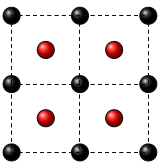
: Fig. 1: Example of cubic RS made by two different (black and red) atomic species.
$$\displaystyle E^{tot}(\boldsymbol{u},\boldsymbol{\eta}) = E^{0} + E^{phonon}(\boldsymbol{u}) + E^{elastic}(\boldsymbol{\eta}) + E^{coupling}(\boldsymbol{u},\boldsymbol{\eta}) $$

: Fig. 2: Example of lattice perturbations: atomic displacements and strain.
The methodology followed in MULTIBINIT consists in making a Taylor expansion around the RS, which is assumed to be a stationary point of the BO energy surface. As such, the energy expression can be further decomposed as follows :
$$\displaystyle E^{tot}(\boldsymbol{u},\boldsymbol{\eta}) = E^{0} + [ E^{phonon}_{harm}(\boldsymbol{u}) + E^{elastic}_{harm}(\boldsymbol{\eta}) + E^{coupling}_{harm}(\boldsymbol{u},\boldsymbol{\eta})] + [E^{phonon}_{anharm}(\boldsymbol{u}) + E^{elastic}_{anharm}(\boldsymbol{\eta}) + E^{coupling}_{anharm}(\boldsymbol{u},\boldsymbol{\eta})] $$
The first term $E^0$ is the energy of the RS, which has been fully relaxed (e.g. [[ionmov]]=2 and [[optcell]]=2) with very strict tolerance criterium ([[tolmxf]] < 1E-7) since we assume that all first energy derivatives are zero. This $E^0$ energy has to be included in the global DDB file, by including the ground-state DDB when merging all partial DDBs with [[lesson:rf2| mrgddb]].
Then, for the set of harmonic terms, the coefficients correspond to various second derivatives of the energy respect to atomic displacements and macroscopic strains.
They can be directly computed with ABINIT using DFPT ([[lesson:rf1| phonon response]], [[lesson:elastic|strain response]])
and used as parameters of our model. See also [[lesson:polarization|electric polarization]].
As such, our second-principles model reproduces exactly the first-principles results at the harmonic level
(i.e. full phonon dispersion curves, elastic and piezoelectric constants of the RS).
In practice, the global DDB file produced by ABINIT is so used as an input file for MULTIBINIT containing all the harmonic coefficients.
This file must contain second energy derivatives respect to (i) all atomic displacements
([[rfphon]] 1; [[rfatpol]] 1 natom; [[rfdir]] 1 1 1)
on a converged grid of q-points (defining the range of interactions in real space),
(ii) macroscopic strains ([[rfstrs]] 3; [[rfdir]] 1 1 1) and also, for insulators,
(iii) electric fields ([[rfelfd]] 1; [[rfdir]] 1 1 1) in order to provide the Born effective charges and dielectric constant
used for the description of long-range dipole-dipole interactions.
The coefficients of the set of anharmonic terms correspond to higher-order derivatives of the energy respect to atomic displacements and macroscopic strains.
They are numerous and not computed individually at the first-principles level.
Instead, the most important terms will be selected by MULTIBINIT and related coefficients fitted in order to reproduce the BO energy surface.
To that end, a training set (TS) of ABINIT data needs to be provided on which the fit will be realized.
This TS consists in a set of atomistic configurations realized on a suitable supercell depending on the range of anharmonic interactions (typically 2x2x2 supercell) and for which energy, forces and stresses are provided.
This takes the form of an ABINIT netcdf "_HIST.nc" file.
Providing an appropriate TS, properly sampling the BO surface, is crucial to obtain an appropriate model.
How to built it depends on the kind of system (stable or with instabilities) and will not be further discussed here.
In summary, constructing a second-principles lattice model with MULTIBINIT requires two input files which are direct output of ABINIT :
(i) a full "DDB" file containing the reference energy and second energy derivatives which correspond to harmonic coefficients of the model and
(ii) a "_HIST.nc" file containing the energy, forces and stresses of an appropriate training set of configurations
from which the anharmonic terms will be automatically selected and fitted.
For this tutorial both these files will be provided.
## 2 Fitting procedure: creating anharmonicities
In this tutorial, we take the perovskite $\mathrm{BaHfO_3}$ in its cubic phase as an exemple of a material without lattice instabilities.
*Optional exercise $\Longrightarrow$ Compute the phonon band structure with [[help:anaddb|anaddb]].*
You can download the complete DDB file (resulting from the previous calculations) here:
{% dialog tests/tutomultibinit/Input/tmulti_l_6_DDB %}
**Before starting, you might to consider working in a different subdirectory than for the other lessons. Why not create "Work_fitLatticeModel"?**
The file "~abinit/tests/tutomultibinit/Input/tmulti_l_6_1.files" lists the file names and root names.
You can copy it in the **Work_fitLatticeModel** directory and look at this file content, you should see:
tmulti_l_6_1.abi
tmulti_l_6_1.abo
tmulti_l_6_DDB
no
tmulti_l_6_HIST.nc
no
As mentioned in the guide of [[help:multibinit | MULTIBINIT]]:
* "tmulti_l_6_1.abi" is the main input file
* "tmulti_l_6_1.abo" is the main output file
* "tmulti_l_6_DDB" is the DDB which contains the system definition and the list of energy derivatives
* "tmulti_l_6_HIST.nc" is the set of DFT configurations to fit
It is now time to copy the file ~abinit/tests/tutomultibinit/Input/tmulti_l_6_1.abi, ~abinit/tests/tutomultibinit/Input/tmulti_l_6_DDB and tmulti_l_6_HIST.nc in your **Work_fitLatticeModel** directory.
You should read carefully the input file:
{% dialog tests/tutomultibinit/Input/tmulti_l_6_1.abi %}
and read the documentation about the fit input variables:
* [[multibinit: fit_ncoeff]]
* [[multibinit: fit_rangePower]]
* [[multibinit: fit_cutoff]]
* [[multibinit: fit_SPC_maxS]]
* [[multibinit: fit_iatom]]
* [[multibinit: fit_EFS]]
* [[multibinit: sel_EFS]]
You can now run (it should take less than 2 minutes):
mpirun -np 10 multibinit < multi_l_6_1.files > tmulti_l_6_1_stdout&
The resulting output file "tmulti_l_6_1.abo" should be rather similar to the one below.
{% dialog tests/tutomultibinit/Refs/tmulti_l_6_1.abo %}
The fitted anharmonocites are stored in "tmulti_l_6_1_coeffs.xml" and informations about the differences between the DFT data and the model are stored in "TRS\_fit\_diff\_energy.dat" and "TRS\_fit\_diff\_stress.dat". The global information about the reproduction of the DFT data is written in the output file.
**Before** the fit (including the harmonic part only), the goal function is equal to:
Goal function values at the begining of the fit process (eV^2/A^2):
Energy : 2.2780100662032291E-03
Forces+Stresses : 3.9733621903060741E-02
Forces : 2.4711894644538119E-02
Stresses : 1.5021727258522627E-02
**After** adding the anharmonicities, the goal function value is equal to
Goal function values at the end of the fit process (eV^2/A^2):
Energy : 1.7493658081925374E-04
Forces+Stresses : 1.1685294481702690E-02
Forces : 9.1861216904870410E-03
Stresses : 2.4991727912156494E-03
In order to save computational time, the previous example restricts the fitting procedure to [[multibinit: fit_iatom]] = 2. This means that only anharmonic terms linked to the interactions between Hf and its nearest neighbours are considered, which might not be enough to produce a fully accurate model.
*Optional exercise $\Longrightarrow$ Try to fit on all irreducible atoms with [[multibinit: fit_iatom]] = 0. This procedure is time consumming (around 15 min). You can also play with [[multibinit: fit_cutoff]] to see if there is other terms selected.*
## 3 Bounding of the model
Since the approach of the procedure is based on a polynomial expansion of the energy, it is common that the produced model is diverging at high temperature. In order to avoid this divergence, we will produce additional terms (order 6 and 8 terms) that ensure the boundness of the model.
**Before starting, you might to consider working in a different subdirectory than for the other lessons. Why not create "Work_boundingLatticeModel"?**
The file ~abinit/tests/tutomultibinit/Input/tmulti\_l\_7\_1.files lists the file names and root names.
You can copy it in the **Work_boundingLatticeModel** directory and look at this file content, you should see:
tmulti_l_7_1.abi
tmulti_l_7_1.abo
tmulti_l_6_DDB
tmulti_l_7_1_coeffs.xml
tmulti_l_6_HIST.nc
no
"tmulti\_l\_7\_1\_coeffs.xml" is the model that we produced with [[multibinit: fit_iatom]]=0 and [[multibinit: fit_cutoff]]=$a \sqrt{3}/2$ and has to be bounded.
It is now time to copy the file ~abinit/tests/tutomultibinit/Input/tmulti\_l\_7\_1.abi, ~abinit/tests/tutomultibinit/Input/tmulti\_l\_6\_DDB, tmulti\_l\_7\_1\_coeffs.xml and tmulti\_l\_6\_HIST.nc in your **Work_boundingLatticeModel** directory.
You should read carefully the input file:
{% dialog tests/tutomultibinit/Input/tmulti_l_7_1.abi %}
and read the documentation about the bounding input variables:
* [[multibinit: bound_model]]
* [[multibinit: bound_rangePower]]
* [[multibinit: bound_penalty]]
You can now run (it should take less than 1 minute):
multibinit < multi_l_7_1.files > tmulti_l_7_1_stdout&
After this procedure, a new model has been generated with higher-order even terms according to [[multibinit: bound_rangePower]]. You can check in the ouput file that the inclusion of these new terms preserves the value of the goal function for forces and stresses.
## 4 Running molecular dynamics with an effective model
The aim of the construction of effective models is to be able to run realistic molecular-dynamics simulations in order to access material properties at finite temperatures.
The file ~abinit/tests/tutomultibinit/Input/tmulti\_l\_8\_1.files lists the file names and root names.
You can copy it in the **Work_MDLatticeModel** directory and look at this file content, you should see:
tmulti_l_8_1.abi
tmulti_l_8_1.abo
tmulti_l_6_DDB
tmulti_l_8_1.xml
no
no
"tmulti\_l\_8\_1\_coeffs.xml" is the model that have been bounded in the previous step.
It is now time to copy the file ~abinit/tests/tutomultibinit/Input/tutomulti\_l\_7\_1.abi, ~abinit/tests/tutomultibinit/Input/tmulti\_l\_6\_DDB, tmulti\_l\_7\_1\_coeffs.xml and tmulti\_l\_6\_HIST.nc in your **Work_MDLatticeModel** directory.
You should read carefully the input file:
{% dialog tests/tutomultibinit/Input/tmulti_l_8_1.abi %}
and read the documentation about the fit input variables:
* [[multibinit: dynamics]]
* [[hmctt]]
* [[ntime]]
* [[dtion]]
You can now run (it should take less than 2 minutes):
multibinit -np 10 < multi_l_8_1.files > tmulti_l_8_1_stdout&
You can visualize your dynamics with the [AGATE](https://github.com/piti-diablotin/agate) software:
agate tmulti_l_8_1_HIST.nc
This simulation intents to reproduce the behaviour of BaHfO$_\mathrm{3}$ at room temperature. You can check that the system is thermalized at the end of the calculation by looking at energergy, pressure, volume and temperature with the [AGATE](https://github.com/piti-diablotin/agate) software:
* <tt> :plot etotal </tt>
* <tt> :plot P </tt>
* <tt> :plot V </tt>
* <tt> :plot T </tt>
$\mathrm{BaHfO_3}$ remains cubic at all temperatures which is not the case of all materials. For instance, $\mathrm{SrTiO_3}$ exhibits an antiferrodistrotive (AFD) phase transition from $\mathrm{Pm\bar{3}m}$ to $\mathrm{I4/mcm}$ at 105K (experimentally). MULTIBINIT allows to study such kind of structural phase transition.
*Optional exercise $\Longrightarrow$ Try to recover the phase transition of $\mathrm{SrTiO_3}$ (PBEsol DDB is located in "~abinit/tests/tutomultibinit/Input/tutomulti_l_9_1.ddb" and the anharmonic part of the model in "~abinit/tests/tutomultibinit/Input/tmulti_l_9_1.xml").*

You should recover the results above, which highlights properly the AFD phase transition although at slightly higher temperature than experimentally observed. You should also notice the appeaance of polarization at very low temperature: this arises from the incipient ferroelectric character of $\mathrm{SrTiO_3}$ using classical MD simulations, neglecting quantum fluctuations.
* * *
This MULTIBINIT tutorial is now finished.
|
