1
2
3
4
5
6
7
8
9
10
11
12
13
14
15
16
17
18
19
20
21
22
23
24
25
26
27
28
29
30
31
32
33
34
35
36
37
38
39
40
41
42
43
44
45
46
47
48
49
50
51
52
53
54
55
56
57
58
59
60
61
62
63
64
65
66
67
68
69
70
71
72
73
74
75
76
77
78
79
80
81
82
83
84
85
86
87
88
89
90
91
92
93
94
95
96
97
98
99
100
101
102
103
104
105
106
107
108
109
110
111
112
113
114
115
116
117
118
119
120
121
122
123
124
125
126
127
128
129
130
131
132
133
134
135
136
137
138
139
140
141
142
143
144
145
146
147
148
149
150
151
152
153
154
155
156
157
158
159
160
161
162
163
164
165
166
167
168
169
170
171
172
173
174
175
176
177
178
179
180
181
182
183
184
185
186
187
188
189
190
191
192
193
194
195
196
197
198
199
200
201
202
203
204
205
206
207
208
209
210
211
212
213
214
215
216
217
218
219
220
221
222
223
224
225
226
227
228
229
230
231
232
233
234
235
236
237
238
239
240
241
242
243
244
245
246
247
248
249
250
251
252
253
254
255
256
257
258
259
260
261
262
263
264
265
266
267
268
269
270
271
272
273
274
275
276
277
278
279
280
281
282
283
284
285
286
287
288
289
290
291
292
293
294
295
296
297
298
299
300
301
302
303
304
305
306
307
308
309
310
311
312
313
314
315
316
317
318
319
320
321
322
323
324
325
326
327
328
329
330
331
332
333
334
335
336
337
338
339
340
341
342
343
344
345
346
347
348
349
350
351
352
353
354
355
356
357
358
359
360
361
362
363
364
365
366
367
368
369
370
371
372
373
374
375
376
377
378
379
380
381
382
383
384
385
386
387
388
389
390
391
392
393
394
395
396
397
398
399
400
401
402
403
404
405
406
407
408
409
410
411
412
413
414
415
416
417
418
419
420
421
422
423
424
425
426
427
428
429
430
431
432
433
434
435
436
437
438
439
440
441
442
443
444
445
446
447
448
449
450
451
452
453
454
455
456
457
458
459
460
461
462
463
464
465
466
467
468
469
470
471
|
# Benchmark
The LEAF github repository contains two similar benchmarking programs, one using LEAF, the other configurable to use `tl::expected` or Boost Outcome, that simulate transporting error objects across 10 levels of stack frames, measuring the performance of the three libraries.
Links:
* LEAF: https://boostorg.github.io/leaf
* `tl::expected`: https://github.com/TartanLlama/expected
* Boost Outcome V2: https://www.boost.org/doc/libs/release/libs/outcome/doc/html/index.html
## Library design considerations
LEAF serves a similar purpose to other error handling libraries, but its design is very different. The benchmarks are comparing apples and oranges.
The main design difference is that when using LEAF, error objects are not communicated in return values. In case of a failure, the `leaf::result<T>` object transports only an `int`, the unique error ID.
Error objects skip the error neutral functions in the call stack and get moved directly to the the error handling scope that needs them. This mechanism does not depend on RVO or any other optimization: as soon as the program passes an error object to LEAF, it moves it to the correct error handling scope.
Other error handling libraries instead couple the static type of the return value of *all* error neutral functions with the error type an error reporting function may return. This approach suffers from the same problems as statically-enforced exception specifications:
* It's difficult to use in polymorphic function calls, and
* It impedes interoperability between the many different error types any non-trivial program must handle.
(The Boost Outcome library is also capable of avoiding such excessive coupling, by passing for the third `P` argument in the `outcome<T, E, P>` template a pointer that erases the exact static type of the object being transported. However, this would require a dynamic memory allocation).
## Syntax
The most common check-only use case looks almost identically in LEAF and in Boost Outcome (`tl::expected` lacks a similar macro):
```c++
// Outcome
{
BOOST_OUTCOME_TRY(v, f()); // Check for errors, forward failures to the caller
// If control reaches here, v is the successful result (the call succeeded).
}
```
```c++
// LEAF
{
BOOST_LEAF_AUTO(v, f()); // Check for errors, forward failures to the caller
// If control reaches here, v is the successful result (the call succeeded).
}
```
When we want to handle failures, in Boost Outcome and in `tl::expected`, accessing the error object (which is always stored in the return value) is a simple continuation of the error check:
```c++
// Outcome, tl::expected
if( auto r = f() )
{
auto v = r.value();
// No error, use v
}
else
{ // Error!
switch( r.error() )
{
error_enum::error1:
/* handle error_enum::error1 */
break;
error_enum::error2:
/* handle error_enum::error2 */
break;
default:
/* handle any other failure */
}
}
```
When using LEAF, we must explicitly state our intention to handle errors, not just check for failures:
```c++
// LEAF
leaf::try_handle_all
[]() -> leaf::result<T>
{
BOOST_LEAF_AUTO(v, f());
// No error, use v
},
[]( leaf::match<error_enum, error_enum::error1> )
{
/* handle error_enum::error1 */
},
[]( leaf::match<error_enum, error_enum::error2> )
{
/* handle error_enum::error2 */
},
[]
{
/* handle any other failure */
} );
```
The use of `try_handle_all` reserves storage on the stack for the error object types being handled (in this case, `error_enum`). If the failure is either `error_enum::error1` or `error_enum::error2`, the matching error handling lambda is invoked.
## Code generation considerations
Benchmarking C++ programs is tricky, because we want to prevent the compiler from optimizing out things it shouldn't normally be able to optimize in a real program, yet we don't want to interfere with "legitimate" optimizations.
The primary approach we use to prevent the compiler from optimizing everything out to nothing is to base all computations on a call to `std::rand()`.
When benchmarking error handling, it makes sense to measure the time it takes to return a result or error across multiple stack frames. This calls for disabling inlining.
The technique used to disable inlining in this benchmark is to mark functions with `__attribute__((noinline))`. This is imperfect, because optimizers can still peek into the body of the function and optimize things out, as is seen in this example:
```c++
__attribute__((noinline)) int val() {return 42;}
int main()
{
return val();
}
```
Which on clang 9 outputs:
```x86asm
val():
mov eax, 42
ret
main:
mov eax, 42
ret
```
It does not appear that anything like this is occurring in our case, but it is still a possibility.
> NOTES:
>
> - The benchmarks are compiled with exception handling disabled.
> - LEAF is able to work with external `result<>` types. The benchmark uses `leaf::result<T>`.
## Show me the code!
The following source:
```C++
leaf::result<int> f();
leaf::result<int> g()
{
BOOST_LEAF_AUTO(x, f());
return x+1;
}
```
Generates this code on clang ([Godbolt](https://godbolt.org/z/v58drTPhq)):
```x86asm
g(): # @g()
push rbx
sub rsp, 32
mov rbx, rdi
lea rdi, [rsp + 8]
call f()
mov eax, dword ptr [rsp + 24]
mov ecx, eax
and ecx, 3
cmp ecx, 3
jne .LBB0_1
mov eax, dword ptr [rsp + 8]
add eax, 1
mov dword ptr [rbx], eax
mov eax, 3
jmp .LBB0_3
.LBB0_1:
cmp ecx, 2
jne .LBB0_3
mov rax, qword ptr [rsp + 8]
mov qword ptr [rbx], rax
mov rax, qword ptr [rsp + 16]
mov qword ptr [rbx + 8], rax
mov eax, 2
.LBB0_3:
mov dword ptr [rbx + 16], eax
mov rax, rbx
add rsp, 32
pop rbx
ret
```
> Description:
>
> * The happy path can be recognized by the `add eax, 1` instruction generated for `x + 1`.
>
> * `.LBB0_3`: Regular failure; the returned `result<T>` object holds only the `int` discriminant.
>
> * `.LBB0_1`: Failure; the returned `result<T>` holds the `int` discriminant and a `std::shared_ptr<leaf::polymorphic_context>` (used to hold error objects transported from another thread).
Note that `f` is undefined, hence the `call` instruction. Predictably, if we provide a trivial definition for `f`:
```C++
leaf::result<int> f()
{
return 42;
}
leaf::result<int> g()
{
BOOST_LEAF_AUTO(x, f());
return x+1;
}
```
We get:
```x86asm
g(): # @g()
mov rax, rdi
mov dword ptr [rdi], 43
mov dword ptr [rdi + 16], 3
ret
```
With a less trivial definition of `f`:
```C++
leaf::result<int> f()
{
if( rand()%2 )
return 42;
else
return leaf::new_error();
}
leaf::result<int> g()
{
BOOST_LEAF_AUTO(x, f());
return x+1;
}
```
We get ([Godbolt](https://godbolt.org/z/87Kezzrs4)):
```x86asm
g(): # @g()
push rbx
mov rbx, rdi
call rand
test al, 1
jne .LBB1_2
mov eax, 4
lock xadd dword ptr [rip + boost::leaf::leaf_detail::id_factory<void>::counter], eax
add eax, 4
mov dword ptr fs:[boost::leaf::leaf_detail::id_factory<void>::current_id@TPOFF], eax
and eax, -4
or eax, 1
mov dword ptr [rbx + 16], eax
mov rax, rbx
pop rbx
ret
.LBB1_2:
mov dword ptr [rbx], 43
mov eax, 3
mov dword ptr [rbx + 16], eax
mov rax, rbx
pop rbx
ret
```
Above, the call to `f()` is inlined:
* `.LBB1_2`: Success
* The atomic `add` is from the initial error reporting machinery in LEAF, generating a unique error ID for the error being reported.
## Benchmark matrix dimensions
The benchmark matrix has 2 dimensions:
1. Error object type:
a. The error object transported in case of a failure is of type `e_error_code`, which is a simple `enum`.
b. The error object transported in case of a failure is of type `struct e_system_error { e_error_code value; std::string what; }`.
c. The error object transported in case of a failure is of type `e_heavy_payload`, a `struct` of size 4096.
2. Error rate: 2%, 98%
Now, transporting a large error object might seem unusual, but this is only because it is impractical to return a large object as *the* return value in case of an error. LEAF has two features that make communicating any, even large error objects, practical:
* The return type of error neutral functions is not coupled with the error object types that may be reported. This means that in case of a failure, any function can easily contribute any error information it has available.
* LEAF will only bother with transporting a given error object if an active error handling scope needs it. This means that library functions can and should contribute any and all relevant information when reporting a failure, because if the program doesn't need it, it will simply be discarded.
## Source code
[deep_stack_leaf.cpp](deep_stack_leaf.cpp)
[deep_stack_other.cpp](deep_stack_other.cpp)
## Godbolt
Godbolt has built-in support for Boost (Outcome/LEAF), but `tl::expected` both provide a single header, which makes it very easy to use them online as well. To see the generated code for the benchmark program, you can copy and paste the following into Godbolt:
`leaf::result<T>` ([godbolt](https://godbolt.org/z/1hqqnfhMf))
```c++
#include "https://raw.githubusercontent.com/boostorg/leaf/master/benchmark/deep_stack_leaf.cpp"
```
`tl::expected<T, E>` ([godbolt](https://godbolt.org/z/6dfcdsPcc))
```c++
#include "https://raw.githubusercontent.com/TartanLlama/expected/master/include/tl/expected.hpp"
#include "https://raw.githubusercontent.com/boostorg/leaf/master/benchmark/deep_stack_other.cpp"
```
`outcome::result<T, E>` ([godbolt](https://godbolt.org/z/jMEfGMrW9))
```c++
#define BENCHMARK_WHAT 1
#include "https://raw.githubusercontent.com/boostorg/leaf/master/benchmark/deep_stack_other.cpp"
```
## Build options
To build both versions of the benchmark program, the compilers are invoked using the following command line options:
* `-std=c++17`: Required by other libraries (LEAF only requires C++11);
* `-fno-exceptions`: Disable exception handling;
* `-O3`: Maximum optimizations;
* `-DNDEBUG`: Disable asserts.
In addition, the LEAF version is compiled with:
* `-DBOOST_LEAF_CFG_DIAGNOSTICS=0`: Disable diagnostic information for error objects not recognized by the program. This is a debugging feature, see [Configuration Macros](https://boostorg.github.io/leaf/#configuration).
## Results
Below is the output the benchmark programs running on an old MacBook Pro. The tables show the elapsed time for 10,000,000 iterations of returning a result across 10 stack frames, depending on the error type and the rate of failures. In addition, the programs generate a `benchmark.csv` file in the current working directory.
### gcc 9.2.0:
`leaf::result<T>`:
Error type | 2% (μs) | 98% (μs)
----------------|---------:|--------:
e_error_code | 594965 | 545882
e_system_error | 614688 | 1203154
e_heavy_payload | 736701 | 7397756
`tl::expected<T, E>`:
Error type | 2% (μs) | 98% (μs)
----------------|---------:|--------:
e_error_code | 921410 | 820757
e_system_error | 670191 | 5593513
e_heavy_payload | 1331724 | 31560432
`outcome::result<T, E>`:
Error type | 2% (μs) | 98% (μs)
----------------|---------:|--------:
e_error_code | 1080512 | 773206
e_system_error | 577403 | 1201693
e_heavy_payload | 13222387 | 32104693
`outcome::outcome<T, E>`:
Error type | 2% (μs) | 98% (μs)
----------------|---------:|--------:
e_error_code | 832916 | 1170731
e_system_error | 947298 | 2330392
e_heavy_payload | 13342292 | 33837583
### clang 11.0.0:
`leaf::result<T>`:
Error type | 2% (μs) | 98% (μs)
----------------|---------:|--------:
e_error_code | 570847 | 493538
e_system_error | 592685 | 982799
e_heavy_payload | 713966 | 5144523
`tl::expected<T, E>`:
Error type | 2% (μs) | 98% (μs)
----------------|---------:|--------:
e_error_code | 461639 | 312849
e_system_error | 620479 | 3534689
e_heavy_payload | 1037434 | 16078669
`outcome::result<T, E>`:
Error type | 2% (μs) | 98% (μs)
----------------|---------:|--------:
e_error_code | 431219 | 446854
e_system_error | 589456 | 1712739
e_heavy_payload | 12387405 | 16216894
`outcome::outcome<T, E>`:
Error type | 2% (μs) | 98% (μs)
----------------|---------:|--------:
e_error_code | 711412 | 1477505
e_system_error | 835691 | 2374919
e_heavy_payload | 13289404 | 29785353
### msvc 19.24.28314:
`leaf::result<T>`:
Error type | 2% (μs) | 98% (μs)
----------------|---------:|--------:
e_error_code | 1205327 | 1449117
e_system_error | 1290277 | 2332414
e_heavy_payload | 1503103 | 13682308
`tl::expected<T, E>`:
Error type | 2% (μs) | 98% (μs)
----------------|---------:|--------:
e_error_code | 938839 | 867296
e_system_error | 1455627 | 8943881
e_heavy_payload | 2637494 | 49212901
`outcome::result<T, E>`:
Error type | 2% (μs) | 98% (μs)
----------------|---------:|--------:
e_error_code | 935331 | 1202475
e_system_error | 1228944 | 2269680
e_heavy_payload | 15239084 | 55618460
`outcome::outcome<T, E>`:
Error type | 2% (μs) | 98% (μs)
----------------|---------:|--------:
e_error_code | 1472035 | 2529057
e_system_error | 1997971 | 4004965
e_heavy_payload | 16027423 | 64572924
## Charts
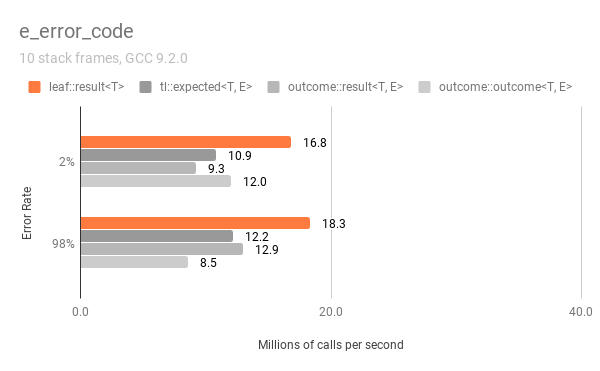
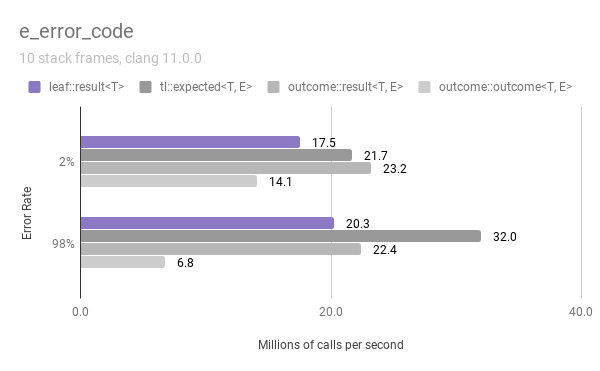
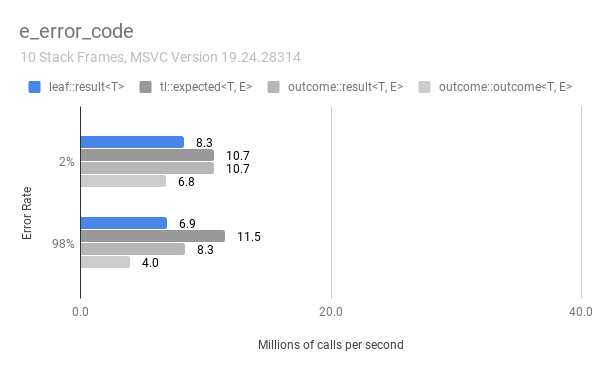
The charts below are generated from the results from the previous section, converted from elapsed time in microseconds to millions of calls per second.
### gcc 9.2.0:


### clang 11.0.0:


### msvc 19.24.28314:


## Thanks
Thanks for the valuable feedback: Peter Dimov, Glen Fernandes, Sorin Fetche, Niall Douglas, Ben Craig, Vinnie Falco, Jason Dictos
|
