1
2
3
4
5
6
7
8
9
10
11
12
13
14
15
16
17
18
19
20
21
22
23
24
25
26
27
28
29
30
31
32
33
34
35
36
37
38
39
40
41
42
43
44
45
46
47
48
49
50
51
52
53
54
55
56
57
58
59
60
61
62
63
64
65
66
67
68
69
70
71
72
73
74
75
76
77
78
79
80
81
82
83
84
85
86
87
88
89
90
91
92
93
94
95
96
97
98
99
100
101
102
103
104
105
106
107
108
109
110
111
112
113
114
115
116
117
118
119
120
121
122
123
124
125
126
127
128
129
130
131
132
133
134
135
136
137
138
139
140
141
142
143
144
145
146
147
148
149
150
151
152
153
154
155
156
157
158
159
160
161
162
163
164
165
166
167
168
169
170
171
172
173
174
175
176
177
178
179
180
181
182
183
184
185
186
187
188
189
190
191
192
193
194
195
196
197
198
199
200
201
202
203
204
205
206
207
208
209
210
211
212
213
214
215
216
217
218
219
220
221
222
223
224
225
226
227
228
229
230
231
232
233
234
235
236
237
238
239
240
241
242
243
244
245
246
247
248
249
250
251
252
253
254
255
256
257
258
259
260
261
262
263
264
265
266
267
268
269
270
271
272
273
274
275
276
277
278
279
280
281
282
283
284
285
286
287
288
289
290
291
292
293
294
295
296
297
298
299
300
301
302
303
304
305
306
307
308
309
310
311
312
313
314
315
316
317
318
319
320
321
322
323
324
325
326
327
328
329
330
331
332
|
fast BAM/CRAM depth calculation for **WGS**, **exome**, or **targeted sequencing**.
[](http://bioconda.github.io/recipes/mosdepth/README.html)

[](https://github.com/brentp/mosdepth/actions?query=workflow%3ABuild)
[](https://travis-ci.com/brentp/mosdepth)
[](https://academic.oup.com/bioinformatics/article/doi/10.1093/bioinformatics/btx699/4583630?guestAccessKey=35b55064-4566-4ab3-a769-32916fa1c6e6)
`mosdepth` can output:
+ per-base depth about 2x as fast `samtools depth`--about 25 minutes of CPU time for a 30X genome.
+ mean per-window depth given a window size--as would be used for CNV calling.
+ the mean per-region given a BED file of regions.
* the mean or median per-region cumulative coverage histogram given a window size
+ a distribution of proportion of bases covered at or above a given threshold for each chromosome and genome-wide.
+ quantized output that merges adjacent bases as long as they fall in the same coverage bins e.g. (10-20)
+ threshold output to indicate how many bases in each region are covered at the given thresholds.
+ A summary of mean depths per chromosome and within specified regions per chromosome.
+ a [d4](https://github.com/38/d4-format) file (better than bigwig).
when appropriate, the output files are bgzipped and indexed for ease of use.
## usage
```
mosdepth 0.3.0
Usage: mosdepth [options] <prefix> <BAM-or-CRAM>
Arguments:
<prefix> outputs: `{prefix}.mosdepth.global.dist.txt`
`{prefix}.mosdepth.summary.txt`
`{prefix}.mosdepth.region.dist.txt` (if --by is specified)
`{prefix}.per-base.bed.gz|per-base.d4` (unless -n/--no-per-base is specified)
`{prefix}.regions.bed.gz` (if --by is specified)
`{prefix}.quantized.bed.gz` (if --quantize is specified)
`{prefix}.thresholds.bed.gz` (if --thresholds is specified)
<BAM-or-CRAM> the alignment file for which to calculate depth.
Common Options:
-t --threads <threads> number of BAM decompression threads. (use 4 or fewer) [default: 0]
-c --chrom <chrom> chromosome to restrict depth calculation.
-b --by <bed|window> optional BED file or (integer) window-sizes.
-n --no-per-base dont output per-base depth. skipping this output will speed execution
substantially. prefer quantized or thresholded values if possible.
-f --fasta <fasta> fasta file for use with CRAM files.
--d4 output per-base depth in d4 format. This is much faster.
Other options:
-F --flag <FLAG> exclude reads with any of the bits in FLAG set [default: 1796]
-i --include-flag <FLAG> only include reads with any of the bits in FLAG set. default is unset. [default: 0]
-x --fast-mode dont look at internal cigar operations or correct mate overlaps (recommended for most use-cases).
-q --quantize <segments> write quantized output see docs for description.
-Q --mapq <mapq> mapping quality threshold. reads with a mapping quality less than this are ignored [default: 0]
-T --thresholds <thresholds> for each interval in --by, write number of bases covered by at
least threshold bases. Specify multiple integer values separated
by ','.
-R --read-groups <string> only calculate depth for these comma-separated read groups IDs.
-h --help show help
```
If you use mosdepth please cite [the publication in bioinformatics](https://academic.oup.com/bioinformatics/article/doi/10.1093/bioinformatics/btx699/4583630?guestAccessKey=35b55064-4566-4ab3-a769-32916fa1c6e6)
See the section below for more info on distribution.
If `--by` is a BED file with 4 or more columns, it is assumed the the 4th column is the name.
That name will be propagated to the `mosdepth` output in the 4th column with the depth in the 5th column.
If you don't want this behavior, simply send a bed file with 3 columns.
### exome example
To calculate the coverage in each exome capture region:
```
mosdepth --by capture.bed sample-output sample.exome.bam
```
For a 5.5GB exome BAM and all 1,195,764 ensembl exons as the regions,
this completes in 1 minute 38 seconds with a single CPU.
Per-base output will go to `sample-output.per-base.bed.gz`,
the mean for each region will go to `sample-output.regions.bed.gz`;
each of those will be written along with a CSI index that can be
used for tabix queries.
The distribution of depths will go to `sample-output.mosdepth.dist.txt`
### WGS example
For 500-base windows
```
mosdepth -n --fast-mode --by 500 sample.wgs $sample.wgs.cram
```
`-n` means don't output per-base data, this will make `mosdepth`
a bit faster as there is some cost to outputting that much text.
--fast-mode avoids the extra calculations of mate pair overlap and cigar operations,
and also allows htslib to extract less data from CRAM, providing a substantial speed
improvement.
### Callable regions example
To create a set of "callable" regions as in [GATK's callable loci tool](https://software.broadinstitute.org/gatk/documentation/tooldocs/current/org_broadinstitute_gatk_tools_walkers_coverage_CallableLoci.php):
```
# by setting these ENV vars, we can control the output labels (4th column)
export MOSDEPTH_Q0=NO_COVERAGE # 0 -- defined by the arguments to --quantize
export MOSDEPTH_Q1=LOW_COVERAGE # 1..4
export MOSDEPTH_Q2=CALLABLE # 5..149
export MOSDEPTH_Q3=HIGH_COVERAGE # 150 ...
mosdepth -n --quantize 0:1:5:150: $sample.quantized $sample.wgs.bam
```
For this case. A regions with depth of 0 are labelled as "NO_COVERAGE", those with
coverage of 1,2,3,4 are labelled as "LOW_COVERAGE" and so on.
The result is a BED file where adjacent bases with depths that fall into the same
bin are merged into a single region with the 4th column indicating the label.
### Distribution only with modified precision
To get only the distribution value, without the depth file or the per-base and using 3 threads:
```
MOSDEPTH_PRECISION=5 mosdepth -n -t 3 $sample $bam
```
Output will go to `$sample.mosdepth.dist.txt`
This also forces the output to have 5 decimals of precision rather than the default of 2.
## D4
D4 is a format created by [Hao Hou](https://github.com/38) in the Quinlan lab. It is
incorporated into `mosdepth` as of version 0.3.0 for per-base output with the `--d4` flag.
It improves write speed dramatically; for one test-case it takes **24.8s** to write a
per-base.bed.gz with mosdepth compared to **7.7s** to write a d4 file. For the same case,
running `mosdepth` without writing per-base takes 5.9 seconds so D4 greatly mitigates
the cost of outputing per-base depth **and** the output is more useful.
## Installation
The simplest option is to download the [binary from the releases](https://github.com/brentp/mosdepth/releases).
Another quick way is to [](http://bioconda.github.io/recipes/mosdepth/README.html)
It can also be installed with `brew` as `brew install brewsci/bio/mosdepth` or used via docker with quay:
```
docker pull quay.io/biocontainers/mosdepth:0.2.4--he527e40_0
docker run -v /hostpath/:/opt/mount quay.io/biocontainers/mosdepth:0.2.4--he527e40_0 mosdepth -n --fast-mode -t 4 --by 1000 /opt/mount/sample /opt/mount/$bam
```
The binary from releases is static, with no dependencies. If you build it yourself,
`mosdepth` requires htslib version 1.4 or later. If you get an error
about "`libhts.so` not found", set `LD_LIBRARY_PATH` to the directory that
contains `libhts.so`. e.g.
`LD_LIBRARY_PATH=~/src/htslib/ mosdepth -h`
If you get the error `could not import: hts_check_EOF` you may need to
install a more recent version of htslib.
If you do want to install from source, see the [travis.yml](https://github.com/brentp/mosdepth/blob/master/.travis.yml)
and the [install.sh](https://github.com/brentp/mosdepth/blob/master/scripts/install.sh).
If you use archlinux, you can [install as a package](https://aur.archlinux.org/packages/mosdepth/)
## distribution output
This is **useful for QC**.
The `$prefix.mosdepth.global.dist.txt` file contains, a cumulative distribution indicating the
proportion of total bases (or the proportion of the `--by` for `$prefix.mosdepth.region.dist.txt`) that were covered
for at least a given coverage value. It does this for each chromosome, and for the
whole genome.
Each row will indicate:
+ chromosome (or "total")
+ coverage level
+ proportion of bases covered at that level
The last value in each chromosome will be coverage level of 0 aligned with
1.0 bases covered at that level.
A python plotting script is provided in `scripts/plot-dist.py` that will make
plots like below. Use is `python scripts/plot-dist.py \*global.dist.txt` and the output
is `dist.html` with a plot for the full set along with one for each chromosome.
Using something like that, we can plot the distribution from the entire genome.
Below we show this for samples with ~60X coverage:

We can also view the Y chromosome to verify that males and females
track separately. Below, we that see female samples cluster along the axes while male samples have
close to 30X coverage for almost 40% of the genome.
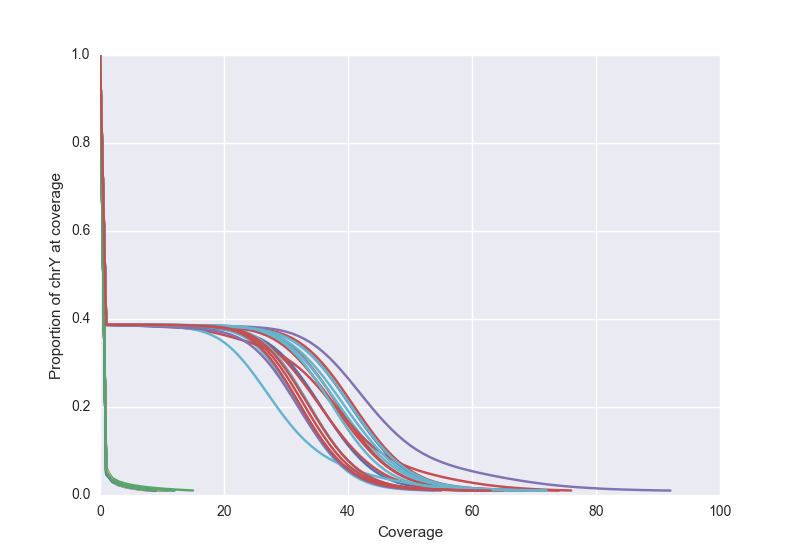
See [this blog post](http://www.gettinggeneticsdone.com/2014/03/visualize-coverage-exome-targeted-ngs-bedtools.html) for
more details.
## thresholds
given a set of regions to the `--by` argment, `mosdepth` can report the number of bases in each region that
are covered at or above each threshold value given to `--thresholds`. e.g:
```
mosdepth --by exons.bed --thresholds 1,10,20,30 $prefix $bam
```
will create a file $prefix.thresholds.bed.gz with an extra column for each requested threshold.
An example output for the above command (assuming exons.bed had a 4th column with gene names) would look like (including the header):
```
#chrom start end region 1X 10X 20X 30X
1 11869 12227 ENSE00002234944 358 157 110 0
1 11874 12227 ENSE00002269724 353 127 10 0
1 12010 12057 ENSE00001948541 47 8 0 0
1 12613 12721 ENSE00003582793 108 0 0 0
```
If there is no name (4th) column in the bed file send to `--by` then that column will contain "unknown"
in the output.
This is extremely efficient. In our tests, excluding per-base output (`-n`) and using this argument with
111K exons and 12 values to `--thresholds` increases the run-time by < 5%.
## quantize
quantize allows splitting coverage into bins and merging adjacent regions that fall into the same bin even if they have
different exact coverage values. This can dramatically reduce the size of the output compared to the per-base.
It also allows outputting regions of low, high, and "callable" coverage as in [GATK's callable loci tool](https://software.broadinstitute.org/gatk/documentation/tooldocs/current/org_broadinstitute_gatk_tools_walkers_coverage_CallableLoci.php).
An example of quantize arguments:
```
--quantize 0:1:4:100:200: # ... arbitary number of quantize bins.
```
indicates bins of: 0:1, 1:4, 4:100, 100:200, 200:infinity
where the upper endpoint is non-inclusive.
The default for `mosdepth` is to output labels as above (0:1, 1:4, 4:100... etc.)
To change what is reported as the bin number, a user can set environment variables e.g.:
```
export MOSDEPTH_Q0=NO_COVERAGE
export MOSDEPTH_Q1=LOW_COVERAGE
export MOSDEPTH_Q2=CALLABLE
export MOSDEPTH_Q3=HIGH_COVERAGE
```
In this case, the bin label is replaced by the text in the appropriate environment variable.
This is very efficient. In our tests, excluding per-base output (`-n`) and using this argument with
9 bins to `--quantize` increases the run-time by ~ 20%. In contrast, the difference in time with
and without `-n` can be 2-fold.
## how it works
As it encounters each chromosome, `mosdepth` creates an array the length of the chromosome.
For every start it encounters, it increments the value in that position of the array. For every
stop, it decrements that position. From this, the depth at a particular position is the
cumulative sum of all array positions preceding it (a similar algorithm is used in BEDTools
where starts and stops are tracked separately). `mosdepth` **avoids double-counting
overlapping mate-pairs** and it **tracks every aligned part of every read using the CIGAR
operations**. Because of this data structure, the the coverage `distribution` calculation
can be done without a noticeable increase in run-time. The image below conveys the concept:

This array accounting is very fast. There are no extra allocations or objects to track and
it is also conceptually simple. For these reasons, it is faster than `samtools depth` which
works by using the [pileup](http://samtools.sourceforge.net/pileup.shtml) machinery that
tracks each read, each base.
The `mosdepth` method has some limitations. Because a large array is allocated and it is
required (in general) to take the cumulative sum of all preceding positions to know the depth
at any position, it is slower for small, 1-time regional queries. It is, however fast for
window-based or BED-based regions, because it first calculates the full chromosome coverage
and then reports the coverage for each region in that chromosome. Another downside is it uses
more memory than samtools. The amount of memory is approximately equal to 32-bits * longest chrom
length, so for the 249MB chromosome 1, it will require 1GB of memory.
`mosdepth` is written in [nim](https://nim-lang.org/) and it uses our [htslib](https://github.com/samtools/htslib)
via our nim wrapper [hts-nim](https://github.com/brentp/hts-nim/)
## speed and memory comparison
`mosdepth`, `samtools`, `bedtools`, and `sambamba` were run on a 30X genome.
relative times are relative to mosdepth per-base mode with a single thread.
`mosdepth` can report the mean depth in 500-base windows genome-wide info
under 9 minutes of user time with 3 threads.
| format | tool | threads | mode | relative time | run-time | memory |
| ------ | ---------- | -------- | ------ | ------------- | ------- | -------|
| BAM | mosdepth | 1 | base | 1 | 25:23 | 1196 |
| BAM | mosdepth | 3 | base | 0.57 | 14:27 | 1197 |
| CRAM | mosdepth | 1 | base | 1.17 | 29:47 | 1205 |
| CRAM | mosdepth | 3 | base | 0.56 | 14:08 | 1225 |
| BAM | mosdepth | 3 | window | 0.34 | 8:44 | 1277 |
| BAM | mosdepth | 1 | window | 0.80 | 20:26 | 1212 |
| CRAM | mosdepth | 3 | window | 0.35 | 8:47 | 1233 |
| CRAM | mosdepth | 1 | window | 0.88 | 22:23 | 1209 |
| BAM | sambamba | 1 | base | 5.71 | 2:24:53 | 166 |
| BAM | samtools | 1 | base | 1.98 | 50:12 | 27 |
| CRAM | samtools | 1 | base | 1.79 | 45:21 | 451 |
| BAM | bedtools | 1 | base | 5.31 | 2:14:44 | 1908 |
Note that the threads to `mosdepth` (and samtools) are decompression threads. After
about 4 threads, there is no benefit for additional threads:

### Accuracy
We compared `samtools depth` with default arguments to `mosdepth` without overlap detection and discovered **no
differences across the entire chromosome**.
|
