1
2
3
4
5
6
7
8
9
10
11
12
13
14
15
16
17
18
19
20
21
22
23
24
25
26
27
28
29
30
31
32
33
34
35
36
37
38
39
40
41
42
43
44
45
46
47
48
49
50
51
52
53
54
55
56
57
58
59
60
61
62
63
64
65
66
67
68
69
70
71
72
73
74
75
76
77
78
79
80
81
82
83
84
85
86
87
88
89
90
91
92
93
94
95
96
97
98
99
100
101
102
103
104
105
106
107
108
109
110
111
112
113
114
115
116
117
118
119
120
121
122
123
124
125
126
127
128
129
130
131
132
133
134
135
136
137
138
139
140
141
142
143
144
145
146
147
148
149
150
151
152
153
154
155
156
157
158
159
160
161
162
163
164
165
166
167
168
169
170
171
172
173
174
175
176
177
178
179
180
181
182
183
184
185
186
187
188
189
190
191
192
193
194
195
196
197
198
199
200
201
202
203
204
205
206
207
208
209
210
211
212
213
214
215
216
217
218
219
220
221
222
223
224
225
226
227
228
229
230
231
232
233
234
235
236
237
238
239
240
241
242
243
244
245
246
247
248
249
250
251
252
253
254
255
256
257
258
259
260
261
262
263
264
265
266
267
268
269
270
271
272
273
274
275
276
277
278
279
280
281
282
283
284
285
286
287
288
289
290
291
292
293
294
295
296
297
298
299
300
301
302
303
304
305
306
307
308
309
310
311
312
313
314
315
316
317
318
319
320
321
322
323
324
325
326
327
328
329
330
331
332
333
334
335
336
337
338
339
340
341
342
343
344
345
346
347
348
349
350
351
352
353
354
355
356
357
358
359
360
361
362
363
364
365
366
367
368
369
370
371
372
373
374
375
376
377
378
379
380
381
382
383
384
385
386
387
388
389
390
391
392
393
394
395
396
397
398
399
400
401
402
403
404
405
406
407
408
409
410
411
412
413
414
415
416
417
418
419
420
421
422
423
424
425
426
427
428
429
430
431
432
433
434
435
436
437
438
439
440
441
442
443
444
445
446
447
448
449
450
451
452
453
454
455
456
457
458
459
460
461
462
463
464
465
466
467
468
469
470
471
472
473
474
475
476
477
478
479
480
481
482
483
484
485
486
487
488
489
490
491
492
493
494
495
496
|
# HOC Interpreter
- [HOC Interpreter](#hoc-interpreter)
- [**Background**](#background)
- [**Source Code**](#source-code)
- [**HOC Grammar**](#hoc-grammar)
- [**HOC Initialization**](#hoc-initialization)
- [****HOC Interpreter - executing the machine****](#hoc-interpreter-executing-the-machine)
- [****HOC Interpreter example - printf****](#hoc-interpreter-example-printf)
---
## **Background**
Quote from Wikipedia
> **"HOC**, an acronym for **High Order Calculator**, is an [interpreted](https://en.wikipedia.org/wiki/Interpreter_(computing) "Interpreter (computing)") [programming language](https://en.wikipedia.org/wiki/Programming_language "Programming language") that was used in the 1984 book [The Unix Programming Environment](https://en.wikipedia.org/wiki/The_Unix_Programming_Environment "The Unix Programming Environment") to demonstrate how to build interpreters using [Yacc](https://en.wikipedia.org/wiki/Yacc "Yacc")."
Source: [https://en.wikipedia.org/wiki/Hoc\_(programming\_language)](https://en.wikipedia.org/wiki/Hoc_(programming_language))
This books stands as ground base for the implementation of HOC Interpreter in NEURON. Points of interest are:
* chapter 8 → details about HOC design and development, done in 6 stages. It goes incrementally from a simple calculator to base HOC language.
* appendix 2 → HOC manual
* appendix 3 → code listing of the last stage (hoc6)
## **Source Code**
We can distinguish several folders under **'src':**
* **'src/oc' →** Source code for the base HOC interpreter
* **'src/ivoc' →** GUI-related code but also general purpose data structures like Vector, List or File (developed in C++)
* **'src/nrnoc' →** NEURON-related HOC code
* **'src/nrniv' →** modern NEURON, as it is used today; contains several C++ neuron-related additions.
**Entry point**
Main entry point called **'ivocmain'** is found in **'ivocmain.cpp'** located under **'src/ivoc'**.
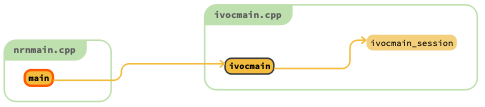
This will call '**ivocmain\_session()**' with parameter **'start\_session'** set to 1 that will effectively be dropping into the HOC Interpreter via **'hoc\_main1()'**:
```cpp
int ivocmain (int argc, const char** argv, const char** env) {
return ivocmain_session(argc, argv, env, 1);
}
int ivocmain_session (int argc, const char** argv, const char** env, int start_session) {
.........
hoc_main1(our_argc, our_argv, env);
.........
}
```
## **HOC Grammar**
With respect to the HOC grammar we have:
* **'src/oc/parse.ypp' →** HOC language is defined thanks to **bison/yacc;** this file holds actual HOC grammar
The grammar consists of token definitions, left-right precedence setup, grammar rules (i.e. expressions like assignments) and actions; these actions represent code blocks triggered when rules have been recognised.
HOC also provides functions and procedures. Grammar wise, the difference is that functions are treated as expressions whereas procedures are statements. Technically, a function will return a value and a procedure will not.
Given different depth of rules, parsing makes use of a stack where we normally push operands and operators. These are basically symbols(**Symbol**) or machine instructions tied to grammar actions(**Inst**).
HOC uses an interpreter data stack, an instruction machine and a separate function/procedure (nested) call stack (combined together as a stack machine).
Therefore grammar parsing type is defined as:
%union { /* stack type */
Symbol *sym; /* symbol table pointer */
Inst *inst; /* machine instruction */
int narg; /* number of arguments */
void* ptr;
}
which will generate
typedef union YYSTYPE
Parsing relies on a lexer function that performs input tokenisation, called **'yylex()'** (implemented in **'src/oc/hoc.c'**)**.**

It "communicates" with the parser (**yyparse()**) via a variable of the same type as the stack: **'YYSTYPE yylval'**.
As mentioned earlier, tokens are defined in the grammar. Each of them have a type that corresponds to what we have in **YYSTYPE**, for example:
%token <sym> LOCALOBJ AUTOOBJ
%token <narg> ARG NUMZERO ARGREF
%token <ptr> INTERNALSECTIONNAME PYSEC PYSECNAME PYSECOBJ
%type <inst> expr stmt asgn prlist delsym stmtlist strnasgn
means _**LOCALOBJ**_ is of type \`_**Symbol** **\*sym; /\* symbol table pointer \*/\`.**_ Grammar rules can also be mapped to a type, for example **_strnasgn_** is of type \`**_Inst \*inst; /\* machine instruction \*/\`._**
* **'src/oc/hoc.h' →** includes two headers
* **'redef.h' →** some HOC redefinitions
* **'hocdec.h' →** here we find global data structures.
HOC is context aware, so to that end we have a symbol table where we put new variables but also keywords, builtins and other constructs (see _**HOC Initialisation**_). We find the **_Symbol_** struct here:
```cpp
typedef struct Symbol { /* symbol table entry */
char *name;
short type;
short subtype; /* Flag for user integers */
short public; /* flag set public variable */
short defined_on_the_fly;/* moved here because otherwize gcc and borland do not align the same way */
union {
int oboff; /* offset into object data pointer space */
double *pval; /* User defined doubles - also for alias to scalar */
HocStruct Object* object_; /* alias to an object */
char *cstr; /* constant string */
double *pnum; /* Numbers */
int *pvalint; /* User defined integers */
float *pvalfloat; /* User defined floats */
int u_auto; /* stack offset # for AUTO variable */
double (*ptr)(); /* if BLTIN */
Proc *u_proc;
struct {
short type; /* Membrane type to find Prop */
int index; /* prop->param[index] */
}rng;
HocStruct Symbol **ppsym; /* Pointer to symbol pointer array */
HocStruct Template *template;
HocStruct Symbol* sym; /* for external */
} u;
unsigned s_varn; /* dependent variable number - 0 means indep */
Arrayinfo *arayinfo; /* ARRAY information if null then scalar */
HocSymExtension* extra; /* additions to symbol allow compatibility
with old nmodl dll's */
HocStruct Symbol *next; /* to link to another */
} Symbol;
```
Union _**u**_ is used to hold actual value of the symbol given its type.
We also have _**Inst,**_ which represents the data type of a machine instruction and is tied to function pointers of different types that correspond to different functions or grammar actions:
```cpp
typedef int (*Pfri)(void);
typedef void (*Pfrv)(void);
typedef double (*Pfrd)(void);
typedef struct Object** (*Pfro)(void);
typedef const char** (*Pfrs)(void);
typedef int (*Pfri_vp)(void*);
typedef void (*Pfrv_vp)(void*);
typedef double (*Pfrd_vp)(void*);
typedef struct Object** (*Pfro_vp)(void*);
typedef const char** (*Pfrs_vp)(void*);
typedef union Inst { /* machine instruction list type */
Pfrv pf;
Pfrd pfd;
Pfro pfo;
Pfrs pfs;
Pfrv_vp pfv_vp;
Pfrd_vp pfd_vp;
Pfro_vp pfo_vp;
Pfrs_vp pfs_vp;
HocUnion Inst *in;
HocStruct Symbol *sym;
void* ptr;
int i;
} Inst;
```
The interpreter data stack has the following type **_Datum_**:
```cpp
typedef union Datum { /* interpreter stack type */
double val;
Symbol *sym;
int i;
double *pval; /* first used with Eion in NEURON */
HocStruct Object **pobj;
HocStruct Object *obj; /* sections keep this to construct a name */
char **pstr;
HocStruct hoc_Item* itm;
hoc_List* lst;
void* _pvoid; /* not used on stack, see nrnoc/point.c */
} Datum;
```
* **'src/oc/code.c' →** here we find the stack machine definitions and routines that manipulate it, and as well as functions tied to different functionalities or grammar actions (HOC routines), like for example _**call()**_ that will perform a function call.
```cpp
#define NSTACK 1000 /* default size */
#define nstack hoc_nstack
static Datum *stack; /* the stack */
static Datum *stackp; /* next free spot on stack */
static Datum *stacklast; /* last stack element */
#define NPROG 50000
Inst *prog; /* the machine */
Inst *progp; /* next free spot for code generation */
Inst *pc; /* program counter during execution */
Inst *progbase; /* start of current subprogram */
Inst *prog_parse_recover; /* start after parse error */
int hoc_returning; /* 1 if return stmt seen, 2 if break, 3 if continue */
/* 4 if stop */
typedef struct Frame { /* proc/func call stack frame */
Symbol *sp; /* symbol table entry */
Inst *retpc; /* where to resume after return */
Datum *argn; /* n-th argument on stack */
int nargs; /* number of arguments */
Inst *iter_stmt_begin; /* Iterator statement starts here */
Object *iter_stmt_ob; /* context of Iterator statement */
Object *ob; /* for stack frame debug message */
} Frame;
#define NFRAME 512 /* default size */
#define nframe hoc_nframe
static Frame *frame, *fp, *framelast; /* first, frame pointer, last */
```
The important thing to note here is the _**Frame**_ structure, used for functions and procedures. They are installed in a symbol table and have a make us of a machine instruction **_retpc_** used to know where to return after execution.
Arguments come in variably like **$1, $2** and so on, and the way we incorporate them is by pointing to the last one on the stack (_**Datum \*argn**_) and passing **_int nargs._**
* **'src/oc/symbol.c' →** defines several symbol tables and utility functions to install and lookup symbols (see _**HOC Initialisation**_)
```cpp
typedef struct Symlist {
HocStruct Symbol *first;
HocStruct Symbol *last;
}Symlist;
Symlist *hoc_built_in_symlist = (Symlist *)0; /* keywords, built-in functions, all name linked into hoc. Look in this list last */
Symlist *hoc_top_level_symlist = (Symlist *)0; /* all user names seen at top-level (non-public names inside templates do not appear here) */
Symlist *symlist = (Symlist *)0; /* the current user symbol table: linked list */
Symlist *p_symlist = (Symlist *)0; /* current proc, func, or temp table */
/* containing constants, strings, and auto */
/* variables. Discarding these lists at */
/* appropriate times prevents storage leakage. */
```
* **'src/oc/hoc\_oop.c' →** holds HOC functions providing support for OOP
## **HOC Initialization**
* Argument parsing
Before HOC interpreter initialisation, **'ivocmain\_session()'** takes into account different options passed down from command line arguments and sets variables accordingly.
HOC-interpreter importance wise, we have:
* * **'NSTACK'→** HOC interpreter stack space
* **'NFRAME' →** number of frames available.
```
options:\n\
.......
-NSTACK integer size of stack (default 1000)\n\
-NFRAME integer depth of function call nesting (default 200)\n\
........
```
Default values are used if user does not supply them → in **'src/oc/code.c'.** We often need to specify a higher **NFRAME** (i.e. 1000 when we do morphology loading as that tends towards deeper function call nesting when parsing).
These values are checked systematically when we use the stack or frames for procedures and functions (everything is in **'src/oc/code.c',** check out _STACKCHK_ macro as well); the actual space allocation for HOC stack and frames is done in **'hoc\_init\_space()'.**
* Interpreter initialisation
**'hoc\_main1\_init()'** is in charge of the HOC interpreter initialisation. In the following image we can see **'hoc\_main1()'** is also a caller; this is the hoc interpreter part taking input line by line and executing it, discussed in next section.

Most of the initialisation is actually handled through **'hoc\_init()'**


**'hoc\_init()'** will perform the following
1. call **'hoc\_init\_space()'** to allocate space for HOC interpreter stack and frames
2. install symbols with the help of **'hoc\_install'** (alias of **'install()'** function implemented in **'src/oc/symbol.c'**):
1. keywords like : **if, else, proc, localobj** and so on
2. constants like: **PI, GAMMA, FARADAY** and so on
3. builtin HOC functions like: **sin(), cos(), sqrt(), xopen(), sscanf(), execute(), load\_file(), nrnversion()** and so forth


3. install some variable symbols using **'hoc\_install\_var()'** defined in **'src/oc/symbol.c'**
4. call **'hoc\_spinit()'** implemented in **'src/oc/hocusr.c',** which will
1. **hoc\_install()** user variables ( like **float/double/integer, scalars, arrays, vectors**)
2. **hoc\_install()** user functions (like **pt3dadd(), finitialize(), psection()** and so on)
3. call **'hoc\_last\_init()'** to finalise setup, including:
1. create **NrnThreads**
2. **hoc\_install()** neuron related variables ( **t, dt, v, i\_membrane\_)** and user properties ( **nseg, L, rallbranch, Ra)**
3. finish memory allocations for different neuron variables
4. call **modl\_reg()** and **mswin\_load\_dll()** to load external mechanisms from **mech** library
5. call **'hoc\_class\_registration()'** implemented in **'src/ivoc/classreg.cpp'** which will register classes found in different parts of the source tree, like:
1. **List, Vector, Matrix** and so on, classes from **'src/ivoc/'**
2. **Shape, BBSaveState** and so on, classes from **'src/nrniv'**
****
## ****HOC Interpreter - executing the machine****
As pointed out in previous section, ****'hoc\_main1()'**** launches the interpreter and executes different hoc commands either line by line from input file or from prompt.
This is handled by the next routine:
**HOC interpreter main routine**
```cpp
while (moreinput())
hoc_run1();
return 0;
```
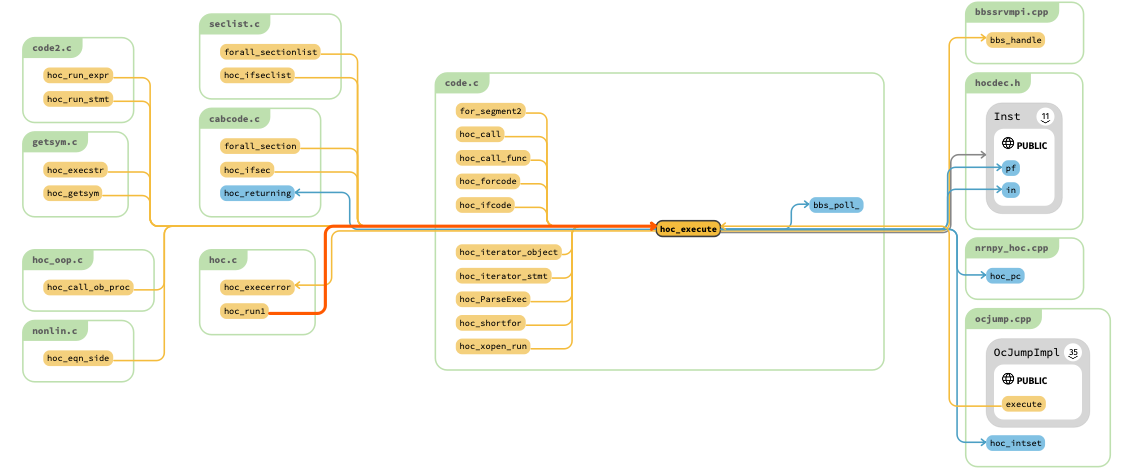
Whereas **'hoc\_run1()'** will perform parsing (ultimately via bison generated **'yyparse()'**), which will then point to the start machine instruction **Inst** that is passed on to execution via _**execute (hoc\_execute()** redef)_:
```cpp
for (initcode(); hoc_yyparse(); initcode())
{
execute(progbase)
}
```
## ****HOC Interpreter example - printf****
When a function (or even a procedure) is called we have:
* arguments parsed (and eventually computed) pushed to the interpreter data stack
* the interpreter machine will have
* _**call**_ opcode → this is linked to the _**call()**_ function implemented in _**'src/oc/code.c'**_
* _**sym**_ holding the symbol table pointer for the function
* _**nargs**_ holding the number of arguments passed to the function
* a new Frame is pushed onto the frame stack, containing
* **_argn_ →** pointer to interpreter stack of the last argument
* **_nargs_ →** number of arguments
* **_retpc_ →** where to return after the function call
* **_sp_ →** symbol table pointer of the printf

How does this map to _**parse.ypp**_ grammar? Corresponding part is :
expr:
.......
| function begin '(' arglist ')'
{ $$ = $2; code(call); codesym($1); codei($4); PN;}
Here we notice _**call**_ opcode that was pushed to the interpreter machine, together with the _**sym**_ of called function and the number of args via _**codei**_ call.
So given the following HOC call:
oc>printf("%s equals %d", "one plus two", 1+2)
the parsing will parse the arguments and the interpreter will perform **_call()_.** At this point, program counter _**pc**_ points to the **_printf_** symbol table entry and just after we have the number of arguments _**nargs.**_ We now push and setup a new _**Frame**_:
```cpp
void call(void) /* call a function */
{
int i, isec;
Symbol *sp = pc[0].sym; /* symbol table entry for printf*/
/* stack a new frame */
if (++fp >= framelast) {
--fp;
execerror(sp->name, "call nested too deeply, increase with -NFRAME framesize option");
}
fp->sp = sp;
fp->nargs = pc[1].i;
fp->retpc = pc + 2; /* This is where we return to after the printf call */
...
fp->argn = stackp - 2; /* pointer to the last argument */
```
By inspecting the frame we notice:
```cpp
(lldb) p *fp
(Frame) $2 = {
sp = 0x0000000100d07dc0
retpc = 0x0000000100b6c060
argn = 0x0000000101008c20
nargs = 3
iter_stmt_begin = 0x0000000000000000
iter_stmt_ob = 0x0000000000000000
ob = 0x0000000000000000
}
(lldb) p *fp->sp
(Symbol) $3 = {
name = 0x0000000100d07e00 "printf"
type = 280 // this is the type of the symbol, which corresponds to a builtin function: FUN_BLTIN = 280
subtype = 0
public = 0
defined_on_the_fly = 0
u = {
oboff = 13663760
pval = 0x0000000100d07e10
object_ = 0x0000000100d07e10
cstr = 0x0000000100d07e10 "??'"
pnum = 0x0000000100d07e10
pvalint = 0x0000000100d07e10
pvalfloat = 0x0000000100d07e10
u_auto = 13663760
ptr = 0x0000000100d07e10 (0x0000000100d07e10)
u_proc = 0x0000000100d07e10
rng = (type = 32272, index = 1)
ppsym = 0x0000000100d07e10
template = 0x0000000100d07e10
sym = 0x0000000100d07e10
}
s_varn = 0
arayinfo = 0x0000000000000000
extra = 0x0000000000000000
next = 0x0000000100d07e30
}
(lldb) p *fp->argn
(Datum) $4 = {
val = 3 // value of the last argument (1+2) has already been computed
sym = 0x4008000000000000
i = 0
pval = 0x4008000000000000
pobj = 0x4008000000000000
obj = 0x4008000000000000
pstr = 0x4008000000000000
itm = 0x4008000000000000
lst = 0x4008000000000000
_pvoid = 0x4008000000000000
}
```
_**call()**_ will continue on to check the symbol, which tells us we are calling a builtin function (_**FUN\_BLTIN = 280**_, see _**fp**_ above), and call its function pointer mapped to **_hoc\_PRintf_**:
```cpp
if (sp->type == FUN_BLTIN || sp->type == OBJECTFUNC || sp->type == STRINGFUNC) {
stackp += sp->u.u_proc->nauto * 2; /* Offset stack for auto space */
STACKCHK
(*(sp->u.u_proc->defn.pf))(); /* this is where we call the printf function */
if (hoc_errno_check()) {
hoc_warning("errno set during call of", sp->name);
}
} else
```


_**hoc\_sprint1()**_ will be in charge of formatting the output using the parsed arguments. Once printing is done via _**plprint()**_, a call to _**ret()**_ will perform Frame clean-up, pop arguments from interpreter data stack and set program counter _**pc**_ to returning point _**retpc**_:
```cpp
void hoc_ret(void) { /* common return from func, proc, or iterator */
int i;
/* unref all the auto object pointers */
for (i = fp->sp->u.u_proc->nobjauto; i > 0; --i) {
hoc_obj_unref(stackp[-2*i].obj);
}
stackp -= fp->sp->u.u_proc->nauto * 2; /* Pop off the autos */
frameobj_clean(fp);
for (i = 0; i < fp->nargs; i++)
nopopm(); /* pop arguments */
pc = (Inst *)fp->retpc;
--fp;
hoc_returning = 1;
}
```
Length of outputted string (21 here) is pushed onto the interpreter data stack. Notice **_hoc\_returning_** that is set to 1 to let the stack machine know execution is done; this is how we can signal nested calls if needed (out of scope for this example).
At the end of **hoc\_execute()** we get:
one plus two equals 3 21
|
