1
2
3
4
5
6
7
8
9
10
11
12
13
14
15
16
17
18
19
20
21
22
23
24
25
26
27
28
29
30
31
32
33
34
35
36
37
38
39
40
41
42
43
44
45
46
47
48
49
50
51
52
53
54
55
56
57
58
59
60
61
62
63
64
65
66
67
68
69
70
71
72
73
74
75
76
77
78
79
80
81
82
83
84
85
86
87
88
89
90
91
92
93
94
95
96
97
98
99
100
101
102
103
104
105
106
107
108
109
110
111
112
113
114
115
116
117
118
119
120
121
122
123
124
125
126
127
128
129
130
131
132
133
134
135
136
137
138
139
140
141
142
143
144
145
146
147
148
149
150
151
152
153
154
155
156
157
158
159
160
161
162
163
164
165
166
167
168
169
170
171
172
173
174
175
176
177
178
179
180
181
182
183
184
185
186
187
188
189
190
191
192
193
194
195
196
197
198
199
200
201
202
203
204
205
206
207
208
209
210
211
212
213
214
215
216
217
218
219
220
221
222
223
224
225
226
227
228
229
230
231
232
233
234
235
236
237
238
239
240
241
242
243
244
245
246
247
248
249
250
251
252
253
254
255
256
257
258
259
260
261
262
263
264
265
266
267
268
269
270
271
272
273
274
275
276
277
278
279
280
281
282
283
284
285
286
287
288
289
|
## The NMODL Framework
[](https://travis-ci.org/BlueBrain/nmodl) [](https://dev.azure.com/pramodskumbhar/nmodl/_build/latest?definitionId=2&branchName=master) [](https://codecov.io/gh/BlueBrain/nmodl) [](https://bestpractices.coreinfrastructure.org/projects/4467)
The NMODL Framework is a code generation engine for **N**EURON **MOD**eling **L**anguage ([NMODL](https://www.neuron.yale.edu/neuron/static/py_doc/modelspec/programmatic/mechanisms/nmodl.html)). It is designed with modern compiler and code generation techniques to:
* Provide **modular tools** for parsing, analysing and transforming NMODL
* Provide **easy to use**, high level Python API
* Generate **optimised code** for modern compute architectures including CPUs, GPUs
* **Flexibility** to implement new simulator backends
* Support for **full** NMODL specification
### About NMODL
Simulators like [NEURON](https://www.neuron.yale.edu/neuron/) use NMODL as a domain specific language (DSL) to describe a wide range of membrane and intracellular submodels. Here is an example of exponential synapse specified in NMODL:
```python
NEURON {
POINT_PROCESS ExpSyn
RANGE tau, e, i
NONSPECIFIC_CURRENT i
}
UNITS {
(nA) = (nanoamp)
(mV) = (millivolt)
(uS) = (microsiemens)
}
PARAMETER {
tau = 0.1 (ms) <1e-9,1e9>
e = 0 (mV)
}
ASSIGNED {
v (mV)
i (nA)
}
STATE {
g (uS)
}
INITIAL {
g = 0
}
BREAKPOINT {
SOLVE state METHOD cnexp
i = g*(v - e)
}
DERIVATIVE state {
g' = -g/tau
}
NET_RECEIVE(weight (uS)) {
g = g + weight
}
```
### Installation
See [INSTALL.md](https://github.com/BlueBrain/nmodl/blob/master/INSTALL.md) for detailed instructions to build the NMODL from source.
### Try NMODL with Docker
To quickly test the NMODL Framework's analysis capabilities we provide a
[docker](https://www.docker.com) image, which includes the NMODL Framework python library and a
fully functional Jupyter notebook environment. After installing [docker](https://docs.docker.com/compose/install/) and [docker-compose](https://docs.docker.com/compose/install/) you can pull and run the NMODL image from your terminal.
To try Python interface directly from CLI, you can run docker image as:
```
docker run -it --entrypoint=/bin/sh bluebrain/nmodl
```
And try NMODL Python API discussed later in this README as:
```
$ python3
Python 3.6.8 (default, Apr 8 2019, 18:17:52)
>>> from nmodl import dsl
>>> import os
>>> examples = dsl.list_examples()
>>> nmodl_string = dsl.load_example(examples[-1])
...
```
To try Jupyter notebooks you can download docker compose file and run it as:
```sh
wget "https://raw.githubusercontent.com/BlueBrain/nmodl/master/docker/docker-compose.yml"
DUID=$(id -u) DGID=$(id -g) HOSTNAME=$(hostname) docker-compose up
```
If all goes well you should see at the end status messages similar to these:
```
[I 09:49:53.923 NotebookApp] The Jupyter Notebook is running at:
[I 09:49:53.923 NotebookApp] http://(4c8edabe52e1 or 127.0.0.1):8888/?token=a7902983bad430a11935
[I 09:49:53.923 NotebookApp] Use Control-C to stop this server and shut down all kernels (twice to skip confirmation).
To access the notebook, open this file in a browser:
file:///root/.local/share/jupyter/runtime/nbserver-1-open.html
Or copy and paste one of these URLs:
http://(4c8edabe52e1 or 127.0.0.1):8888/?token=a7902983bad430a11935
```
Based on the example above you should then open your browser and navigate to the URL `http://127.0.0.1:8888/?token=a7902983bad430a11935`.
You can open and run all example notebooks provided in the `examples` folder. You can also create
new notebooks in `my_notebooks`, which will be stored in a subfolder `notebooks` at your current
working directory.
### Using the Python API
Once the NMODL Framework is installed, you can use the Python parsing API to load NMOD file as:
```python
from nmodl import dsl
examples = dsl.list_examples()
nmodl_string = dsl.load_example(examples[-1])
driver = dsl.NmodlDriver()
modast = driver.parse_string(nmodl_string)
```
The `parse_file` API returns Abstract Syntax Tree ([AST](https://en.wikipedia.org/wiki/Abstract_syntax_tree)) representation of input NMODL file. One can look at the AST by converting to JSON form as:
```python
>>> print (dsl.to_json(modast))
{
"Program": [
{
"NeuronBlock": [
{
"StatementBlock": [
{
"Suffix": [
{
"Name": [
{
"String": [
{
"name": "POINT_PROCESS"
}
...
```
Every key in the JSON form represent a node in the AST. You can also use visualization API to look at the details of AST as:
```
from nmodl import ast
ast.view(modast)
```
which will open AST view in web browser:

The central *Program* node represents the whole MOD file and each of it's children represent the block in the input NMODL file. Note that this requires X-forwarding if you are using Docker image.
Once the AST is created, one can use exisiting visitors to perform various analysis/optimisations. One can also easily write his own custom visitor using Python Visitor API. See [Python API tutorial](docs/notebooks/nmodl-python-tutorial.ipynb) for details.
NMODL Frameowrk also allows to transform AST representation back to NMODL form as:
```python
>>> print (dsl.to_nmodl(modast))
NEURON {
POINT_PROCESS ExpSyn
RANGE tau, e, i
NONSPECIFIC_CURRENT i
}
UNITS {
(nA) = (nanoamp)
(mV) = (millivolt)
(uS) = (microsiemens)
}
PARAMETER {
tau = 0.1 (ms) <1e-09,1000000000>
e = 0 (mV)
}
...
```
### High Level Analysis and Code Generation
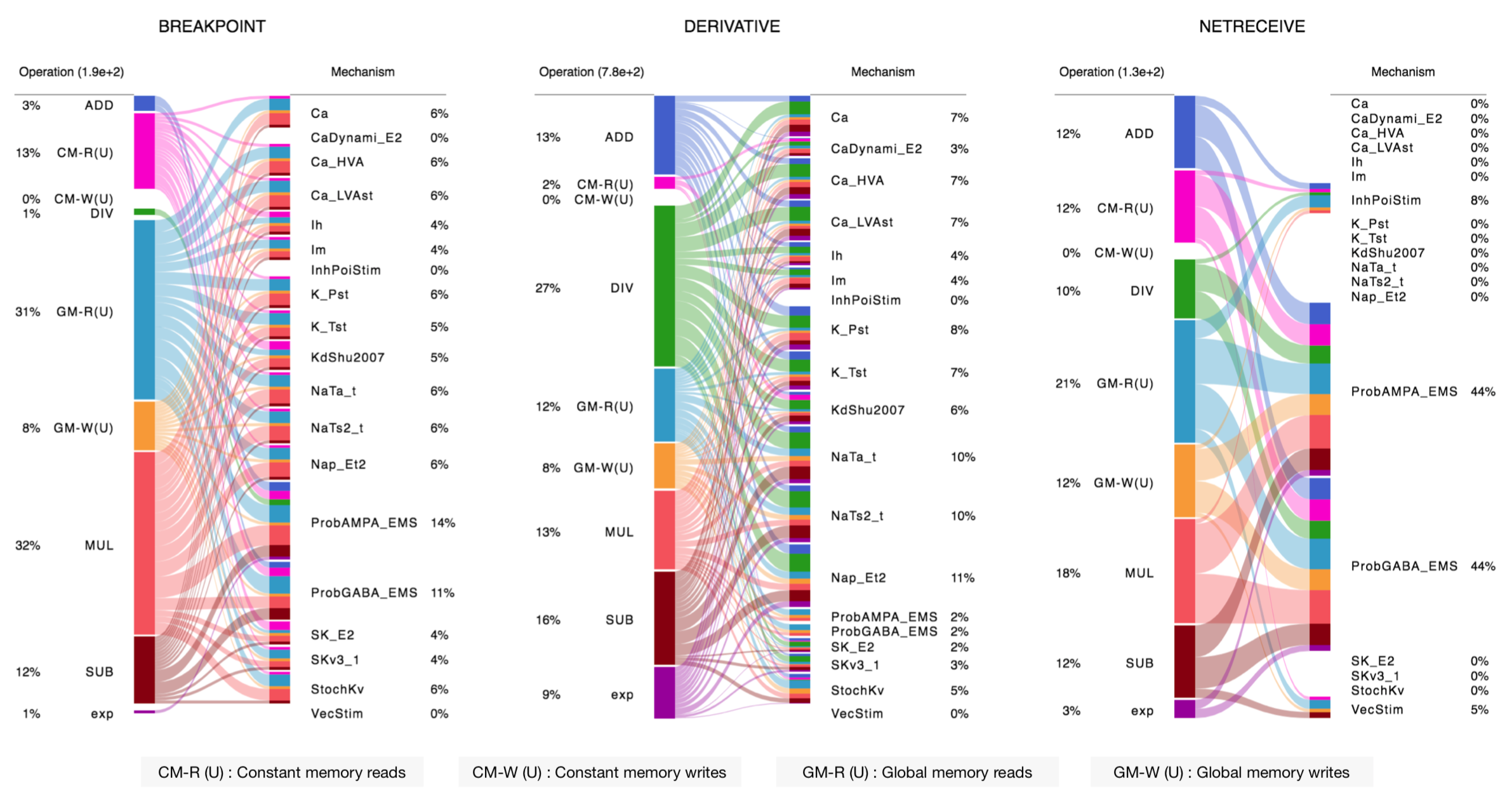
The NMODL Framework provides rich model introspection and analysis capabilities using [various visitors](https://bluebrain.github.io/nmodl/html/doxygen/group__visitor__classes.html). Here is an example of theoretical performance characterisation of channels and synapses from rat neocortical column microcircuit [published in 2015](https://www.cell.com/abstract/S0092-8674%2815%2901191-5):
To understand how you can write your own introspection and analysis tool, see [this tutorial](docs/notebooks/nmodl-python-tutorial.ipynb).
Once analysis and optimization passes are performed, the NMODL Framework can generate optimised code for modern compute architectures including CPUs (Intel, AMD, ARM) and GPUs (NVIDIA, AMD) platforms. For example, C++, OpenACC and OpenMP backends are implemented and one can choose these backends on command line as:
```
$ nmodl expsyn.mod sympy --analytic
```
To know more about code generation backends, [see here](https://bluebrain.github.io/nmodl/html/doxygen/group__codegen__backends.html). NMODL Framework provides number of options (for code generation, optimization passes and ODE solver) which can be listed as:
```
$ nmodl -H
NMODL : Source-to-Source Code Generation Framework [version]
Usage: /path/<>/nmodl [OPTIONS] file... [SUBCOMMAND]
Positionals:
file TEXT:FILE ... REQUIRED One or more MOD files to process
Options:
-h,--help Print this help message and exit
-H,--help-all Print this help message including all sub-commands
--verbose=info Verbose logger output (trace, debug, info, warning, error, critical, off)
-o,--output TEXT=. Directory for backend code output
--scratch TEXT=tmp Directory for intermediate code output
--units TEXT=/path/<>/nrnunits.lib
Directory of units lib file
Subcommands:
host
HOST/CPU code backends
Options:
--c C/C++ backend (true)
acc
Accelerator code backends
Options:
--oacc C/C++ backend with OpenACC (false)
sympy
SymPy based analysis and optimizations
Options:
--analytic Solve ODEs using SymPy analytic integration (false)
--pade Pade approximation in SymPy analytic integration (false)
--cse CSE (Common Subexpression Elimination) in SymPy analytic integration (false)
--conductance Add CONDUCTANCE keyword in BREAKPOINT (false)
passes
Analyse/Optimization passes
Options:
--inline Perform inlining at NMODL level (false)
--unroll Perform loop unroll at NMODL level (false)
--const-folding Perform constant folding at NMODL level (false)
--localize Convert RANGE variables to LOCAL (false)
--global-to-range Convert GLOBAL variables to RANGE (false)
--localize-verbatim Convert RANGE variables to LOCAL even if verbatim block exist (false)
--local-rename Rename LOCAL variable if variable of same name exist in global scope (false)
--verbatim-inline Inline even if verbatim block exist (false)
--verbatim-rename Rename variables in verbatim block (true)
--json-ast Write AST to JSON file (false)
--nmodl-ast Write AST to NMODL file (false)
--json-perf Write performance statistics to JSON file (false)
--show-symtab Write symbol table to stdout (false)
codegen
Code generation options
Options:
--layout TEXT:{aos,soa}=soa Memory layout for code generation
--datatype TEXT:{float,double}=soa Data type for floating point variables
--force Force code generation even if there is any incompatibility
--only-check-compatibility Check compatibility and return without generating code
--opt-ionvar-copy Optimize copies of ion variables (false)
```
### Documentation
We are working on user documentation, you can find current drafts of :
* [User Documentation](https://bluebrain.github.io/nmodl/)
* [Developer / API Documentation](https://bluebrain.github.io/nmodl/html/doxygen/index.html)
### Citation
If you would like to know more about the the NMODL Framework, see following paper:
* Pramod Kumbhar, Omar Awile, Liam Keegan, Jorge Alonso, James King, Michael Hines and Felix Schürmann. 2019. An optimizing multi-platform source-to-source compiler framework for the NEURON MODeling Language. In Eprint : [arXiv:1905.02241](https://arxiv.org/pdf/1905.02241.pdf)
### Support / Contribuition
If you see any issue, feel free to [raise a ticket](https://github.com/BlueBrain/nmodl/issues/new). If you would like to improve this framework, see [open issues](https://github.com/BlueBrain/nmodl/issues) and [contribution guidelines](CONTRIBUTING.md).
### Examples / Benchmarks
The benchmarks used to test the performance and parsing capabilities of NMODL Framework are currently being migrated to GitHub. These benchmarks will be published soon in following repositories:
* [NMODL Benchmark](https://github.com/BlueBrain/nmodlbench)
* [NMODL Database](https://github.com/BlueBrain/nmodldb)
## Funding & Acknowledgment
The development of this software was supported by funding to the Blue Brain Project, a research center of the École polytechnique fédérale de Lausanne (EPFL), from the Swiss government's ETH Board of the Swiss Federal Institutes of Technology. In addition, the development was supported by funding from the National Institutes of Health (NIH) under the Grant Number R01NS11613 (Yale University) and the European Union’s Horizon 2020 Framework Programme for Research and Innovation under the Specific Grant Agreement No. 785907 (Human Brain Project SGA2).
Copyright © 2017-2022 Blue Brain Project/EPFL
|
