1
2
3
4
5
6
7
8
9
10
11
12
13
14
15
16
17
18
19
20
21
22
23
24
25
26
27
28
29
30
31
32
33
34
35
36
37
38
39
40
41
42
43
44
45
46
47
48
49
50
51
52
53
54
55
56
57
58
59
60
61
62
63
64
65
66
67
68
69
70
71
72
73
74
75
76
77
78
79
80
81
82
83
84
85
86
87
88
89
90
91
92
93
94
95
96
97
98
99
100
101
102
103
104
105
106
107
108
109
110
111
112
113
114
115
116
117
118
119
120
121
122
123
124
125
126
127
128
129
130
131
132
133
134
135
136
137
138
139
140
141
142
143
144
145
146
147
148
149
150
151
152
153
154
155
156
157
158
159
160
161
162
163
164
165
166
167
168
169
170
171
172
173
174
175
176
177
178
179
180
181
182
183
184
185
186
187
188
189
190
191
192
193
194
195
196
197
198
199
200
201
202
203
204
205
206
207
208
209
210
211
212
213
214
215
216
217
218
219
220
221
222
223
224
225
226
227
228
229
230
231
232
233
234
235
236
237
238
239
240
241
242
243
244
245
246
247
248
249
250
251
252
253
254
255
256
257
258
259
260
261
262
263
264
265
266
267
268
269
270
271
272
273
274
275
276
277
278
279
280
281
282
283
284
285
286
287
288
289
290
291
292
293
294
295
296
297
298
299
300
301
302
303
304
305
306
307
308
309
310
311
312
313
314
315
316
317
318
319
320
321
322
323
324
325
326
327
328
329
330
331
332
333
334
335
336
337
338
339
340
341
342
343
344
345
346
347
348
349
350
351
352
353
354
355
356
357
358
359
360
361
362
363
364
365
366
367
368
369
370
371
372
373
374
375
376
377
378
379
380
381
382
383
384
385
386
387
388
389
390
391
392
393
394
395
396
397
398
399
400
401
402
403
404
405
406
407
408
409
410
411
412
413
414
415
416
417
418
419
420
421
422
423
424
425
426
427
428
429
430
431
432
433
434
435
436
437
438
439
440
441
442
443
444
445
446
447
448
449
450
451
452
453
454
455
456
457
458
459
460
461
462
463
464
465
466
467
468
469
470
471
472
473
474
475
476
477
478
479
480
481
482
483
484
485
486
487
488
489
490
491
492
493
494
495
496
497
498
499
500
501
502
503
504
505
506
507
508
509
510
511
512
513
514
515
516
517
518
519
520
521
522
523
524
525
526
527
528
529
530
531
532
533
534
535
536
537
538
539
540
541
542
543
544
545
546
547
548
549
550
551
552
553
554
555
556
557
558
559
560
561
562
563
564
565
566
567
568
569
570
571
572
573
574
575
576
577
578
579
580
581
582
583
584
585
586
587
588
589
590
591
592
593
594
595
596
597
598
599
600
601
602
603
604
605
606
607
608
609
610
611
612
613
614
615
616
617
618
619
620
621
622
623
624
625
626
627
628
629
630
631
632
633
634
635
636
637
638
639
640
641
642
643
644
645
646
647
648
649
650
651
652
653
654
655
656
657
658
659
660
661
662
663
664
665
666
667
668
669
670
671
672
673
674
675
676
677
678
679
680
681
682
683
684
685
686
687
688
689
690
691
692
693
694
695
696
697
698
699
700
701
702
703
704
705
706
707
708
709
710
711
712
713
714
715
716
717
718
719
720
721
722
723
724
725
726
727
728
729
730
731
732
733
734
735
736
737
738
739
740
741
742
743
744
745
746
747
748
749
750
751
752
753
754
755
756
757
758
759
760
761
762
763
764
765
766
767
768
769
770
771
772
773
774
775
776
777
778
779
780
781
782
783
784
785
786
787
788
789
790
791
792
793
794
795
796
797
798
799
800
801
802
803
804
805
806
807
808
809
810
811
812
813
814
815
816
817
818
819
820
821
822
823
824
825
826
827
828
829
830
831
832
833
834
835
836
837
838
839
840
841
842
843
844
845
846
847
848
849
850
851
852
853
854
855
856
857
858
859
860
861
862
863
864
865
866
867
868
869
870
871
872
873
874
875
876
877
878
879
880
881
882
883
884
885
886
|
[](https://stand-with-ukraine.pp.ua)
# pspg - Postgres Pager
Everybody who uses `psql` also uses the `less` pager. Which, while it works well, has no special
support for tabular data. I found a few projects, but none was good enough for this purpose.
Thus I decided to write a small specialized pager to use as a `psql` pager.
This pager can be used from the following command line clients, too:
- `mysql`
- `sqlite`
- [`pgcli`](https://github.com/dbcli/pgcli/)
- `monetdb`
- [`Trino (formerly Presto SQL)`](https://trino.io/)
- [`usql`](https://github.com/xo/usql/)
- [`sqlcl`](https://github.com/okbob/pspg/#sqlcl) (for oracle)
- [`nushell`](https://www.nushell.sh/)
## Main target
* ability to freeze the first few rows, or first few columns
* ability to sort data by the specified numeric column
* ability to use fancy themes - like `mcview` or `FoxPro` - http://okbob.blogspot.com/2019/12/pspg-themes-what-you-use-it.html
* mouse is supported and used
* ability to copy a selected range to the clipboard
## Installation and basic configuration
The `pspg` can be simply installed from Debian (Ubuntu) repositories. RedHat (Fedora) repositories
contains `pspg` too:
# Debian (Ubuntu)
sudo apt-get install pspg
# RedHat (Fedora)
sudo dnf install pspg
Basic configuration is very simple - just set system environment variable `PSQL_PAGER`:
export PSQL_PAGER='pspg'
or with some common options (`-b` means blackwhite theme, `-X` preserve content after exit):
export PSQL_PAGER='pspg -X -b'
Attention: options used in command line has higher priority than options specified in configuration file (`~/.pspgconf`).
Native installation on MS Windows is not supported, but `pspg` works well inside `wsl2`.
Inside wsl2 environment, the installation is same like on used Linux system.
Installation on macOS/homebrew is simple by `brew install pspg`.
## Video presentation
[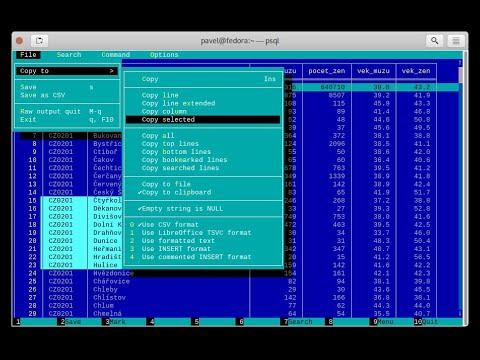](https://www.youtube.com/watch?v=JyxuEkoYDQk)
## Screenshots


## Options
[pavel@localhost ~]$ pspg --help
pspg is a Unix pager designed for table browsing.
Usage:
pspg [OPTION] [file]
General options:
--about about authors
--help show this help
-V, --version show version
--info show info about libraries and system
--direct-color force direct-color terminal mode
-f, --file=FILE open file
-F, --quit-if-one-screen
quit if content is one screen
--clipboard-app=NUM specify app used by copy to clipboard (1, 2, 3, 4)
--esc-delay=NUM specify escape delay in ms (-1 inf, 0 not used, )
--interactive force interactive mode
--ignore_file_suffix don't try to deduce format from file suffix
--ni not interactive mode (only for csv and query)
--no-watch-file don't watch inotify event of file
--no-mouse don't use own mouse handling
--no-progressive-load don't use progressive data load
--no-sigint-search-reset
without reset searching on sigint (CTRL C)
--no-sleep without waits against flickering
--no_xterm_mouse_mode don't use optional xterm mouse mode
--only-for-tables use std pager when content is not table
--on-sigint-exit exit on sigint(CTRL C or Escape)
--pgcli-fix try to fix some pgcli related issues
--querystream read queries from stream forever
--quit-on-f3 exit on F3 like mc viewers
--rr=ROWNUM rows reserved for specific purposes
--stream read input forever
-X, --reprint-on-exit preserve content after exit
Output format options:
-a, --ascii force ascii
-b, --blackwhite black-white style
-s, --style=N set color style number (0..22)
--bold-labels row, column labels use bold font
--bold-cursor cursor use bold font
--border type of borders (0..2)
--double-header header separator uses double lines
--force-uniborder replace ascii borders by unicode borders
--highlight-odd-rec highlights odd records (when it is supported by style)
--hide-header-line hides header line (between column names and data)
--ignore-short-rows rows with wrong column numbers are ignored
--null=STRING STRING used instead NULL
Searching options
-g --hlite-search, -G --HILITE-SEARCH
don't highlight lines for searches
-i --ignore-case ignore case in searches that do not contain uppercase
-I --IGNORE-CASE ignore case in all searches
Interface options:
-c, --freezecols=N freeze N columns (0..9)
--less-status-bar status bar like less pager
--line-numbers show line number column
--menu-always show top bar menu every time
--no-bars, --no-commandbar, --no-topbar
don't show bottom, top bar or both
--no-cursor row cursor will be hidden
--no-last-row-search don't use the last pattern when starting a new search
--no-scrollbar don't show scrollbar
--no-sound don't use beep when scroll is not possible
--tabular-cursor cursor is visible only when data has table format
--vertical-cursor show vertical column cursor
Input format options:
--csv input stream has csv format
--csv-separator char used as field separator
--csv-header [on/off] specify header line usage
--skip-columns-like="SPACE SEPARATED STRING LIST"
columns with substr in name are ignored
--csv-trim-width=NUM trim value after NUM chars
--csv-trim-rows=NUM trim value after NUM rows
--tsv input stream has tsv format
On exit options:
--on-exit-reset sends reset terminal sequence "\33c"
--on-exit-clean sends clean terminal sequence "\033[2J"
--on-exit-erase-line sends erase line terminal sequence "\33[2K\r"
--on-exit-sgr0 sends sgr0 terminal sequence "\033[0;10m"
Watch mode options:
-q, --query=QUERY execute query
-w, --watch time the query (or read file) is repeated every time (sec)
Connection options:
-d, --dbname=DBNAME database name
-h, --host=HOSTNAME database server host (default: "local socket")
-p, --port=PORT database server port (default: "5432")
-U, --username=USERNAME database user name
-W, --password force password prompt
Debug options:
--log=FILE log debug info to file
--wait=NUM wait NUM seconds to allow attach from a debugger
pspg shares a lot of key commands with the less pager or the vi editor.
Options can also be passed within the `PSPG` environment variable. Configuration
file is processed first. Options from the `PSPG` variable are processed afterwards
step and command line options are processed at the end. One option can
be processed multiple times, the last value wins.
## Environment variables
| Name | Usage |
|---------------|-------------------------------------------|
|`PSPG` | can hold same options like command line |
|`PSPG_CONF` | path to configuration file |
|`PSPG_HISTORY` | path to file pspg's readline history file |
## Example of config file
The default path of config file is `~/.pspgconf`.
The fields names can be different than from related command line options:
ascii_menu = false
bold_labels = false
bold_cursor = false
ignore_case = false
ignore_lower_case = false
no_cursor = false
no_sound = false
no_mouse = false
less_status_bar = false
no_highlight_search = false
no_highlight_lines = false
force_uniborder = false
show_rownum = false
without_commandbar = false
without_topbar = false
vertical_cursor = false
on_sigint_exit = false
no_sigint_search_reset = false
double_header = false
quit_on_f3 = false
pgcli_fix = false
xterm_mouse_mode = true
show_scrollbar = true
menu_always = false
empty_string_is_null = true
last_row_search = true
progressive_load_mode = true
highlight_odd_rec = false
hide_header_line = false
on_exit_reset = false
on_exit_clean = false
on_exit_erase_line = false
on_exit_sgr0 = false
direct_color = false
theme = 16
border_type = 2
default_clipboard_format = 0
clipboard_app = 0
hist_size = 500
esc_delay = -1
## Themes
|Code| Name |
|---:|---------------------------------------|
| 0 | black & white |
| 1 | Midnight Commander like |
| 2 | FoxPro like |
| 3 | Pdmenu like |
| 4 | White theme |
| 5 | Mutt like |
| 6 | PCFand like |
| 7 | Green theme |
| 8 | Blue theme |
| 9 | Word Perfect like |
| 10 | Low contrast blue theme |
| 11 | Dark cyan/black mode |
| 12 | Paradox like |
| 13 | dBase IV retro style |
| 14 | dBase IV retro style (Magenta labels) |
| 15 | Red white theme |
| 16 | Simple theme |
| 17 | Solarized dark theme |
| 18 | Solarized light theme |
| 19 | Gruvbox light theme |
| 20 | Tao Light theme |
| 21 | FlatWhite theme |
| 22 | Relational pipes theme |
| 23 | Paper Color theme |
| 24 | Dracula theme |
see http://okbob.blogspot.cz/2017/07/i-hope-so-every-who-uses-psql-uses-less.html
### Custom themes
The theme can be customized over base and menu templates referencing the
built-in themes. The custom theme file should be saved in directory with `pspg`
configuration. The name of this file should be .pspg_theme_xxx. The custom
theme can be selected by command line option `--custom-style=name` or by
command `\ctheme name`.

Example of a custom theme file (named `.pspg_theme_mc2` (it can be activated by
command `\ctheme mc2`)):
template = 1
template_menu = 3
background = black, white
data = black, white
label = black, white, italic, bold
border = #000000, white
footer = lightgray, white
cursor_data = blue, white, italic, bold, dim, reverse
cursor_border = blue, blue , italic, bold, dim, reverse
cursor_label = blue, white, italic, bold, dim, reverse
cursor_footer = blue, white, italic, bold, dim, reverse
cursor_bookmark = red, white, italic, bold, dim, reverse
cross_cursor = white, blue, italic, bold
cross_cursor_border = brightblue, blue
status_bar = black, lightgray
title = black, lightgray
scrollbar_arrows = black, white
scrollbar_background = lightgray, white
scrollbar_slider = white, gray
Some keys can be marked by symbol `*`. Marked keys are used for odd records.
data* = black, lightgray
label* = black, lightgray, italic, bold
border* = #000000, lightgray
`template` and `template_menu` set fallback values for any keys not specified
in the custom theme. `template_menu` in particular is currently the only way to
customize the F9 menu appearance.
| key | customizes |
|---------------------------------------|---------------------------------------------------------------------|
| `background` | Background color |
| `data` | Data (non-header or frozen column) text |
| `border` | Border color |
| `label` | Label (header or frozen column) text |
| `row_number` | Line numbers |
| `record_number` | |
| `selected_area` | |
| `footer` | Results footer (non-tabular e.g. rowcount) |
| `cursor_data` | Highlighted data (non-header or frozen column) text |
| `cursor_border` | Highlighted border color |
| `cursor_label` | Highlighted label (header or frozen column) text |
| `cursor_row_number` | Highlighted line numbers |
| `cursor_record_number` | |
| `cursor_selected_area` | |
| `cursor_footer` | Highlighted results footer (non-tabular e.g. rowcount) |
| `scrollbar_arrows` | Scrollbar up and down arrows |
| `scrollbar_background` | Scrollbar "empty" background |
| `scrollbar_slider` | Scrollbar slider over the background |
| `scrollbar_active_slider` | Scrollbar slider grabbed by mouse |
| `title` | Results headline (in psql describe commands) |
| `status_bar` | Top query and cursor location information |
| `prompt_bar` | |
| `info_bar` | Info text (e.g. "Not found" when searching) |
| `input_bar` | Input prompt and text (e.g. search) |
| `error_bar` | |
| `bookmark` | |
| `bookmark_border` | |
| `cursor_bookmark` | |
| `cross_cursor` | Highlighted cell at intersection of horizontal and vertical cursors |
| `cross_cursor_border` | Borders at intersection of horizontal and vertical cursors |
| `matched_pattern` | Search result match text |
| `matched_pattern_nohl` | |
| `matched_line` | Line containing search result |
| `matched_line_border` | Borders in search result line |
| `matched_pattern_cursor` | Highlighted search result match text |
| `matched_line_vertical_cursor` | Vertically highlighted search result match text |
| `matched_line_vertical_cursor_border` | Borders of vertically highlighted cell with search result match |
| `error` | |
ANSI colors `Black`, `Red`, `Green`, `Brown`, `Blue`, `Magenta`, `Cyan`,
`LightGray`, `Gray`, `BrightRed`, `BrightGreen`, `Yellow`, `BrightBlue`,
`BrightMagenta`, `BrightCyan`, `White`, and `Default` will display as your
terminal emulator configures them. Alternatively, you can specify hex RGB
values `#FF00FF`.
Styles are any combination of: `bold`, `italic`, `underline`, `reverse`,
`standout`, `dim`.
If the format of some key is not correct, then this row is ignored. For debugging of
custom theme is good to start `pspg` with option `--log`. An information about broken
definitions are stored in log file.
## Keyboard commands
| Key(s) | Command |
|--------------------------------------------------------------------------|---------------------------------------------------------------------|
| <kbd>0</kbd>, <kbd>1</kbd>, <kbd>2</kbd>, <kbd>3</kbd>, .., <kbd>9</kbd> | freeze first N columns |
| <kbd>KEY_UP</kbd>, <kbd>k</kbd> | navigate backward by one line |
| <kbd>KEY_DOWN</kbd>, <kbd>j</kbd> | navigate forward by one line |
| <kbd>KEY_LEFT</kbd>, <kbd>h</kbd> | scroll to left |
| <kbd>KEY_RIGHT</kbd>, <kbd>l</kbd> | scroll to right |
| <kbd>Ctrl</kbd>+<kbd>KEY_LEFT</kbd> | scroll one char left |
| <kbd>Ctrl</kbd>+<kbd>KEY_RIGHT</kbd> | scroll one char right |
| <kbd>Shift</kbd>+<kbd>KEY_LEFT</kbd> | scroll one column left |
| <kbd>Shift</kbd>+<kbd>KEY_RIGHT</kbd> | scroll one column right |
| <kbd>Ctrl</kbd>+<kbd>Home</kbd>, <kbd>g</kbd> | go to the start of file |
| <kbd>Ctrl</kbd>+<kbd>End</kbd>, <kbd>G</kbd> | go to the end of file |
| <kbd>Alt</kbd>+<kbd>l</kbd> | go to line number |
| <kbd>H</kbd> | go to first line of current window |
| <kbd>M</kbd> | go to half of current window |
| <kbd>L</kbd> | go to end of current window |
| <kbd>PPAGE</kbd>, <kbd>Ctrl</kbd>+<kbd>b</kbd> | backward one window |
| <kbd>NPAGE</kbd>, <kbd>Ctrl</kbd>+<kbd>f</kbd>, <kbd>space</kbd> | forward one window |
| <kbd>HOME</kbd>, <kbd>^</kbd> | go to begin of line, first column |
| <kbd>END</kbd>, <kbd>$</kbd> | go to end of line, last column |
| <kbd>Ctrl</kbd>+<kbd>e</kbd> | scroll a window down |
| <kbd>Ctrl</kbd>+<kbd>y</kbd> | scroll a window up |
| <kbd>Ctrl</kbd>+<kbd>d</kbd> | forward a half window |
| <kbd>Ctrl</kbd>+<kbd>u</kbd> | backward a half window |
| <kbd>s</kbd> | save content to file |
| <kbd>/</kbd> | search for a pattern which will take you to the next occurrence |
| <kbd>?</kbd> | search for a pattern which will take you to the previous occurrence |
| <kbd>n</kbd> | for next match |
| <kbd>N</kbd> | for next match in reverse direction |
| <kbd>c</kbd> | column search |
| <kbd>Alt</kbd>+<kbd>/</kbd> | search for a pattern inside selected area |
| <kbd>Alt</kbd>+<kbd>?</kbd> | backward search for a pattern inside selected area |
| <kbd>Alt</kbd>+<kbd>c</kbd> | switch (on, off) drawing line cursor |
| <kbd>Alt</kbd>+<kbd>m</kbd> | switch (on, off) own mouse handler |
| <kbd>Alt</kbd>+<kbd>n</kbd> | switch (on, off) drawing line numbers |
| <kbd>Alt</kbd>+<kbd>v</kbd>, <kbd>double click</kbd> on column header | switch (on, off) drawing column cursor |
| <kbd>Mouse button wheel</kbd> | scroll vertical |
| <kbd>Alt</kbd>+<kbd>Mouse button wheel</kbd> | scroll horizontal |
| <kbd>F9</kbd> | show menu |
| <kbd>q</kbd>, <kbd>F10</kbd>, <kbd>Esc</kbd> <kbd>0</kbd> | quit |
| <kbd>Alt</kbd>+<kbd>q</kbd> | quit and print raw (unformatted) content |
| <kbd>Alt</kbd>+<kbd>k</kbd>, <kbd>Alt</kbd>+<kbd>double click</kbd> | switch bookmark |
| <kbd>Alt</kbd>+<kbd>j</kbd> | go to next bookmark |
| <kbd>Alt</kbd>+<kbd>i</kbd> | go to previous bookmark |
| <kbd>Alt</kbd>+<kbd>o</kbd> | flush bookmarks |
| <kbd>a</kbd> | sort ascendent |
| <kbd>d</kbd> | sort descendent |
| <kbd>u</kbd> | unsorted (sorted in origin order) |
| <kbd>Space</kbd> | stop/continue in watch mode |
| <kbd>R</kbd> | Repaint screen and refresh input file |
| <kbd>Ins</kbd> | export row, column or cell to default target |
| <kbd>shift</kbd>+<kbd>cursor up, down</kbd> | define row range |
| <kbd>Ctrl</kbd>+<kbd>Shift</kbd>+<kbd>cursor left, right</kbd> | define column range |
| <kbd>F3</kbd> | start/finish of selection rows |
| <kbd>Shift</kbd>+<kbd>F3</kbd> | start/finish of selection block |
| <kbd>Ctrl</kbd>+<kbd>drag mouse</kbd> | defines rows selection, on column header defines column selection |
| <kbd>Ctrl</kbd>+<kbd>o</kbd> | show primary screen, press any key to return to pager again |
| <kbd>%</kbd>, <kbd>Ctrl</kbd>+<kbd>a</kbd> | select all |
## Backslash commands
| Command | Description |
|--------------------------------------------------------------|----------------------------|
| `\N` | go to line number |
| `\+N` | go to N lines forward |
| `\-N` | go to N lines backward |
| `\N+` | go to line number |
| `\N-` | go to line number from end |
| `\theme N` | set theme number |
| `\copy [all\|selected] [nullstr "str"] [csv\|tsv\|insert\|text\|pipesep\|sqlvalues]` | copy data to clipboard |
| `\save [all\|selected] [nullstr "str"] [csv\|tsv\|insert\|text\|pipesep\|sqlvalues]` | copy data to clipboard |
| `\order [N\|column name]` | sort by column |
| `\orderd [N\|column name]` | desc sort by column |
| `\sort [N\|column name]` | sort by column |
| `\sortd [N\|column name]` | desc sort by column |
| `\dsort [N\|column name]` | desc sort by column (alias)|
| `\rsort [N\|column name]` | desc sort by column (alias)|
| `\asc [N\|column name]` | sort by column (alias) |
| `\desc [N\|column name]` | desc sort by column (alias)|
| `\search [back] [selected] [column name] [string\|"string"]` | search string in data |
The output can be redirected to any command when the name starts with pipe symbol:
\copy csv | less
## Ending
The pager can be ended by pressing keys <kbd>q</kbd> or <kbd>F10</kbd> or <kbd>Esc</kbd> <kbd>0</kbd>.
With option `--on-sigint-exit` then the pager is closed by pressing keys <kbd>Ctrl</kbd>+<kbd>c</kbd>
or <kbd>Esc</kbd> <kbd>Esc</kbd>.
## Use <kbd>Escape</kbd>, key instead <key>Alt</key> + <key>key</key>
pspg supports a possibility to use a sequence of keys <kbd>Esc</kbd>, <kbd>key</kbd> instead an
combination of <kbd>Alt</kbd>+<kbd>key</kbd>. The interval between pressing <kbd>Esc</kbd> and
<kbd>key</kbd> is limited by interval specified by option `esc-delay` or by configuration's
option `esc_delay`. This is max delay time in ms. After this interval, the single pressing <kbd>Esc</kbd>
is interpreted as `Escape`. -1 meas unlimited, 0 disables this feature.
## Column search
Column search is case insensitive every time. Searched column is marked by vertical cursor.
Last non empty string searching pattern is used when current searching pattern is empty string.
Searching is starting after visible vertical column or on first visible not freezed columns (after
some horizontal scrolling) or on first column. After last column searching starts from first again.
## Export & Clipboard
For clipboard support the clipboard application should be installed: 1. wl-clipboard (Wayland),
2. xclip (xwindows), 3. pbcopy (MacOS) or 4. clip.exe (WSL2).
`pspg` try to translate unicode symbol '∅' to NULL every time. If you don't use special setting
by `\pset null ...`, then `psql` displays empty string instead NULL. `pspg` hasn't any special
detection (in export routines) for this case. You should to check and enable or disable menu
item `Empty string is NULL`.
`pspg` has automatic detection of clipboard application. Unfortunately, this detection should
not to work for same cases. You can specify the application by specify number (1,2,3,4) to
`--clipboard-app` option.
Formats make a difference! pspg copies records in CSV format by default, which uses comma
separators and **trims initial and trailing whitespace**. Use "formatted text" to copy query output
exactly, or choose one of the other available options.
## Status line description
* `V: [d/d d..d]` - vertical cursor: (column number)/(columns) (char positions from) .. (char positions to)
* `FC: d` - freezed columns length in chars
* `C: d..d/d` - unfreezed visible data in chars (from .. to)/(total)
* `L:[d + d d/d]` - lines (number of first visible line) + (number of line of display), (current line)/(lines)
* `d%` - percent of already displayed data
## Usage as csv viewer
It works well with miller http://johnkerl.org/miller/doc/index.html
<pre>
mlr --icsv --opprint --barred put '' obce.csv | pspg --force-uniborder
</pre>
New version has integrated csv support - just use `--csv` option.
It can be integrated into <code>mc</code>
* copy file from `/etc/mc/mc.ext` to your `~/.config/mc directory`
* insert there
<pre>
##csv
regex/\.csv
View=pspg -f %f --csv
</pre>
* restart <code>mc</code>
## Known issues
* When you use `pspg` on Cygwin, then some temporary freezing of scrolling was reported
In this case, please, use an option `--no-sleep`. I see slow scrolling (via scrollbar)
inside konsole (KDE terminal). The option `--no-sleep` helps too.
## Usage in watch mode
The result of query can be refreshed every n seconds. `pspg` remembers cursor row,
possible vertical cursor, possible ordering. The refreshing should be paused by pressing
<kbd>space</kbd> key. Repeated pressing of this key enables refreshing again.
`pspg` uses inotify API when it is available, and when input file is changed, then
`pspg` reread file immediately. This behave can be disabled by option `--no-watch-file`
or by specification watch time by option `--watch`.
## Streaming modes
`pspg` can read a continuous stream of tabular data from pipe, named pipe or from file
(with an option `--stream` or it can read a stream of queries from pipe or from file
(with an option `--querystream`). In stream mode, only data in table format can be
processed, because `pspg` uses empty line as separator between tables.
The query stream mode is an sequence of SQL statements separated by char GS (Group
separator - 0x1D on separated line.
<pre>
pavel@localhost ~]$ cat < /dev/pts/3 > ~/pipe
select 10
^]
select 20
^]
select *
from
pg_class
^]
</pre>
## Recommended psql configuration
you should to add to your profile:
<pre>
#for Postgres 10 and older
export PAGER="pspg"
#for postgres 11 and newer
export PSQL_PAGER="pspg"
#or "\setenv PAGER pspg" to .psqlrc
</pre>
and <code>.psqlrc</code>
<pre>
\set QUIET 1
\pset linestyle unicode
\pset border 2
\pset null ∅
\unset QUIET
</pre>
some possible configuration:
<pre>
-- Switch pagers with :x and :xx commands
\set x '\\setenv PAGER less'
\set xx '\\setenv PAGER \'pspg -bX --no-mouse\''
:xx
</pre>
`LC_CTYPE` should be correct. Mainly when you use unicode borders.
ncurses doesn't display unicode borders (produced by `psql`) without
correct setting of this variable. Is possible to check a value 'C.UTF8'.
## Attention
When you use a option `--only-for-tables`, then
* set `PAGER` to `pspg` and `PSQL_PAGER` to `less` or
* set `PAGER` to `less` and `PSQL_PAGER` to `pspg`
## MySQL usage
<pre>
MariaDB [sakila]> pager pspg -s 14 -X --force-uniborder --quit-if-one-screen
PAGER set to 'pspg -s 14 -X --force-uniborder --quit-if-one-screen'
MariaDB [sakila]> select now();
MariaDB [sakila]> select * from nicer_but_slower_film_list limit 100;
</pre>
## SQLite
SQLite native client doesn't produce well formatted output, but can be forced
to generate CSV format - and this format is well readable for `pspg`
sqlite3 -csv -header testdb.db 'select * from foo2' | pspg --csv --csv-header=on --double-header
## pgcli
[pgcli](https://github.com/dbcli/pgcli/) needs the following configuration options (`~/.config/pgcli/config`):
pager = /usr/bin/pspg --csv --rr=2 --quit-if-one-screen --ignore-case --csv-header on --pgcli-fix
table_format = csv
Older version of pgcli had very slow output in tabular format. An workaround was using csv format. This should not be necessary on current versions when the performance issue was fixed.
An option `--pgcli-fix` fixed import of partially broken csv format generated by `pgcli`. Modern version of `pgcli` doesn't need csv format,
and doesn't need `--pgcli-fix` option.
pager = /usr/bin/pspg --rr=2 --quit-if-one-screen --ignore-case
## sqlcl
As `sqlcl` doesn't currently support a pager option directly, you can either use a tool like [qsh](https://github.com/muhmud/qsh) to work around this issue, or use the [pspg.sql](https://github.com/okbob/pspg/blob/master/scripts/sqlcl/pspg.sql) script from this repo.
To use the script, start `sqlcl` as shown below (it's important to pass in the details of your current tty):
$ TTY=$(tty) sqlcl system/system @/path/to/pspg.sql
You can now have the results of a query sent to `pspg` like this:
SQL> pspg select * from user_tables;
## nushell
The `pspg` supports default `table_mode`: `rounded` and `table_mode`: `heavy`.
The conversion to csv can be used too.
sys | get cpu | to csv | pspg --csv
Note: `footer_mode` should be disabled
nushell configuration:
$env.config.footer_mode = never
$env.config.table.header_on_separator = false
$env.config.ls.clickable_links = false
$env.config.table.mode = rounded
## Note - mouse
pspg try to use xterm mouse mode 1002, when terminal and ncurses are not too antique. If there
are problems with usage - unwanted visual artefacts when you move with mouse when some mouse
button is pressed, then 1. please, report issue (please, attach log file), 2. use an option
`--no-xterm-mouse-mode` and `pspg` will not try to activate this mode.
## Note - true color themes on KDE konsole terminal
On my Fedora this terminal doesn't correctly display true color themes. The basic problem
is in default `TERM` setting, that is `xterm-256color`. Unfortunately, the `konsole` terminal
is not fully compatible with `xterm`, and doesn't allow color changing. You can force direct
colors by using the option `--direct-color` or by setting `TERM=xterm-direct`. Second option
is more correct setting of `TERM` variable to `konsole-256color`. In this case the `pspg` will
map the true rgb colors to supported 256 colors.
## Note - compilation issue
Some linker issues can be fixed by:
<pre>
I changed
gcc -lncursesw pager.c -o pspg -ggdb
to
gcc pager.c -o pspg -ggdb -lncursesw
</pre>
If you want to use `pspg` as Postgres client, then you need run
`configure --with-postgresql=yes`. On Fedora with own Postgres build
I had to install `openssl-devel` package and I had to set
`export PKG_CONFIG_PATH="/usr/local/pgsql/master/lib/pkgconfig/"`.
On FreeBsd you should to use `gmake` instead `make`.
## Note - Installation details
When you compile code from source, run ./configure first. Sometimes ./autogen.sh first
If you would to display UTF-8 characters, then `pspg` should be linked with `ncursesw`
library. UTF-8 characters are displayed badly when library `ncursesw` is used. You can
see broken characters with incorrect locale setting too.
You can check wide chars support by `pspg --version`. Row `ncurses with wide char support`
is expected. Re-run `configure` with `--with-ncursesw` option. When this command fails check
if development package for ncursesw library is installed.
### Homebrew (for Linux & MacOS)
# brew install pspg
You can compile easily `pspg` without `brew`, but you need `gnu readline` library. MacOS uses
by default readline emulated over libedit, but `pspg` requires full gnu readline library.
LDFLAGS="-L/usr/local/opt/readline/lib" CPPFLAGS="-I/usr/local/opt/readline/include" ./configure
LDFLAGS="-L/usr/local/opt/readline/lib" CPPFLAGS="-I/usr/local/opt/readline/include" make
### Debian
# apt-cache search pspg
# apt-get install pspg
### Fedora (28 and later)
# dnf install pspg
### RPM (CentOS/openSUSE/…)
The pspg is available from community repository https://yum.postgresql.org/packages.php
### Alpine Linux
# apk add pspg
### Gentoo
# emerge -av dev-db/pspg
### Arch Linux
The Arch User Repository contains two versions:
* [pspg](https://aur.archlinux.org/packages/pspg/) is a fixed release.
* [pspg-git](https://aur.archlinux.org/packages/pspg-git/) tracks the `master` branch.
Use the AUR helper of your choice or git and `makepkg` to install pspg.
### FreeBSD
# pkg install pspg
### OpenBSD
# pkg_add pspg
[More about it](https://fluca1978.github.io/2021/10/28/pspgOpenBSD.html)
### Using MacPorts (MacOS only)
# port install pspg
### MS Windows
`pspg` can be simply used on MS Windows by using wsl2. I tested it, and it is working without problems.
* In terminal execute `wsl --install -d Ubuntu-22.04`
* In terminal open Ubuntu session
```
sudo apt-get update
sudo apt-get install pspg
sudo apt-get install postgresql postgresql-contrib
# set password for user postgres
sudo passwd postgres
su - postgres
psql postgres
>> create role pavel login;
\q
exit
touch ~/.psqlrc
mcedit .psqlrc
\pset linestyle unicode
\pset border 2
\setenv PSQL_PAGER 'pspg -b -X'
# press F2 and F10
psql postgres
```
there is not any difference from installation and work on Ubuntu (Debian)
`pspg` is not ported to MS Windows yet. There is the dependency on ncurses and correctly (fully)
implemented function `newterm` (`pdcurses` does this only on Unix platforms). It can work
with WSL2 maybe (I didn't test it). An alternative can be using `less` pager, that is ported
to some MS Win enviroments. `less` depends on `termcap`, and it is little bit more portable
than `pspg` (`termcal` is low layer of ncurses). `less` supports fixed rows and with `--chop-long-lines`
option or just `-S` can be used as pager for `pspg`.
export PSQL_PAGER="less --chop-long-lines --header 1"
### Solaris
There are few issues requires manual code changes for successful compilation - we successfully
tested `pspg`, but although `pspg` was linked with ncursesw libraries, the utf8 encoding support
didn't work fully correctly - probably due some issues in `libc` library. There are problems with
chars encoded to 3bytes - unicode borders, .. Two bytes unicode chars should be displayed well.
You can use `pspg` with usual accented chars, but unicode borders should not be used. Replacement
ascii borders by special borders chars (by ncurses technology) works well - looks on `Options|Force unicode borders`
option.
* Solaris `make` doesn't support conditional statements - should be removed So, remove unsupported
functionality from `Makefile` (`ifdef`,`endif`), replace `-include` by `include` first.
* After running `configure` remove link on `termcap` library from `config.make`. It is garbage
produced by `readline` automake script. Combination with `ncurses` libraries makes some
linking issues.
#### builtin libraries
export CURSES_CFLAGS="-I/usr/include/ncurses/"
export PANEL_LIBS="-lpanelw"
./configure
#### OpenCSW development
export CFLAGS="-m64 -I/opt/csw/include"
export LDFLAGS="-L/opt/csw/lib/64 -R/opt/csw/lib/64"
export PKG_CONFIG_PATH="/opt/csw/lib/64/pkgconfig"
./configure
## Possible ToDo
* Store data in some column format (now data are stored like array of rows). With this change can
be possible to operate over columns - hide columns, change width, cyclic iteration over columns,
change order of columns, mark columns and export only selected columns (selected rows).
* Replace printing document directly to ncurses window by some smarter structure. Internally
there are lot of checks and fixes to support complex dynamic layout. The possibly views should
to remember first row, last row, current row. Now, these data are in global variables or in
DataDesc and ScrDesc structures.
## st_menu
This project uses st_menu library - implementation of CUA menubar and pulldown menu for ncurses
https://github.com/okbob/ncurses-st-menu
## Note
If you like it, send a postcard from your home country to my address, please:
Pavel Stehule
Skalice 12
256 01 Benesov u Prahy
Czech Republic
I invite any questions, comments, bug reports, patches on mail address pavel.stehule@gmail.com
|
