1
2
3
4
5
6
7
8
9
10
11
12
13
14
15
16
17
18
19
20
21
22
23
24
25
26
27
28
29
30
31
32
33
34
35
36
37
38
39
40
41
42
43
44
45
46
47
48
49
50
51
52
53
54
55
56
57
58
59
60
61
62
63
64
65
66
67
68
69
70
71
72
73
74
75
76
77
78
79
80
81
82
83
84
85
86
87
88
89
90
91
92
93
94
95
96
97
98
99
100
101
102
103
104
105
106
107
108
109
110
111
112
113
114
115
116
117
118
119
120
121
122
123
124
125
126
127
128
129
130
131
132
133
134
135
136
137
138
139
140
141
142
143
144
145
146
147
148
149
150
151
152
153
154
155
156
157
158
159
160
161
162
163
164
165
166
167
|
## RcppTOML: Rcpp bindings for [TOML](https://toml.io/en/)
[](https://github.com/eddelbuettel/rcpptoml/actions?query=workflow%3Aci)
[](https://www.gnu.org/licenses/gpl-2.0.html)
[](https://cran.r-project.org/package=RcppTOML)
[](https://cran.r-project.org/package=RcppTOML)
[](https://www.r-pkg.org/pkg/RcppTOML)
[](https://github.com/eddelbuettel/rcpptoml)
### What is TOML?
[TOML](https://toml.io/en/) is a configuration file grammar for humans. It is easier to read and
edit than the alternatives yet arguably more useful as it is strongly typed: values come back as
integer, double, (multiline-) character (strings), boolean or Datetime. Moreover, complex nesting
and arrays are supported as well.
For several years, this package used the C++11 library
[cpptoml](https://github.com/skystrife/cpptoml) written by [Chase
Geigle](https://github.com/skystrife). However, as that library is no longer maintained, current
versions now use the newer C++17 library [toml++](https://github.com/marzer/tomlplusplus) by [Mark
Gillard](https://github.com/marzer).
### Example
Consider the following [TOML](https://toml.io/en/) input example input:
```toml
# This is a TOML document.
title = "TOML Example"
[owner]
name = "Tom Preston-Werner"
dob = 1979-05-27T07:32:00-08:00 # First class dates
[database]
server = "192.168.1.1"
ports = [ 8001, 8001, 8002 ]
connection_max = 5000
enabled = true
[servers]
# Indentation (tabs and/or spaces) is allowed but not required
[servers.alpha]
ip = "10.0.0.1"
dc = "eqdc10"
[servers.beta]
ip = "10.0.0.2"
dc = "eqdc10"
[clients]
data = [ ["gamma", "delta"], [1, 2] ]
# Line breaks are OK when inside arrays
hosts = [
"alpha",
"omega"
]
```
It can be read in _one statement_ and once parsed, R now has properly _typed_ input as shown in
default print method:
```r
R> library(RcppTOML)
R> parseTOML("inst/toml/example.toml")
List of 5
$ clients :List of 2
..$ data :List of 2
.. ..$ : chr [1:2] "gamma" "delta"
.. ..$ : int [1:2] 1 2
..$ hosts: chr [1:2] "alpha" "omega"
$ database:List of 4
..$ connection_max: int 5000
..$ enabled : logi TRUE
..$ ports : int [1:3] 8001 8001 8002
..$ server : chr "192.168.1.1"
$ owner :List of 2
..$ dob : POSIXct[1:1], format: "1979-05-27 15:32:00"
..$ name: chr "Tom Preston-Werner"
$ servers :List of 2
..$ alpha:List of 2
.. ..$ dc: chr "eqdc10"
.. ..$ ip: chr "10.0.0.1"
..$ beta :List of 2
.. ..$ dc: chr "eqdc10"
.. ..$ ip: chr "10.0.0.2"
$ title : chr "TOML Example"
R>
```
See the other examples and the [upstream documentation](https://toml.io/en/) for more.
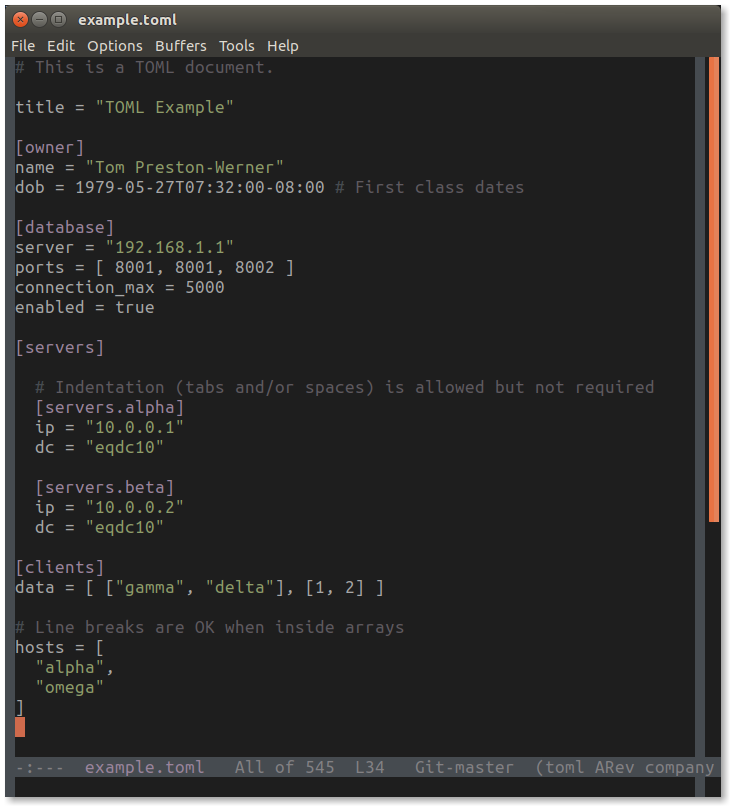
Also note that most decent editors have proper [TOML](https://toml.io/en/) support
which makes editing and previewing a breeze:
### Installation
Installation from source requires a C++17 compiler, and `g++` versions 8 and onward should suffice.
#### From CRAN
The package is on [CRAN](https://cran.r-project.org) and can be installed
from every mirror via
```{.r}
install.packages("RcppTOML")
```
#### From the ghrr-drat
Development releases may be provided by the
[ghrr](https://ghrr.github.io/drat/) repository which can accessed via
```{.r}
## if needed, first do: install.packages("drat")
drat::addRepo("ghrr")
```
after which `install.packages("RcppTOML)` which access this repo.
Alternatively, set the repo information on the fly as _e.g._ in
```r
repos <- c("https://ghrr.github.io/drat", "https://cloud.r-project.org")
install.packages("RcppTOML", repos=repos)
```
which points to the [ghrr](https://ghrr.github.io/drat/) repository as well as a standard CRAN
mirror, but just for the length of this installation step.
### Status
Earlier versions relied upon [cpptoml](https://github.com/skystrife/cpptoml) and were feature-complete with
[TOML v0.5.0](https://toml.io/en/v0.5.0) (see the
[tests/](https://github.com/eddelbuettel/rcpptoml/tree/master/tests) directory). They already parsed
everything that the underlying [cpptoml](https://github.com/skystrife/cpptoml) parsed with the same
(sole) exception of unicode escape characters in strings.
Since switching to [toml++](https://github.com/marzer/tomlplusplus) the package takes advantage of its comprehensive TOML v1.0.0 support and should now be fully 1.0.0 compliant. Some new tests were added to demonstrate this.
As [toml++](https://github.com/marzer/tomlplusplus) also offers export to JSON and YAML as well as
TOML writing, we may add support to some of these features going forward.
### Continued Testing
As we rely on the [tinytest](https://cran.r-project.org/package=tinytest) package, the
already-installed package can also be verified via
```r
tinytest::test_package("RcppTOML")
```
at any point in time.
### Author
Dirk Eddelbuettel
### License
GPL (>= 2)
|
