1
2
3
4
5
6
7
8
9
10
11
12
13
14
15
16
17
18
19
20
21
22
23
24
25
26
27
28
29
30
31
32
33
34
35
36
37
38
39
40
41
42
43
44
45
46
47
48
49
50
51
52
53
54
55
56
57
58
59
60
61
62
63
64
65
66
67
68
69
70
71
72
73
74
75
76
77
78
79
80
81
82
83
84
85
86
87
88
89
90
91
92
93
94
95
96
97
98
99
100
101
102
103
104
105
106
107
108
109
110
111
112
113
114
115
116
117
118
119
120
121
122
123
124
125
126
127
128
129
130
131
132
133
134
135
136
137
138
139
140
141
142
143
144
145
146
147
148
149
150
151
152
153
154
155
156
157
158
159
160
161
162
163
164
165
166
167
168
169
170
171
172
173
174
175
176
177
178
179
180
181
182
183
184
185
186
187
188
189
190
191
192
193
194
195
196
197
198
199
200
201
202
203
204
205
206
207
208
209
210
211
212
213
214
215
216
217
218
219
220
221
222
223
224
225
226
227
228
229
230
231
232
233
234
235
236
237
238
239
240
241
242
243
244
245
246
247
248
249
250
251
252
253
254
255
256
257
258
259
260
261
262
263
264
265
266
267
268
269
270
271
272
273
274
275
276
277
278
279
280
281
282
283
284
285
286
287
288
289
290
291
292
293
294
295
296
297
298
299
300
301
302
303
304
305
306
307
308
309
310
311
312
313
314
315
316
317
318
319
320
321
322
323
324
325
326
327
328
329
330
331
332
333
334
335
336
337
338
339
340
341
342
343
344
345
346
347
348
349
350
351
352
353
354
355
356
357
358
359
360
361
362
363
364
365
366
367
368
369
370
371
372
373
374
375
376
377
378
379
380
381
382
383
384
385
386
387
388
389
390
391
392
393
394
395
396
397
398
399
400
401
402
403
404
405
406
407
408
409
410
411
412
413
414
415
416
417
418
419
420
421
422
423
424
425
426
427
428
429
430
431
432
433
434
435
436
437
438
439
440
441
442
443
444
445
446
447
448
449
450
451
452
453
454
455
456
457
458
459
460
461
462
463
464
465
466
467
468
469
470
471
472
473
474
475
476
477
478
479
480
481
482
483
484
485
486
487
488
489
490
491
492
493
494
495
496
497
498
499
500
501
502
503
504
505
506
507
508
509
510
511
512
513
514
515
516
517
518
519
520
521
522
523
524
525
526
527
528
529
530
531
532
533
534
535
536
537
538
539
540
541
542
543
544
545
546
547
548
549
550
551
552
553
554
555
556
557
558
559
560
561
562
563
564
565
566
567
568
569
570
571
572
573
574
575
576
577
578
579
580
581
582
583
584
585
586
587
588
589
590
591
592
593
594
595
596
597
598
599
600
601
602
603
604
605
606
607
608
609
610
611
612
613
614
615
616
617
618
619
620
621
622
623
624
625
626
627
628
629
630
631
632
633
634
635
636
637
638
639
640
641
642
643
644
645
646
647
648
649
650
651
652
653
654
655
656
657
658
659
660
661
662
663
664
665
666
667
668
669
670
671
672
673
674
675
676
677
678
679
680
681
682
683
684
685
686
687
688
689
690
691
692
693
694
695
696
697
698
699
700
701
702
703
704
705
706
707
708
709
710
711
712
713
714
715
716
717
718
719
720
721
722
723
724
725
726
727
728
729
730
731
732
733
734
735
736
737
738
739
740
741
742
743
744
745
746
747
748
749
750
751
752
753
754
755
756
757
758
759
760
761
762
763
764
765
766
767
768
769
770
771
772
773
774
775
776
777
778
779
780
781
782
783
784
785
786
787
788
789
790
791
792
793
794
795
796
797
798
799
800
801
802
803
804
805
806
807
808
809
810
811
812
813
814
815
816
817
818
819
820
821
822
823
824
825
826
827
828
829
830
831
832
833
834
835
836
837
838
839
840
841
842
843
844
845
846
847
848
849
850
851
852
853
854
855
856
857
858
859
860
861
862
863
864
865
866
867
868
869
870
871
872
873
874
875
876
877
878
879
880
881
882
883
884
885
886
887
888
889
890
891
892
893
894
895
896
897
898
899
900
901
902
903
904
905
906
907
908
909
910
911
912
913
914
915
916
917
918
919
920
921
922
923
924
925
926
927
928
929
930
931
932
933
934
935
936
937
938
939
940
941
942
943
944
945
946
947
948
949
950
951
952
953
954
955
956
957
958
959
960
961
962
963
964
965
966
967
968
969
970
971
972
973
974
975
976
977
978
979
980
981
982
983
984
985
986
987
988
989
990
991
992
993
994
995
996
997
998
999
1000
1001
1002
1003
1004
1005
1006
1007
1008
1009
1010
1011
1012
1013
1014
1015
1016
1017
1018
1019
1020
1021
1022
1023
1024
1025
1026
1027
1028
1029
1030
1031
1032
1033
1034
1035
1036
1037
1038
1039
1040
1041
1042
1043
1044
1045
1046
1047
1048
1049
1050
1051
1052
1053
1054
1055
1056
1057
1058
1059
1060
1061
1062
1063
1064
1065
1066
1067
1068
1069
1070
1071
1072
1073
1074
1075
1076
1077
1078
1079
1080
1081
1082
1083
1084
1085
1086
1087
1088
1089
1090
1091
1092
1093
1094
1095
1096
1097
1098
1099
1100
1101
1102
1103
1104
1105
1106
1107
1108
1109
1110
1111
1112
1113
1114
1115
1116
1117
1118
1119
1120
1121
1122
1123
1124
1125
1126
1127
1128
1129
1130
1131
1132
1133
1134
1135
1136
1137
1138
1139
1140
1141
1142
1143
1144
1145
1146
1147
1148
1149
1150
1151
1152
1153
1154
1155
1156
1157
1158
1159
1160
1161
1162
1163
1164
1165
1166
1167
1168
1169
1170
1171
1172
1173
1174
1175
1176
1177
1178
1179
1180
1181
1182
1183
1184
1185
1186
1187
1188
1189
1190
1191
1192
1193
1194
1195
1196
1197
1198
1199
1200
1201
1202
1203
1204
1205
1206
1207
1208
1209
1210
1211
1212
1213
1214
1215
1216
1217
1218
1219
1220
1221
1222
1223
1224
1225
1226
1227
1228
|
---
title: "Working with RabbitMQ exchanges and publishing messages from Ruby with Bunny"
layout: article
---
## About this guide
This guide covers the use of exchanges according to the AMQP 0.9.1
specification, including broader topics related to message publishing,
common usage scenarios and how to accomplish typical operations using
Bunny.
This work is licensed under a <a rel="license"
href="http://creativecommons.org/licenses/by/3.0/">Creative Commons
Attribution 3.0 Unported License</a> (including images and
stylesheets). The source is available [on
GitHub](https://github.com/ruby-amqp/rubybunny.info).
## What version of Bunny does this guide cover?
This guide covers Bunny 2.11.0 and later versions.
## Exchanges in AMQP 0.9.1 — Overview
### What are AMQP exchanges?
An *exchange* accepts messages from a producer application and routes
them to message queues. They can be thought of as the "mailboxes" of
the AMQP world. Unlike some other messaging middleware products and
protocols, in AMQP, messages are *not* published directly to queues.
Messages are published to exchanges that route them to queue(s) using
pre-arranged criteria called *bindings*.
There are multiple exchange types in the AMQP 0.9.1 specification,
each with its own routing semantics. Custom exchange types can be
created to deal with sophisticated routing scenarios (e.g. routing
based on geolocation data or edge cases) or just for convenience.
### Concept of Bindings
A *binding* is an association between a queue and an exchange. A queue
must be bound to at least one exchange in order to receive messages
from publishers. Learn more about bindings in the [Bindings
guide](/articles/bindings.html).
### Exchange attributes
Exchanges have several attributes associated with them:
* Name
* Type (direct, fanout, topic, headers or some custom type)
* Durability
* Whether the exchange is auto-deleted when no longer used
* Other metadata (sometimes known as *X-arguments*)
## Exchange types
There are four built-in exchange types in AMQP v0.9.1:
* Direct
* Fanout
* Topic
* Headers
As stated previously, each exchange type has its own routing semantics
and new exchange types can be added by extending brokers with
plugins. Custom exchange types begin with "x-", much like custom HTTP
headers, e.g. [x-consistent-hash
exchange](https://github.com/rabbitmq/rabbitmq-consistent-hash-exchange)
or [x-random exchange](https://github.com/jbrisbin/random-exchange).
## Message attributes
Before we start looking at various exchange types and their routing
semantics, we need to introduce message attributes. Every AMQP message
has a number of *attributes*. Some attributes are important and used
very often, others are rarely used. AMQP message attributes are
metadata and are similar in purpose to HTTP request and response
headers.
Every AMQP 0.9.1 message has an attribute called *routing key*. The
routing key is an "address" that the exchange may use to decide how to
route the message. This is similar to, but more generic than, a URL in
HTTP. Most exchange types use the routing key to implement routing
logic, but some ignore it and use other criteria (e.g. message
content).
## Fanout exchanges
### How fanout exchanges route messages
A fanout exchange routes messages to all of the queues that are bound
to it and the routing key is ignored. If N queues are bound to a
fanout exchange, when a new message is published to that exchange a
*copy of the message* is delivered to all N queues. Fanout exchanges
are ideal for the [broadcast
routing](http://en.wikipedia.org/wiki/Broadcasting_%28computing%29) of
messages.
Graphically this can be represented as:

### Declaring a fanout exchange
There are two ways to declare a fanout exchange:
* Using the `Bunny::Channel#fanout` method
* Instantiate `Bunny::Exchange` directly
Here are two examples to demonstrate:
``` ruby
require "bunny"
conn = Bunny.new
conn.start
ch = conn.create_channel
x = ch.fanout("activity.events")
```
``` ruby
require "bunny"
conn = Bunny.new
conn.start
ch = conn.create_channel
x = Bunny::Exchange.new(ch, :fanout, "activity.events")
```
### Fanout routing example
To demonstrate fanout routing behavior we can declare ten server-named
exclusive queues, bind them all to one fanout exchange and then
publish a message to the exchange:
``` ruby
#!/usr/bin/env ruby
# encoding: utf-8
require "rubygems"
require "bunny"
puts "=> Fanout exchange routing"
puts
conn = Bunny.new
conn.start
ch = conn.create_channel
x = ch.fanout("examples.pings")
10.times do |i|
q = ch.queue("", :auto_delete => true).bind(x)
q.subscribe do |delivery_info, properties, payload|
puts "[consumer] #{q.name} received a message: #{payload}"
end
end
x.publish("Ping")
sleep 0.5
x.delete
puts "Disconnecting..."
conn.close
```
When run, this example produces the following output:
<pre>
=> Fanout exchange routing
[consumer] amq.gen-A8z-tj-n_0U39GdPGncV-A received a message: Ping
[consumer] amq.gen-jht-OtRwdD8LuHMxrA5SNQ received a message: Ping
[consumer] amq.gen-LQTh8IdojOCrvOnEuFog8w received a message: Ping
[consumer] amq.gen-PV-Dg8_gSvLO9eK6le6wwQ received a message: Ping
[consumer] amq.gen-ofAMc3FXRZIj3O55fXDSwA received a message: Ping
[consumer] amq.gen-TXJiZEjwZ0squ12_Z9mP0A received a message: Ping
[consumer] amq.gen-XQjh2xrC9khbMZMg_0Zzfw received a message: Ping
[consumer] amq.gen-XVSKsdWwhyxRiJn-jAFEGg received a message: Ping
[consumer] amq.gen-ZaY2pD_9NaOICxAMWPoIYw received a message: Ping
[consumer] amq.gen-oElfvP_crgASWkk6EhrJLA received a message: Ping
Disconnecting...
</pre>
Each of the queues bound to the exchange receives a *copy* of the
message.
### Fanout use cases
Because a fanout exchange delivers a copy of a message to every queue bound to it, its use cases are quite similar:
* Massively multiplayer online (MMO) games can use it for leaderboard updates or other global events
* Sport news sites can use fanout exchanges for distributing score updates to mobile clients in near real-time
* Distributed systems can broadcast various state and configuration updates
* Group chats can distribute messages between participants using a fanout exchange (although AMQP does not have a built-in concept of presence, so [XMPP](http://xmpp.org) may be a better choice)
### Pre-declared fanout exchanges
AMQP 0.9.1 brokers must implement a fanout exchange type and
pre-declare one instance with the name of `"amq.fanout"`.
Applications can rely on that exchange always being available to
them. Each vhost has a separate instance of that exchange, it is *not
shared across vhosts* for obvious reasons.
## Direct exchanges
### How direct exchanges route messages
A direct exchange delivers messages to queues based on a *message
routing key*, an attribute that every AMQP v0.9.1 message contains.
Here is how it works:
* A queue binds to the exchange with a routing key K
* When a new message with routing key R arrives at the direct exchange, the exchange routes it to the queue if K = R
A direct exchange is ideal for the [unicast
routing](http://en.wikipedia.org/wiki/Unicast) of messages (although
they can be used for [multicast
routing](http://en.wikipedia.org/wiki/Multicast) as well).
Here is a graphical representation:

### Declaring a direct exchange
* Using the `Bunny::Channel#direct` method
* Instantiate `Bunny::Exchange` directly
Here are two examples to demonstrate:
``` ruby
require "bunny"
conn = Bunny.new
conn.start
ch = conn.create_channel
x = ch.direct("imaging")
```
``` ruby
require "bunny"
conn = Bunny.new
conn.start
ch = conn.create_channel
x = Bunny::Exchange.new(ch, :direct, "imaging")
```
### Direct routing example
Since direct exchanges use the *message routing key* for routing,
message producers need to specify it:
``` ruby
#!/usr/bin/env ruby
# encoding: utf-8
require "rubygems"
require "bunny"
puts "=> Direct exchange routing"
puts
conn = Bunny.new
conn.start
ch = conn.create_channel
x = ch.direct("examples.imaging")
q1 = ch.queue("", :auto_delete => true).bind(x, :routing_key => "resize")
q1.subscribe do |delivery_info, properties, payload|
puts "[consumer] #{q1.name} received a 'resize' message"
end
q2 = ch.queue("", :auto_delete => true).bind(x, :routing_key => "watermark")
q2.subscribe do |delivery_info, properties, payload|
puts "[consumer] #{q2.name} received a 'watermark' message"
end
# just an example
data = rand.to_s
x.publish(data, :routing_key => "resize")
x.publish(data, :routing_key => "watermark")
sleep 0.5
x.delete
q1.delete
q2.delete
puts "Disconnecting..."
conn.close
```
The routing key will then be compared for equality with routing keys
on bindings, and consumers that subscribed with the same routing key
each get a copy of the message.
Output for the example looks like this:
```
=> Direct exchange routing
[consumer] amq.gen-8XIeaBCmykwnJUtHVEkT5Q received a 'resize' message
[consumer] amq.gen-Zht5YW3_MhK-YBLZouxp5Q received a 'watermark' message
Disconnecting...
```
### Direct Exchanges and Load Balancing of Messages
Direct exchanges are often used to distribute tasks between multiple
workers (instances of the same application) in a round robin manner.
When doing so, it is important to understand that, in AMQP 0.9.1,
*messages are load balanced between consumers and not between queues*.
The [Queues and Consumers](/articles/queues.html) guide provides more
information on this subject.
### Pre-declared direct exchanges
AMQP 0.9.1 brokers must implement a direct exchange type and
pre-declare two instances:
* `amq.direct`
* *""* exchange known as *default exchange* (unnamed, referred to as an empty string by many clients including Bunny)
Applications can rely on those exchanges always being available to
them. Each vhost has separate instances of those exchanges, they are
*not shared across vhosts* for obvious reasons.
### Default exchange
The default exchange is a direct exchange with no name (Bunny refers
to it using an empty string) pre-declared by the broker. It has one
special property that makes it very useful for smaller applications,
namely that *every queue is automatically bound to it with a routing
key which is the same as the queue name*.
For example, when you declare a queue with the name of
"search.indexing.online", RabbitMQ will bind it to the default
exchange using "search.indexing.online" as the routing key. Therefore
a message published to the default exchange with routing key =
"search.indexing.online" will be routed to the queue
"search.indexing.online". In other words, the default exchange makes
it *seem like it is possible to deliver messages directly to queues*,
even though that is not technically what is happening.
The default exchange is used by the "Hello, World" example:
``` ruby
#!/usr/bin/env ruby
# encoding: utf-8
require "rubygems"
require "bunny"
conn = Bunny.new
conn.start
ch = conn.create_channel
q = ch.queue("bunny.examples.hello_world", :auto_delete => true)
q.subscribe do |delivery_info, properties, payload|
puts "Received #{payload}"
end
q.publish("Hello!", :routing_key => q.name)
sleep 1.0
conn.close
```
### Direct Exchange Use Cases
Direct exchanges can be used in a wide variety of cases:
* Direct (near real-time) messages to individual players in an MMO game
* Delivering notifications to specific geographic locations (for example, points of sale)
* Distributing tasks between multiple instances of the same application all having the same function, for example, image processors
* Passing data between workflow steps, each having an identifier (also consider using headers exchange)
* Delivering notifications to individual software services in the network
## Topic Exchanges
### How Topic Exchanges Route Messages
Topic exchanges route messages to one or many queues based on matching
between a message routing key and the pattern that was used to bind a
queue to an exchange. The topic exchange type is often used to
implement various [publish/subscribe
pattern](http://en.wikipedia.org/wiki/Publish/subscribe) variations.
Topic exchanges are commonly used for the [multicast
routing](http://en.wikipedia.org/wiki/Multicast) of messages.
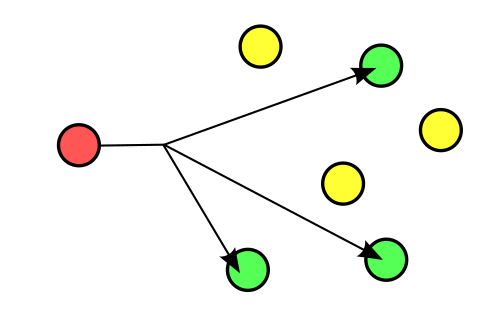
Topic exchanges can be used for [broadcast
routing](http://en.wikipedia.org/wiki/Broadcasting_%28computing%29),
but fanout exchanges are usually more efficient for this use case.
### Topic Exchange Routing Example
Two classic examples of topic-based routing are stock price updates
and location-specific data (for instance, weather
broadcasts). Consumers indicate which topics they are interested in
(think of it like subscribing to a feed for an individual tag of your
favourite blog as opposed to the full feed). The routing is enabled by
specifying a *routing pattern* to the `Bunny::Queue#bind` method, for
example:
``` ruby
x = ch.topic("weather", :auto_delete => true)
q = ch.queue("americas.south", :auto_delete => true).bind(x, :routing_key => "americas.south.#")
q.subscribe do |delivery_info, properties, payload|
puts "An update for South America: #{payload}, routing key is #{delivery_info.routing_key}"
end
```
In the example above we bind a queue with the name of "americas.south" to the topic exchange declared earlier using the `Bunny::Queue#bind` method. This means that
only messages with a routing key matching "americas.south.#" will be routed to the "americas.south" queue.
A routing pattern consists of several words separated by dots, in a
similar way to URI path segments being joined by slash. A few of
examples:
* asia.southeast.thailand.bangkok
* sports.basketball
* usa.nasdaq.aapl
* tasks.search.indexing.accounts
The following routing keys match the "americas.south.#" pattern:
* americas.south
* americas.south.*brazil*
* americas.south.*brazil.saopaulo*
* americas.south.*chile.santiago*
In other words, the "#" part of the pattern matches 0 or more words.
For the pattern "americas.south.*", some matching routing keys are:
* americas.south.*brazil*
* americas.south.*chile*
* americas.south.*peru*
but not
* americas.south
* americas.south.chile.santiago
As you can see, the "*" part of the pattern matches 1 word only.
Full example:
``` ruby
#!/usr/bin/env ruby
# encoding: utf-8
require "rubygems"
require "bunny"
connection = Bunny.new
connection.start
channel = connection.create_channel
# topic exchange name can be any string
exchange = channel.topic("weather", :auto_delete => true)
# Subscribers.
channel.queue("americas.north").bind(exchange, :routing_key => "americas.north.#").subscribe do |delivery_info, properties, payload|
puts "An update for North America: #{payload}, routing key is #{delivery_info.routing_key}"
end
channel.queue("americas.south").bind(exchange, :routing_key => "americas.south.#").subscribe do |delivery_info, properties, payload|
puts "An update for South America: #{payload}, routing key is #{delivery_info.routing_key}"
end
channel.queue("us.california").bind(exchange, :routing_key => "americas.north.us.ca.*").subscribe do |delivery_info, properties, payload|
puts "An update for US/California: #{payload}, routing key is #{delivery_info.routing_key}"
end
channel.queue("us.tx.austin").bind(exchange, :routing_key => "#.tx.austin").subscribe do |delivery_info, properties, payload|
puts "An update for Austin, TX: #{payload}, routing key is #{delivery_info.routing_key}"
end
channel.queue("it.rome").bind(exchange, :routing_key => "europe.italy.rome").subscribe do |delivery_info, properties, payload|
puts "An update for Rome, Italy: #{payload}, routing key is #{delivery_info.routing_key}"
end
channel.queue("asia.hk").bind(exchange, :routing_key => "asia.southeast.hk.#").subscribe do |delivery_info, properties, payload|
puts "An update for Hong Kong: #{payload}, routing key is #{delivery_info.routing_key}"
end
exchange.publish("San Diego update", :routing_key => "americas.north.us.ca.sandiego").
publish("Berkeley update", :routing_key => "americas.north.us.ca.berkeley").
publish("San Francisco update", :routing_key => "americas.north.us.ca.sanfrancisco").
publish("New York update", :routing_key => "americas.north.us.ny.newyork").
publish("São Paulo update", :routing_key => "americas.south.brazil.saopaulo").
publish("Hong Kong update", :routing_key => "asia.southeast.hk.hongkong").
publish("Kyoto update", :routing_key => "asia.southeast.japan.kyoto").
publish("Shanghai update", :routing_key => "asia.southeast.prc.shanghai").
publish("Rome update", :routing_key => "europe.italy.roma").
publish("Paris update", :routing_key => "europe.france.paris")
sleep 1.0
connection.close
```
### Topic Exchange Use Cases
Topic exchanges have a very broad set of use cases. Whenever a problem
involves multiple consumers/applications that selectively choose which
type of messages they want to receive, the use of topic exchanges
should be considered. To name a few examples:
* Distributing data relevant to specific geographic location, for example, points of sale
* Background task processing done by multiple workers, each capable of handling specific set of tasks
* Stocks price updates (and updates on other kinds of financial data)
* News updates that involve categorization or tagging (for example, only for a particular sport or team)
* Orchestration of services of different kinds in the cloud
* Distributed architecture/OS-specific software builds or packaging where each builder can handle only one architecture or OS
## Declaring/Instantiating Exchanges
With Bunny, exchanges can be declared in two ways: by instantiating
`Bunny::Exchange` or by using a number of convenience methods on
`Bunny::Channel`:
* `Bunny::Channel#default_exchange`
* `Bunny::Channel#direct`
* `Bunny::Channel#topic`
* `Bunny::Channel#fanout`
* `Bunny::Channel#headers`
The previous sections on specific exchange types (direct, fanout,
headers, etc.) provide plenty of examples of how these methods can be
used.
## Checking if an Exchange Exists
Sometimes it's convenient to check if an exchange exists. To do so, at the protocol
level you use `exchange.declare` with `passive` seto to `true`. In response
RabbitMQ responds with a channel exception if the exchange does not exist.
Bunny provides a convenience method, `Bunny::Session#exchange_exists?`, to do this:
``` ruby
conn = Bunny.new
conn.start
conn.exchange_exists?("logs")
```
## Publishing messages
To publish a message to an exchange, use `Bunny::Exchange#publish`:
``` ruby
x.publish("some data")
```
The method accepts message body and a number of message and delivery metadata options. Routing key can be blank (`""`) but never `nil`.
The body needs to be a string. The message payload is completely opaque to the library and is not modified by Bunny or RabbitMQ in any way.
### Data serialization
You are encouraged to take care of data serialization before publishing (i.e. by using JSON, Thrift, Protocol Buffers or some other serialization library).
Note that because AMQP is a binary protocol, text formats like JSON largely lose their advantage of being easy to inspect as data travels across the network,
so if bandwidth efficiency is important, consider using [MessagePack](http://msgpack.org/) or [Protocol Buffers](http://code.google.com/p/protobuf/).
A few popular options for data serialization are:
* JSON: [json gem](https://rubygems.org/gems/json) (part of standard Ruby library on Ruby 1.9) or [yajl-ruby](https://rubygems.org/gems/yajl-ruby) (Ruby bindings to YAJL)
* BSON: [bson gem](https://rubygems.org/gems/bson) for JRuby (implemented as a Java extension) or [bson_ext](https://rubygems.org/bson_ext) for C-based Rubies
* [Message Pack](http://msgpack.org) has Ruby bindings and provides a Java implementation for JRuby
* XML: [Nokogiri](https://nokogiri.org) is a swiss army knife for XML processing with Ruby, built on top of libxml2
* Protocol Buffers: [beefcake](https://github.com/bmizerany/beefcake)
### Message metadata
RabbitMQ messages have various metadata attributes that can be set
when a message is published. Some of the attributes are well-known and
mentioned in the AMQP 0.9.1 specification, others are specific to a
particular application. Well-known attributes are listed here as
options that `Bunny::Exchange#publish` takes:
* `:persistent`
* `:mandatory`
* `:timestamp`
* `:expiration`
* `:type`
* `:reply_to`
* `:content_type`
* `:content_encoding`
* `:correlation_id`
* `:priority`
* `:message_id`
* `:user_id`
* `:app_id`
All other attributes can be added to a *headers table* (in Ruby, a
hash) that `Bunny::Exchange#publish` accepts as the `:headers` option.
An example:
``` ruby
# or Process.clock_gettime(Process::CLOCK_MONOTONIC) if using a monotonic clock is important
now = Time.now
x.publish("hello",
:routing_key => queue_name,
:app_id => "bunny.example",
:priority => 8,
:type => "kinda.checkin",
# headers table keys can be anything
:headers => {
:coordinates => {
:latitude => 59.35,
:longitude => 18.066667
},
:time => now,
:participants => 11,
:venue => "Stockholm",
:true_field => true,
:false_field => false,
:nil_field => nil,
:ary_field => ["one", 2.0, 3, [{"abc" => 123}]]
},
:timestamp => now.to_i,
:reply_to => "a.sender",
:correlation_id => "r-1",
:message_id => "m-1")
```
<dl>
<dt>:routing_key</dt>
<dd>Used for routing messages depending on the exchange type and configuration.</dd>
<dt>:persistent</dt>
<dd>When set to true, RabbitMQ will persist message to disk.</dd>
<dt>:mandatory</dt>
<dd>
This flag tells the server how to react if the message cannot be routed to a queue. If this flag is set to true, the server will return an unroutable message
to the producer with a `basic.return` AMQP method. If this flag is set to false, the server silently drops the message.
</dd>
<dt>:content_type</dt>
<dd>MIME content type of message payload. Has the same purpose/semantics as HTTP Content-Type header.</dd>
<dt>:content_encoding</dt>
<dd>MIME content encoding of message payload. Has the same purpose/semantics as HTTP Content-Encoding header.</dd>
<dt>:priority</dt>
<dd>Message priority, from 0 to 9.</dd>
<dt>:message_id</dt>
<dd>
Message identifier as a string. If applications need to identify messages, it is recommended that they use this attribute instead of putting it
into the message payload.
</dd>
<dt>:reply_to</dt>
<dd>
Commonly used to name a reply queue (or any other identifier that helps a consumer application to direct its response).
Applications are encouraged to use this attribute instead of putting this information into the message payload.
</dd>
<dt>:correlation_id</dt>
<dd>
ID of the message that this message is a reply to. Applications are encouraged to use this attribute instead of putting this information
into the message payload.
</dd>
<dt>:type</dt>
<dd>Message type as a string. Recommended to be used by applications instead of including this information into the message payload.</dd>
<dt>:user_id</dt>
<dd>
Sender's identifier. Note that RabbitMQ will check that the <a href="http://www.rabbitmq.com/validated-user-id.html">value of this attribute is the same as username AMQP connection was authenticated with</a>, it SHOULD NOT be used to transfer, for example, other application user ids or be used as a basis for some kind of Single Sign-On solution.
</dd>
<dt>:app_id</dt>
<dd>Application identifier string, for example, "eventoverse" or "webcrawler"</dd>
<dt>:timestamp</dt>
<dd>Timestamp of the moment when message was sent, in seconds since the Epoch</dd>
<dt>:expiration</dt>
<dd>Message expiration specification as a string</dd>
<dt>:arguments</dt>
<dd>A map of any additional attributes that the application needs. Nested hashes are supported. Keys must be strings.</dd>
</dl>
It is recommended that application authors use well-known message
attributes when applicable instead of relying on custom headers or
placing information in the message body. For example, if your
application messages have priority, publishing timestamp, type and
content type, you should use the respective AMQP message attributes
instead of reinventing the wheel.
### Validated User ID
In some scenarios it is useful for consumers to be able to know the
identity of the user who published a message. RabbitMQ implements a
feature known as [validated User
ID](http://www.rabbitmq.com/extensions.html#validated-user-id). If
this property is set by a publisher, its value must be the same as the
name of the user used to open the connection. If the user-id property
is not set, the publisher's identity is not validated and remains
private.
### Publishing Callbacks and Reliable Delivery in Distributed Environments
A commonly asked question about RabbitMQ clients is "how to execute a
piece of code after a message is received".
Message publishing with Bunny happens in several steps:
* `Bunny::Exchange#publish` takes a payload and various metadata attributes
* Resulting payload is staged for writing
* On the next event loop tick, data is transferred to the OS kernel using one of the underlying NIO APIs
* OS kernel buffers data before sending it
* Network driver may also employ buffering
<div class="alert alert-error"> As you can see, "when data is sent" is
a complicated issue and while methods to flush buffers exist, flushing
buffers does not guarantee that the data was received by the broker
because it might have crashed while data was travelling down the wire.
The only way to reliably know whether data was received by the broker or a peer application is to use message acknowledgements. This is how TCP works and this
approach is proven to work at the enormous scale of the modern Internet. AMQP 0.9.1 fully embraces this fact and Bunny follows.
</div>
In cases when you cannot afford to lose a single message, AMQP 0.9.1
applications can use one (or a combination of) the following protocol
features:
* Publisher confirms (a RabbitMQ-specific extension to AMQP 0.9.1)
* Publishing messages as mandatory
* Transactions (these introduce noticeable overhead and have a relatively narrow set of use cases)
A more detailed overview of the pros and cons of each option can be
found in a [blog post that introduces Publisher Confirms
extension](http://bit.ly/rabbitmq-publisher-confirms) by the RabbitMQ
team. The next sections of this guide will describe how the features
above can be used with Bunny.
### Publishing messages as mandatory
When publishing messages, it is possible to use the `:mandatory`
option to publish a message as "mandatory". When a mandatory message
cannot be *routed* to any queue (for example, there are no bindings or
none of the bindings match), the message is returned to the producer.
The following code example demonstrates a message that is published as
mandatory but cannot be routed (no bindings) and thus is returned back
to the producer:
``` ruby
#!/usr/bin/env ruby
# encoding: utf-8
require "rubygems"
require "bunny"
puts "=> Publishing messages as mandatory"
puts
conn = Bunny.new
conn.start
ch = conn.create_channel
x = ch.default_exchange
x.on_return do |return_info, properties, content|
puts "Got a returned message: #{content}"
end
q = ch.queue("", :exclusive => true)
q.subscribe do |delivery_info, properties, content|
puts "Consumed a message: #{content}"
end
x.publish("This will NOT be returned", :mandatory => true, :routing_key => q.name)
x.publish("This will be returned", :mandatory => true, :routing_key => "akjhdfkjsh#{rand}")
sleep 0.5
puts "Disconnecting..."
conn.close
```
### Returned messages
When a message is returned, the application that produced it can
handle that message in different ways:
* Store it for later redelivery in a persistent store
* Publish it to a different destination
* Log the event and discard the message
Returned messages contain information about the exchange they were
published to. Bunny associates returned message callbacks with
consumers. To handle returned messages, use
`Bunny::Exchange#on_return`:
``` ruby
#!/usr/bin/env ruby
# encoding: utf-8
require "rubygems"
require "bunny"
puts "=> Publishing messages as mandatory"
puts
conn = Bunny.new
conn.start
ch = conn.create_channel
x = ch.default_exchange
x.on_return do |return_info, properties, content|
puts "Got a returned message: #{content}"
end
q = ch.queue("", :exclusive => true)
q.subscribe do |delivery_info, properties, content|
puts "Consumed a message: #{content}"
end
x.publish("This will NOT be returned", :mandatory => true, :routing_key => q.name)
x.publish("This will be returned", :mandatory => true, :routing_key => "akjhdfkjsh#{rand}")
sleep 0.5
puts "Disconnecting..."
conn.close
```
A returned message handler has access to AMQP method (`basic.return`)
information, message metadata and payload (as a byte array). The
metadata and message body are returned without modifications so that
the application can store the message for later redelivery.
### Publishing Persistent Messages
Messages potentially spend some time in the queues to which they were
routed before they are consumed. During this period of time, the
broker may crash or experience a restart. To survive it, messages
must be persisted to disk. This has a negative effect on performance,
especially with network attached storage like NAS devices and Amazon
EBS. AMQP 0.9.1 lets applications trade off performance for
durability, or vice versa, on a message-by-message basis.
To publish a persistent message, use the `:persistent` option that
`Bunny::Exchange#publish` accepts:
``` ruby
x.publish(data, :persistent => true)
```
**Note** that in order to survive a broker crash, the messages MUST be persistent and the queue that they were routed to MUST be durable.
[Durability and Message Persistence](/articles/durability.html) provides more information on the subject.
### Message Priority
Starting with RabbitMQ 3.5, queues can be [instructed to support
message priorities](https://www.rabbitmq.com/priority.html).
To specify a priority on a message, pass the `:priority` key to
`Bunny::Exchange#publish`. Note that priority queues have certain
[limitations listed in the RabbitMQ documentation](https://www.rabbitmq.com/priority.html).
### Publishing In Multi-threaded Environments
<div class="alert alert-error">
When using Bunny in multi-threaded
environments, the rule of thumb is: avoid sharing channels across
threads.
</div>
In other words, publishers in your application that publish from
separate threads should use their own channels. The same is a good
idea for consumers.
## Headers exchanges
Now that message attributes and publishing have been introduced, it is
time to take a look at one more core exchange type in AMQP 0.9.1. It
is called the *headers exchange type* and is quite powerful.
### How headers exchanges route messages
#### An Example Problem Definition
The best way to explain headers-based routing is with an
example. Imagine a distributed [continuous
integration](http://martinfowler.com/articles/continuousIntegration.html)
system that distributes builds across multiple machines with different
hardware architectures (x86, IA-64, AMD64, ARM family and so on) and
operating systems. It strives to provide a way for a community to
contribute machines to run tests on and a nice build matrix like [the
one WebKit uses](http://build.webkit.org/waterfall?category=core).
One key problem such systems face is build distribution. It would be
nice if a messaging broker could figure out which machine has which
OS, architecture or combination of the two and route build request
messages accordingly.
A headers exchange is designed to help in situations like this by
routing on multiple attributes that are more easily expressed as
message metadata attributes (headers) rather than a routing key
string.
#### Routing on Multiple Message Attributes
Headers exchanges route messages based on message header
matching. Headers exchanges ignore the routing key attribute. Instead,
the attributes used for routing are taken from the "headers"
attribute. When a queue is bound to a headers exchange, the
`:arguments` attribute is used to define matching rules:
``` ruby
q = ch.queue("hosts.ip-172-37-11-56")
x = ch.headers("requests")
q.bind(x, :arguments => {"os" => "linux"})
```
When matching on one header, a message is considered matching if the
value of the header equals the value specified upon binding. An
example that demonstrates headers routing:
``` ruby
#!/usr/bin/env ruby
# encoding: utf-8
require "rubygems"
require "bunny"
puts "=> Headers exchange routing"
puts
conn = Bunny.new
conn.start
ch = conn.create_channel
x = ch.headers("headers")
q1 = ch.queue("", :exclusive => true).bind(x, :arguments => {"os" => "linux", "cores" => 8, "x-match" => "all"})
q2 = ch.queue("", :exclusive => true).bind(x, :arguments => {"os" => "osx", "cores" => 4, "x-match" => "any"})
q1.subscribe do |delivery_info, properties, content|
puts "#{q1.name} received #{content}"
end
q2.subscribe do |delivery_info, properties, content|
puts "#{q2.name} received #{content}"
end
x.publish("8 cores/Linux", :headers => {"os" => "linux", "cores" => 8})
x.publish("8 cores/OS X", :headers => {"os" => "osx", "cores" => 8})
x.publish("4 cores/Linux", :headers => {"os" => "linux", "cores" => 4})
sleep 0.5
conn.close
```
When executed, it outputs
```
=> Headers exchange routing
amq.gen-xhIzykDAjfcC4orMsi0O6Q received 8 cores/Linux
amq.gen-6O1oKjVd8QbKr7zyy7ssbg received 8 cores/OS X
amq.gen-6O1oKjVd8QbKr7zyy7ssbg received 4 cores/Linux
```
#### Matching All vs Matching One
It is possible to bind a queue to a headers exchange using more than
one header for matching. In this case, the broker needs one more piece
of information from the application developer, namely, should it
consider messages with any of the headers matching, or all of them?
This is what the "x-match" binding argument is for.
When the `"x-match"` argument is set to `"any"`, just one matching
header value is sufficient. So in the example above, any message with
a "cores" header value equal to 8 will be considered matching.
### Declaring a Headers Exchange
There are two ways to declare a headers exchange, either instantiate
`Bunny::Exchange` directly:
``` ruby
x = Bunny::Exchange.new(ch, :headers, "matching")
```
Or use the `Bunny::Channel#headers` method:
``` ruby
x = ch.headers("matching")
```
### Headers Exchange Routing
When there is just one queue bound to a headers exchange, messages are
routed to it if any or all of the message headers match those
specified upon binding. Whether it is "any header" or "all of them"
depends on the `"x-match"` header value. In the case of multiple
queues, a headers exchange will deliver a copy of a message to each
queue, just like direct exchanges do. Distribution rules between
consumers on a particular queue are the same as for a direct exchange.
### Headers Exchange Use Cases
Headers exchanges can be looked upon as "direct exchanges on steroids"
and because they route based on header values, they can be used as
direct exchanges where the routing key does not have to be a string;
it could be an integer or a hash (dictionary) for example.
Some specific use cases:
* Transfer of work between stages in a multi-step workflow ([routing slip pattern](http://eaipatterns.com/RoutingTable.html))
* Distributed build/continuous integration systems can distribute builds based on multiple parameters (OS, CPU architecture, availability of a particular package).
### Pre-declared Headers Exchanges
RabbitMQ implements a headers exchange type and pre-declares one
instance with the name of `"amq.match"`. RabbitMQ also pre-declares
one instance with the name of `"amq.headers"`. Applications can rely
on those exchanges always being available to them. Each vhost has a
separate instance of those exchanges and they are *not shared across
vhosts* for obvious reasons.
## Custom Exchange Types
### consistent-hash
The [consistent hashing AMQP exchange
type](https://github.com/rabbitmq/rabbitmq-consistent-hash-exchange)
is a custom exchange type developed as a RabbitMQ plugin. It uses
[consistent
hashing](http://michaelnielsen.org/blog/consistent-hashing/) to route
messages to queues. This helps distribute messages between queues more
or less evenly.
A quote from the project README:
> In various scenarios, you may wish to ensure that messages sent to an exchange are consistently and equally distributed across a number of different queues based on
> the routing key of the message. You could arrange for this to occur yourself by using a direct or topic exchange, binding queues to that exchange and then publishing
> messages to that exchange that match the various binding keys.
>
> However, arranging things this way can be problematic:
>
> It is difficult to ensure that all queues bound to the exchange will receive a (roughly) equal number of messages without baking in to the publishers quite a lot of
> knowledge about the number of queues and their bindings.
>
> If the number of queues changes, it is not easy to ensure that the new topology still distributes messages between the different queues evenly.
>
> Consistent Hashing is a hashing technique whereby each bucket appears at multiple points throughout the hash space, and the bucket selected is the nearest
> higher (or lower, it doesn't matter, provided it's consistent) bucket to the computed hash (and the hash space wraps around). The effect of this is that when a new
> bucket is added or an existing bucket removed, only a very few hashes change which bucket they are routed to.
>
> In the case of Consistent Hashing as an exchange type, the hash is calculated from the hash of the routing key of each message received. Thus messages that have
> the same routing key will have the same hash computed, and thus will be routed to the same queue, assuming no bindings have changed.
### x-random
The [x-random AMQP exchange
type](https://github.com/jbrisbin/random-exchange) is a custom
exchange type developed as a RabbitMQ plugin by Jon Brisbin. A quote
from the project README:
> It is basically a direct exchange, with the exception that, instead of each consumer bound to that exchange with the same routing key
> getting a copy of the message, the exchange type randomly selects a queue to route to.
This plugin is licensed under [Mozilla Public License
1.1](http://www.mozilla.org/MPL/MPL-1.1.html), same as RabbitMQ.
## Using the Publisher Confirms Extension
Please refer to [RabbitMQ Extensions guide](/articles/extensions.html)
### Message Acknowledgements and Their Relationship to Transactions and Publisher Confirms
Consumer applications (applications that receive and process messages)
may occasionally fail to process individual messages, or might just
crash. Additionally, network issues might be experienced. This raises
a question - "when should the RabbitMQ remove messages from queues?"
This topic is covered in depth in the [Queues
guide](/articles/queues.html), including prefetching and examples.
In this guide, we will only mention how message acknowledgements are
related to AMQP transactions and the Publisher Confirms extension. Let
us consider a publisher application (P) that communications with a
consumer (C) using AMQP 0.9.1. Their communication can be graphically
represented like this:
<pre>
----- ----- -----
| | S1 | | S2 | |
| P | ====> | B | ====> | C |
| | | | | |
----- ----- -----
</pre>
We have two network segments, S1 and S2. Each of them may fail. A publisher (P) is concerned with making sure that messages cross S1, while the broker (B) and consumer (C) are concerned
with ensuring that messages cross S2 and are only removed from the queue when they are processed successfully.
Message acknowledgements cover reliable delivery over S2 as well as successful processing. For S1, P has to use transactions (a heavyweight solution) or the more
lightweight Publisher Confirms, a RabbitMQ-specific extension.
## Binding Queues to Exchanges
Queues are bound to exchanges using `Bunny::Queue#bind`. This topic is
described in detail in the [Queues and Consumers
guide](/articles/queues.html).
## Unbinding Queues from Exchanges
Queues are unbound from exchanges using `Bunny::Queue#unbind`. This
topic is described in detail in the [Queues and Consumers
guide](/articles/queues.html).
## Deleting Exchanges
### Explicitly Deleting an Exchange
Exchanges are deleted using the `Bunny::Exchange#delete`:
``` ruby
x = ch.topic("groups.013c6a65a1de9b15658446c6570ec39ff615ba15")
x.delete
```
### Auto-deleted exchanges
Exchanges can be *auto-deleted*. To declare an exchange as
auto-deleted, use the `:auto_delete` option on declaration:
``` ruby
ch.topic("groups.013c6a65a1de9b15658446c6570ec39ff615ba15", :auto_delete => true)
```
An auto-deleted exchange is removed when the last queue bound to it
is unbound.
## Exchange durability vs Message durability
See [Durability guide](/articles/durability.html)
## Wrapping Up
Publishers publish messages to exchanges. Messages are then routed to queues according to rules called bindings
that applications define. There are 4 built-in exchange types in RabbitMQ and it is possible to create custom
types.
Messages have a set of standard properties (e.g. type, content type) and can carry an arbitrary map
of headers.
Most functions related to exchanges and publishing are found in two Bunny classes:
* `Bunny::Exchange`
* `Bunny::Channel`
## What to Read Next
The documentation is organized as [a number of
guides](/articles/guides.html), covering various topics.
We recommend that you read the following guides first, if possible, in
this order:
* [Bindings](/articles/bindings.html)
* [RabbitMQ Extensions to AMQP 0.9.1](/articles/extensions.html)
* [Durability and Related Matters](/articles/durability.html)
* [Error Handling and Recovery](/articles/error_handling.html)
* [Concurrency Considerations](/articles/concurrency.html)
* [Troubleshooting](/articles/troubleshooting.html)
* [Using TLS (SSL) Connections](/articles/tls.html)
## Tell Us What You Think!
Please take a moment to tell us what you think about this guide [on
Twitter](http://twitter.com/rubyamqp) or the [Bunny mailing
list](https://groups.google.com/forum/#!forum/ruby-amqp)
Let us know what was unclear or what has not been covered. Maybe you
do not like the guide style or grammar or discover spelling
mistakes. Reader feedback is key to making the documentation better.
|
