1
2
3
4
5
6
7
8
9
10
11
12
13
14
15
16
17
18
19
20
21
22
23
24
25
26
27
28
29
30
31
32
33
34
35
36
37
38
39
40
41
42
43
44
45
46
47
48
49
50
51
52
53
54
55
56
57
58
59
60
61
62
63
64
65
66
67
68
69
70
71
72
73
74
75
76
77
78
79
80
81
82
83
84
85
86
87
88
89
90
91
92
93
94
95
96
97
98
99
100
101
102
103
104
105
106
107
108
109
110
111
|
[](https://www.flippercloud.io)
[Website](https://flippercloud.io) | [Documentation](https://flippercloud.io/docs) | [Examples](examples) | [Twitter](https://twitter.com/flipper_cloud)
# Flipper
> Beautiful, performant feature flags for Ruby.
Flipper gives you control over who has access to features in your app.
* Enable or disable features for everyone, specific actors, groups of actors, a percentage of actors, or a percentage of time.
* Configure your feature flags from the console or a web UI.
* Regardless of what data store you are using, Flipper can performantly store your feature flags.
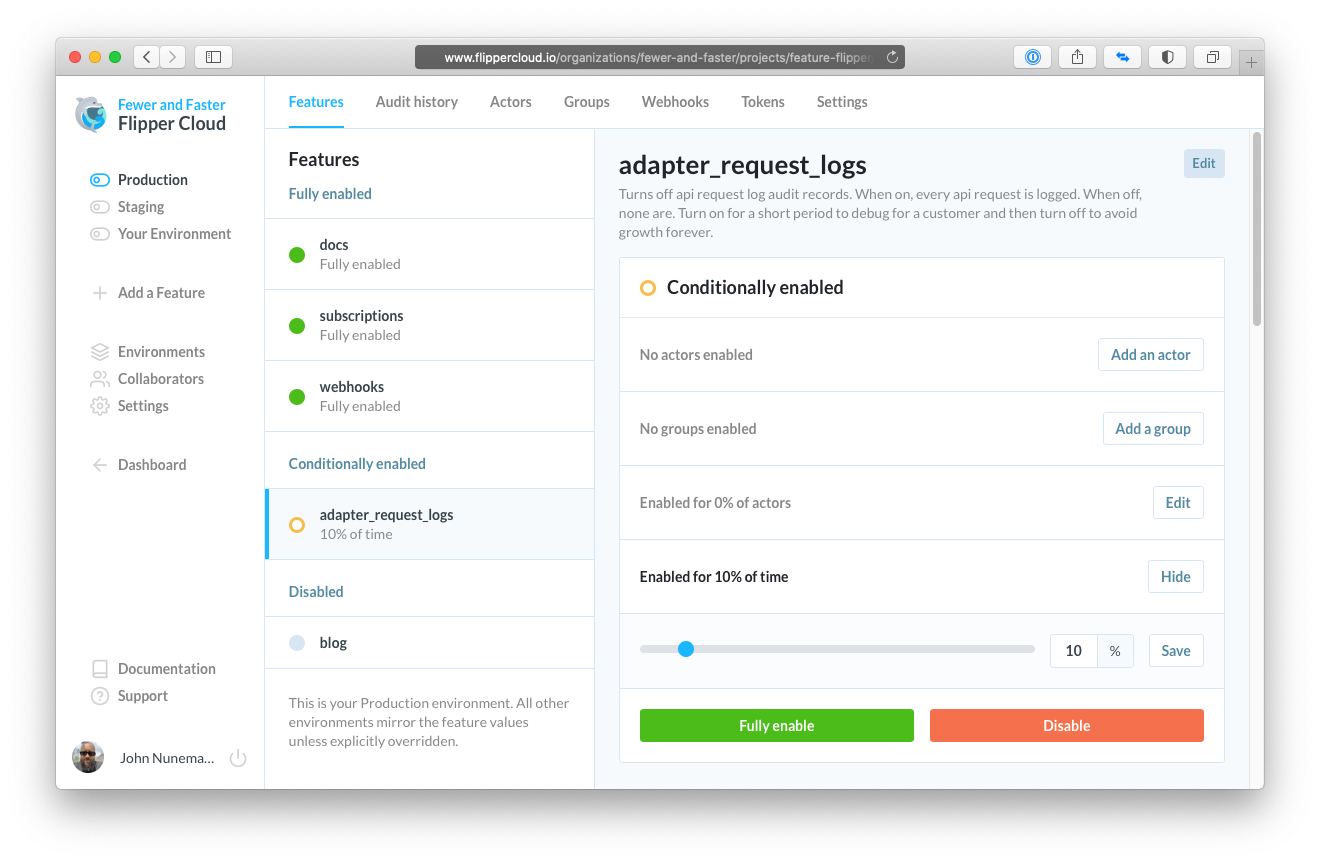
* Use [Flipper Cloud](#flipper-cloud) to cascade features from multiple environments, share settings with your team, control permissions, keep an audit history, and rollback.
Control your software — don't let it control you.
## Installation
Add this line to your application's Gemfile:
gem 'flipper'
You'll also want to pick a storage [adapter](https://flippercloud.io/docs/adapters), for example:
gem 'flipper-active_record'
And then execute:
$ bundle
Or install it yourself with:
$ gem install flipper
## Subscribe & Ship
[💌 Subscribe](https://buttondown.email/flipper) - I'll send you short and sweet emails when we release new versions.
## Getting Started
Use `Flipper#enabled?` in your app to check if a feature is enabled.
```ruby
# check if search is enabled
if Flipper.enabled? :search, current_user
puts 'Search away!'
else
puts 'No search for you!'
end
```
All features are disabled by default, so you'll need to explicitly enable them.
```ruby
# Enable a feature for everyone
Flipper.enable :search
# Enable a feature for a specific actor
Flipper.enable_actor :search, current_user
# Enable a feature for a group of actors
Flipper.enable_group :search, :admin
# Enable a feature for a percentage of actors
Flipper.enable_percentage_of_actors :search, 2
```
Read more about [getting started with Flipper](https://flippercloud.io/docs) and [enabling features](https://flippercloud.io/docs/features).
## Flipper Cloud
Like Flipper and want more? Check out [Flipper Cloud](https://www.flippercloud.io), which comes with:
* **everything in one place** — no need to bounce around from different application UIs or IRB consoles.
* **permissions** — grant access to everyone in your organization or lockdown each project to particular people.
* **multiple environments** — production, staging, enterprise, by continent, whatever you need.
* **personal environments** — no more rake scripts or manual enable/disable to get your laptop to look like production. Every developer gets a personal environment that inherits from production that they can override as they please ([read more](https://www.johnnunemaker.com/flipper-cloud-environments/)).
* **no maintenance** — we'll keep the lights on for you. We also have handy webhooks for keeping your app in sync with Cloud, so **our availability won't affect yours**. All your feature flag reads are local to your app.
* **audit history** — every feature change and who made it.
* **rollbacks** — enable or disable a feature accidentally? No problem. You can roll back to any point in the audit history with a single click.
[](https://www.flippercloud.io)
Cloud is super simple to integrate with Rails ([demo app](https://github.com/fewerandfaster/flipper-rails-demo)), Sinatra or any other framework.
## Contributing
1. Fork it
2. Create your feature branch (`git checkout -b my-new-feature`)
3. Run the tests (`bundle exec rake`). Check out [Docker-Compose](docs/DockerCompose.md) if you need help getting all the adapters running.
4. Commit your changes (`git commit -am 'Added some feature'`)
5. Push to the branch (`git push origin my-new-feature`)
6. Create new Pull Request
## Releasing
1. Update the version to be whatever it should be and commit.
2. `script/release`
3. Profit.
## Brought To You By
| pic | @mention | area |
|---|---|---|
|  | [@jnunemaker](https://github.com/jnunemaker) | most things |
|  | [@bkeepers](https://github.com/bkeepers) | most things |
|  | [@dpep](https://github.com/dpep) | tbd |
|  | [@alexwheeler](https://github.com/alexwheeler) | api |
|  | [@thetimbanks](https://github.com/thetimbanks) | ui |
|  | [@lazebny](https://github.com/lazebny) | docker |
|
