1
2
3
4
5
6
7
8
9
10
11
12
13
14
15
16
17
18
19
20
21
22
23
24
25
26
27
28
29
30
31
32
33
34
35
36
37
38
39
40
41
42
43
44
45
46
47
48
49
50
51
52
53
54
55
56
57
58
59
60
61
62
63
64
65
66
67
68
69
70
71
72
73
74
75
76
77
78
79
80
81
82
83
84
85
86
87
88
89
90
91
92
93
94
95
96
97
98
99
100
101
102
103
104
105
106
107
108
109
110
111
112
113
114
115
116
117
118
119
120
121
122
123
124
125
126
127
128
129
130
131
132
133
134
135
136
137
138
139
140
141
142
143
144
145
146
147
148
149
150
151
152
153
154
155
156
157
158
159
160
161
162
163
164
165
166
167
168
169
170
171
172
173
174
175
176
177
178
179
180
181
182
183
184
185
186
187
188
189
190
191
192
193
194
195
196
197
198
199
200
201
202
203
204
205
206
207
208
209
210
211
212
213
214
215
216
217
218
219
220
221
222
223
224
225
226
227
228
229
230
231
232
233
234
235
236
237
238
239
240
241
242
243
244
245
246
247
248
249
250
251
252
253
254
255
256
257
258
259
260
261
262
263
264
265
266
267
268
269
270
271
272
273
274
275
276
277
278
279
280
281
282
283
284
285
286
287
288
289
290
291
292
293
294
295
296
297
298
299
300
301
302
303
304
305
306
307
308
309
310
311
312
313
314
315
316
317
318
319
320
321
322
323
324
325
326
327
328
329
330
331
332
333
334
335
336
337
338
339
340
341
342
343
344
345
346
347
348
349
350
351
352
353
354
355
356
357
358
359
360
361
362
363
364
365
366
367
368
369
370
371
372
373
374
375
376
377
378
379
380
381
382
383
384
385
386
387
388
389
390
391
392
393
394
395
396
397
398
399
400
401
402
403
404
405
406
407
408
409
410
411
412
413
414
415
416
417
418
419
420
421
422
423
424
425
426
427
428
429
430
431
432
433
434
435
436
437
438
439
440
441
442
443
444
445
446
447
448
449
450
451
452
453
454
455
456
457
458
459
460
461
462
463
464
465
466
467
468
469
470
471
472
473
474
475
476
477
478
479
480
481
482
483
484
485
486
487
488
489
490
491
492
493
494
495
496
497
498
499
500
501
502
503
504
505
506
507
508
509
510
511
512
513
514
515
516
517
518
519
520
521
522
523
524
525
526
527
528
529
530
531
532
533
534
535
536
537
538
539
540
541
542
543
544
545
546
547
548
549
550
551
552
553
554
555
556
557
558
559
560
561
562
563
564
565
566
567
568
569
570
571
572
573
574
575
576
577
578
579
580
581
582
583
584
585
586
587
588
589
590
591
592
593
594
595
596
597
598
599
600
601
602
603
604
605
606
607
608
609
610
611
612
613
614
615
616
617
618
619
620
621
622
623
624
625
626
627
628
629
630
631
632
633
634
635
636
637
638
639
640
641
642
643
644
|
# Moka
[![GitHub Actions][gh-actions-badge]][gh-actions]
[![crates.io release][release-badge]][crate]
[![docs][docs-badge]][docs]
[![dependency status][deps-rs-badge]][deps-rs]
[![codecov][codecov-badge]][codecov]
[![license][license-badge]](#license)
> **note**
> `v0.12.0` had major breaking changes on the API and internal behavior. Please read
> the [MIGRATION-GUIDE.md][migration-guide-v012] for the details.
* * *
Moka is a fast, concurrent cache library for Rust. Moka is inspired by the
[Caffeine][caffeine-git] library for Java.
Moka provides cache implementations on top of hash maps. They support full
concurrency of retrievals and a high expected concurrency for updates.
All caches perform a best-effort bounding of a hash map using an entry replacement
algorithm to determine which entries to evict when the capacity is exceeded.
[gh-actions-badge]: https://github.com/moka-rs/moka/workflows/CI/badge.svg
[release-badge]: https://img.shields.io/crates/v/moka.svg
[docs-badge]: https://docs.rs/moka/badge.svg
[deps-rs-badge]: https://deps.rs/repo/github/moka-rs/moka/status.svg
[codecov-badge]: https://codecov.io/gh/moka-rs/moka/graph/badge.svg?token=7GYZNS7O67
[license-badge]: https://img.shields.io/crates/l/moka.svg
[gh-actions]: https://github.com/moka-rs/moka/actions?query=workflow%3ACI
[crate]: https://crates.io/crates/moka
[docs]: https://docs.rs/moka
[deps-rs]: https://deps.rs/repo/github/moka-rs/moka
[codecov]: https://codecov.io/gh/moka-rs/moka
[caffeine-git]: https://github.com/ben-manes/caffeine
## Features
Moka provides a rich and flexible feature set while maintaining high hit ratio and a
high level of concurrency for concurrent access.
- Thread-safe, highly concurrent in-memory cache implementations:
- Synchronous caches that can be shared across OS threads.
- An asynchronous (futures aware) cache.
- A cache can be bounded by one of the followings:
- The maximum number of entries.
- The total weighted size of entries. (Size aware eviction)
- Maintains near optimal hit ratio by using an entry replacement algorithms inspired
by Caffeine:
- Admission to a cache is controlled by the Least Frequently Used (LFU) policy.
- Eviction from a cache is controlled by the Least Recently Used (LRU) policy.
- [More details and some benchmark results are available here][tiny-lfu].
- Supports expiration policies:
- Time to live.
- Time to idle.
- Per-entry variable expiration.
- Supports eviction listener, a callback function that will be called when an entry
is removed from the cache.
### Choosing the right cache for your use case
No cache implementation is perfect for every use cases. Moka is a complex software
and can be overkill for your use case. Sometimes simpler caches like
[Mini Moka][mini-moka-crate] or [Quick Cache][quick-cache] might be a better fit.
The following table shows the trade-offs between the different cache implementations:
| Feature | Moka v0.12 | Mini Moka v0.10 | Quick Cache v0.6 |
|:------- |:---- |:--------- |:----------- |
| Thread-safe, sync cache | ✅ | ✅ | ✅ |
| Thread-safe, async cache | ✅ | ❌ | ✅ |
| Non-concurrent cache | ❌ | ✅ | ✅ |
| Bounded by the maximum number of entries | ✅ | ✅ | ✅ |
| Bounded by the total weighted size of entries | ✅ | ✅ | ✅ |
| Near optimal hit ratio | ✅ TinyLFU | ✅ TinyLFU | ✅ S3-FIFO |
| Per-key, atomic insertion. (e.g. `get_with` method) | ✅ | ❌ | ✅ |
| Cache-level expiration policies (time-to-live and time-to-idle) | ✅ | ✅ | ❌ |
| Per-entry variable expiration | ✅ | ❌ | ❌ |
| Eviction listener | ✅ | ❌ | ✅ (via lifecycle hook) |
| Lock-free, concurrent iterator | ✅ | ❌ | ❌ |
| Lock-per-shard, concurrent iterator | ❌ | ✅ | ❌ |
| Performance, etc. | Moka v0.12 | Mini Moka v0.10 | Quick Cache v0.6 |
|:------- |:---- |:--------- |:----------- |
| Small overhead compared to a concurrent hash table | ❌ | ❌ | ✅ |
| Does not use background threads | ❌ → ✅ Removed from v0.12 | ✅ | ✅ |
| Small dependency tree | ❌ | ✅ | ✅ |
[tiny-lfu]: https://github.com/moka-rs/moka/wiki#admission-and-eviction-policies
[quick-cache]: https://crates.io/crates/quick_cache
[mini-moka-crate]: https://crates.io/crates/mini-moka
## Moka in Production
Moka is powering production services as well as embedded Linux devices like home
routers. Here are some highlights:
- [crates.io](https://crates.io/): The official crate registry has been using Moka in
its API service to reduce the loads on PostgreSQL. Moka is maintaining
[cache hit rates of ~85%][gh-discussions-51] for the high-traffic download endpoint.
(Moka used: Nov 2021 — present)
- [aliyundrive-webdav][aliyundrive-webdav-git]: This WebDAV gateway for a cloud drive
may have been deployed in hundreds of home Wi-Fi routers, including inexpensive
models with 32-bit MIPS or ARMv5TE-based SoCs. Moka is used to cache the metadata
of remote files. (Moka used: Aug 2021 — present)
[gh-discussions-51]: https://github.com/moka-rs/moka/discussions/51
[aliyundrive-webdav-git]: https://github.com/messense/aliyundrive-webdav
## Recent Changes
> **Note**
> `v0.12.0` had major breaking changes on the API and internal behavior. Please read
> the [MIGRATION-GUIDE.md][migration-guide-v012] for the details.
- [MIGRATION-GUIDE.md][migration-guide-v012]
- [CHANGELOG.md](https://github.com/moka-rs/moka/blob/main/CHANGELOG.md)
[migration-guide-v012]: https://github.com/moka-rs/moka/blob/main/MIGRATION-GUIDE.md
## Table of Contents
- [Features](#features)
- [Choosing the right cache for your use case](#choosing-the-right-cache-for-your-use-case)
- [Moka in Production](#moka-in-production)
- [Change Log](#change-log)
- [Supported Platforms](#supported-platforms)
- [Usage](#usage)
- Examples (Part 1)
- [Synchronous Cache](#example-synchronous-cache)
- [Asynchronous Cache](#example-asynchronous-cache)
- [Avoiding to clone the value at `get`](#avoiding-to-clone-the-value-at-get)
- Example (Part 2)
- [Size Aware Eviction](#example-size-aware-eviction)
- [Expiration Policies](#expiration-policies)
- [Minimum Supported Rust Versions](#minimum-supported-rust-versions)
- Troubleshooting
- [Compile Errors on Some 32-bit Platforms](#compile-errors-on-some-32-bit-platforms)
- [Developing Moka](#developing-moka)
- [Road Map](#road-map)
- [About the Name](#about-the-name)
- [Credits](#credits)
- [License](#license)
## Supported Platforms
Moka should work on most 64-bit and 32-bit platforms if Rust `std` library is
available with threading support. However, WebAssembly (Wasm) and WASI targets are
not supported.
The following platforms are tested on CI:
- Linux 64-bit (x86_64, arm aarch64)
- Linux 32-bit (i646, armv7, armv5, mips)
- If you get compile errors on 32-bit platforms, see
[troubleshooting](#compile-errors-on-some-32-bit-platforms).
The following platforms are not tested on CI but should work:
- macOS (arm64)
- Windows (x86_64 msvc and gnu)
- iOS (arm64)
The following platforms are _not_ supported:
- WebAssembly (Wasm) and WASI targets are not supported.
(See [this project task][gh-proj-49877487])
- `nostd` environment (platforms without `std` library) are not supported.
- 16-bit platforms are not supported.
[gh-proj-49877487]: https://github.com/orgs/moka-rs/projects/1?pane=issue&itemId=49877487
## Usage
To add Moka to your dependencies, run `cargo add` as the followings:
```console
# To use the synchronous cache:
cargo add moka --features sync
# To use the asynchronous cache:
cargo add moka --features future
```
If you want to use the cache under an async runtime such as `tokio` or `async-std`, you should specify the `future` feature. Otherwise, specify the `sync` feature.
## Example: Synchronous Cache
The thread-safe, synchronous caches are defined in the `sync` module.
Cache entries are manually added using `insert` or `get_with` method, and
are stored in the cache until either evicted or manually invalidated.
Here's an example of reading and updating a cache by using multiple threads:
```rust
// Use the synchronous cache.
use moka::sync::Cache;
use std::thread;
fn value(n: usize) -> String {
format!("value {n}")
}
fn main() {
const NUM_THREADS: usize = 16;
const NUM_KEYS_PER_THREAD: usize = 64;
// Create a cache that can store up to 10,000 entries.
let cache = Cache::new(10_000);
// Spawn threads and read and update the cache simultaneously.
let threads: Vec<_> = (0..NUM_THREADS)
.map(|i| {
// To share the same cache across the threads, clone it.
// This is a cheap operation.
let my_cache = cache.clone();
let start = i * NUM_KEYS_PER_THREAD;
let end = (i + 1) * NUM_KEYS_PER_THREAD;
thread::spawn(move || {
// Insert 64 entries. (NUM_KEYS_PER_THREAD = 64)
for key in start..end {
my_cache.insert(key, value(key));
// get() returns Option<String>, a clone of the stored value.
assert_eq!(my_cache.get(&key), Some(value(key)));
}
// Invalidate every 4 element of the inserted entries.
for key in (start..end).step_by(4) {
my_cache.invalidate(&key);
}
})
})
.collect();
// Wait for all threads to complete.
threads.into_iter().for_each(|t| t.join().expect("Failed"));
// Verify the result.
for key in 0..(NUM_THREADS * NUM_KEYS_PER_THREAD) {
if key % 4 == 0 {
assert_eq!(cache.get(&key), None);
} else {
assert_eq!(cache.get(&key), Some(value(key)));
}
}
}
```
You can try the synchronous example by cloning the repository and running the
following cargo instruction:
```console
$ cargo run --example sync_example
```
If you want to atomically initialize and insert a value when the key is not present,
you might want to check [the document][doc-sync-cache] for other insertion methods
`get_with` and `try_get_with`.
[doc-sync-cache]: https://docs.rs/moka/*/moka/sync/struct.Cache.html#method.get_with
## Example: Asynchronous Cache
The asynchronous (futures aware) cache is defined in the `future` module.
It works with asynchronous runtime such as [Tokio][tokio-crate],
[async-std][async-std-crate] or [actix-rt][actix-rt-crate].
To use the asynchronous cache, [enable a crate feature called "future"](#usage).
[tokio-crate]: https://crates.io/crates/tokio
[async-std-crate]: https://crates.io/crates/async-std
[actix-rt-crate]: https://crates.io/crates/actix-rt
Cache entries are manually added using an insert method, and are stored in the cache
until either evicted or manually invalidated:
- Inside an async context (`async fn` or `async` block), use `insert` or `invalidate`
method for updating the cache and `await` them.
- Outside any async context, use `blocking` method to access blocking version of
`insert` or `invalidate` methods.
Here is a similar program to the previous example, but using asynchronous cache with
[Tokio][tokio-crate] runtime:
```rust,ignore
// Cargo.toml
//
// [dependencies]
// moka = { version = "0.12", features = ["future"] }
// tokio = { version = "1", features = ["rt-multi-thread", "macros" ] }
// futures-util = "0.3"
// Use the asynchronous cache.
use moka::future::Cache;
#[tokio::main]
async fn main() {
const NUM_TASKS: usize = 16;
const NUM_KEYS_PER_TASK: usize = 64;
fn value(n: usize) -> String {
format!("value {n}")
}
// Create a cache that can store up to 10,000 entries.
let cache = Cache::new(10_000);
// Spawn async tasks and write to and read from the cache.
let tasks: Vec<_> = (0..NUM_TASKS)
.map(|i| {
// To share the same cache across the async tasks, clone it.
// This is a cheap operation.
let my_cache = cache.clone();
let start = i * NUM_KEYS_PER_TASK;
let end = (i + 1) * NUM_KEYS_PER_TASK;
tokio::spawn(async move {
// Insert 64 entries. (NUM_KEYS_PER_TASK = 64)
for key in start..end {
// insert() is an async method, so await it.
my_cache.insert(key, value(key)).await;
// get() returns Option<String>, a clone of the stored value.
assert_eq!(my_cache.get(&key).await, Some(value(key)));
}
// Invalidate every 4 element of the inserted entries.
for key in (start..end).step_by(4) {
// invalidate() is an async method, so await it.
my_cache.invalidate(&key).await;
}
})
})
.collect();
// Wait for all tasks to complete.
futures_util::future::join_all(tasks).await;
// Verify the result.
for key in 0..(NUM_TASKS * NUM_KEYS_PER_TASK) {
if key % 4 == 0 {
assert_eq!(cache.get(&key).await, None);
} else {
assert_eq!(cache.get(&key).await, Some(value(key)));
}
}
}
```
You can try the asynchronous example by cloning the repository and running the
following cargo instruction:
```console
$ cargo run --example async_example --features future
```
If you want to atomically initialize and insert a value when the key is not present,
you might want to check [the document][doc-future-cache] for other insertion methods
`get_with` and `try_get_with`.
[doc-future-cache]: https://docs.rs/moka/*/moka/future/struct.Cache.html#method.get_with
## Avoiding to clone the value at `get`
For the concurrent caches (`sync` and `future` caches), the return type of `get`
method is `Option<V>` instead of `Option<&V>`, where `V` is the value type. Every
time `get` is called for an existing key, it creates a clone of the stored value `V`
and returns it. This is because the `Cache` allows concurrent updates from threads so
a value stored in the cache can be dropped or replaced at any time by any other
thread. `get` cannot return a reference `&V` as it is impossible to guarantee the
value outlives the reference.
If you want to store values that will be expensive to clone, wrap them by
`std::sync::Arc` before storing in a cache. [`Arc`][rustdoc-std-arc] is a thread-safe
reference-counted pointer and its `clone()` method is cheap.
[rustdoc-std-arc]: https://doc.rust-lang.org/stable/std/sync/struct.Arc.html
```rust,ignore
use std::sync::Arc;
let key = ...
let large_value = vec![0u8; 2 * 1024 * 1024]; // 2 MiB
// When insert, wrap the large_value by Arc.
cache.insert(key.clone(), Arc::new(large_value));
// get() will call Arc::clone() on the stored value, which is cheap.
cache.get(&key);
```
## Example: Size Aware Eviction
If different cache entries have different "weights" — e.g. each entry has
different memory footprints — you can specify a `weigher` closure at the cache
creation time. The closure should return a weighted size (relative size) of an entry
in `u32`, and the cache will evict entries when the total weighted size exceeds its
`max_capacity`.
```rust
use moka::sync::Cache;
fn main() {
let cache = Cache::builder()
// A weigher closure takes &K and &V and returns a u32 representing the
// relative size of the entry. Here, we use the byte length of the value
// String as the size.
.weigher(|_key, value: &String| -> u32 {
value.len().try_into().unwrap_or(u32::MAX)
})
// This cache will hold up to 32MiB of values.
.max_capacity(32 * 1024 * 1024)
.build();
cache.insert(0, "zero".to_string());
}
```
Note that weighted sizes are not used when making eviction selections.
You can try the size aware eviction example by cloning the repository and running the
following cargo instruction:
```console
$ cargo run --example size_aware_eviction
```
## Expiration Policies
Moka supports the following expiration policies:
- **Cache-level expiration policies:**
- Cache-level policies are applied to all entries in the cache.
- **Time to live (TTL)**: A cached entry will be expired after the specified
duration past from `insert`.
- **Time to idle (TTI)**: A cached entry will be expired after the specified
duration past from `get` or `insert`.
- **Per-entry expiration policy:**
- The per-entry expiration lets you sets a different expiration time for each
entry.
For details and examples of above policies, see the "Example: Time-based Expiration"
section ([`sync::Cache`][doc-sync-cache-expiration],
[`future::Cache`][doc-future-cache-expiration]) of the document.
[doc-sync-cache-expiration]: https://docs.rs/moka/latest/moka/sync/struct.Cache.html#example-time-based-expirations
[doc-future-cache-expiration]: https://docs.rs/moka/latest/moka/future/struct.Cache.html#example-time-based-expirations
## Minimum Supported Rust Versions
Moka's minimum supported Rust versions (MSRV) are the followings:
| Feature | MSRV |
|:---------|:--------------------------:|
| `future` | Rust 1.70.0 (June 1, 2023) |
| `sync` | Rust 1.70.0 (June 1, 2023) |
It will keep a rolling MSRV policy of at least 6 months. If the default features with
a mandatory features (`future` or `sync`) are enabled, MSRV will be updated
conservatively. When using other features, MSRV might be updated more frequently, up
to the latest stable.
In both cases, increasing MSRV is _not_ considered a semver-breaking change.
<!--
- quanta v0.12.4 requires 1.70.0.
-->
## Troubleshooting
### Compile Errors on Some 32-bit Platforms
#### Symptoms
When using Moka v0.12.9 or earlier on some 32-bit platforms, you may get compile
errors:
```console
error[E0432]: unresolved import `std::sync::atomic::AtomicU64`
--> ... /moka-0.5.3/src/sync.rs:10:30
|
10 | atomic::{AtomicBool, AtomicU64, Ordering},
| ^^^^^^^^^
| |
| no `AtomicU64` in `sync::atomic`
```
or
```console
error[E0583]: file not found for module `atomic_time`
--> ... /moka-0.12.9/src/common/concurrent.rs:23:1
|
23 | pub(crate) mod atomic_time;
| ^^^^^^^^^^^^^^^^^^^^^^^^^^^
|
```
#### How to Fix
You can fix these compilation errors by one of the following:
1. (Recommended) Upgrade Moka to v0.12.10 or later. (`cargo update -p moka`)
2. Or, keep using Moka v0.12.9 or earlier but disable the default features in
`Cargo.toml`. (`default-features = false`)
- The default features include the `atomic64` feature, which need to be disabled.
These error messages are caused by the absence of `std::sync::atomic::AtomicU64` on
some 32-bit platforms. Moka v0.12.10 and later will automatically use a fallback
implementation when `AtomicU64` is not available. With v0.12.9 and earlier, you must
manually disable the `atomic64` feature to use the fallback implementation.
## Developing Moka
**Running All Tests**
To run all tests including `future` feature and doc tests on the README, use the
following command:
```console
$ RUSTFLAGS='--cfg trybuild' cargo test --all-features
```
**Running All Tests without Default Features**
```console
$ RUSTFLAGS='--cfg trybuild' cargo test \
--no-default-features --features 'future, sync'
```
**Generating the Doc**
```console
$ cargo +nightly -Z unstable-options --config 'build.rustdocflags="--cfg docsrs"' \
doc --no-deps --features 'future, sync'
```
## Roadmap
See the [project roadmap][gh-proj-1] for the updated and detailed plans.
But here are some highlights:
[gh-proj-1]: https://github.com/orgs/moka-rs/projects/1/views/1
- [x] Size-aware eviction. (`v0.7.0` via [#24][gh-pull-024])
- [x] API stabilization. (Smaller core API, shorter names for frequently used
methods) (`v0.8.0` via [#105][gh-pull-105])
- e.g.
- `get_or_insert_with(K, F)` → `get_with(K, F)`
- `get_or_try_insert_with(K, F)` → `try_get_with(K, F)`
- `time_to_live()` → `policy().time_to_live()`
- [x] Notifications on eviction. (`v0.9.0` via [#145][gh-pull-145])
- [x] Variable (per-entry) expiration, using hierarchical timer wheels.
(`v0.11.0` via [#248][gh-pull-248])
- [x] Remove background threads. (`v0.12.0` via [#294][gh-pull-294] and
[#316][gh-pull-316])
- [x] Add upsert and compute methods. (`v0.12.3` via [#370][gh-pull-370])
- [ ] Cache statistics (Hit rate, etc.). ([details][cache-stats])
- [ ] Upgrade TinyLFU to Window-TinyLFU. ([details][tiny-lfu])
- [ ] Restore cache from a snapshot. ([details][restore])
[gh-pull-024]: https://github.com/moka-rs/moka/pull/24
[gh-pull-105]: https://github.com/moka-rs/moka/pull/105
[gh-pull-145]: https://github.com/moka-rs/moka/pull/145
[gh-pull-248]: https://github.com/moka-rs/moka/pull/248
[gh-pull-294]: https://github.com/moka-rs/moka/pull/294
[gh-pull-316]: https://github.com/moka-rs/moka/pull/316
[gh-pull-370]: https://github.com/moka-rs/moka/pull/370
[cache-stats]: https://github.com/moka-rs/moka/issues/234
[restore]: https://github.com/moka-rs/moka/issues/314
## About the Name
Moka is named after the [moka pot][moka-pot-wikipedia], a stove-top coffee maker that
brews espresso-like coffee using boiling water pressurized by steam.
This name would imply the following facts and hopes:
- Moka is a part of the Java Caffeine cache family.
- It is written in Rust. (Many moka pots are made of aluminum alloy or stainless
steel. We know they don't rust though)
- It should be fast. ("Espresso" in Italian means express)
- It should be easy to use, like a moka pot.
[moka-pot-wikipedia]: https://en.wikipedia.org/wiki/Moka_pot
## Credits
### Caffeine
Moka's architecture is heavily inspired by the [Caffeine][caffeine-git] library for
Java. Thanks go to Ben Manes and all contributors of Caffeine.
### cht
The source files of the concurrent hash table under `moka::cht` module were copied
from the [cht crate v0.4.1][cht-v041] and modified by us. We did so for better
integration. cht v0.4.1 and earlier are licensed under the MIT license.
Thanks go to Gregory Meyer.
[cht-v041]: https://github.com/Gregory-Meyer/cht/tree/v0.4.1
## License
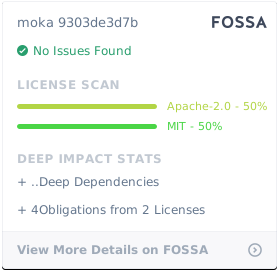
Moka is distributed under either of
- The MIT license
- The Apache License 2.0
at your option.
See [LICENSE-MIT](LICENSE-MIT) and [LICENSE-APACHE](LICENSE-APACHE) for details.
**Note on Licensing:**
Certain components, specifically
[`src/common/frequency_sketch.rs`](src/common/frequency_sketch.rs) and
[`src/common/timer_wheel.rs`](src/common/timer_wheel.rs), are distributed solely
under the Apache License 2.0. These files were ported from the [Caffeine][caffeine-git]
library and are not dual-licensed.
<!--
[](https://app.fossa.com/projects/git%2Bgithub.com%2Fmoka-rs%2Fmoka?ref=badge_large)
-->
|
