1
2
3
4
5
6
7
8
9
10
11
12
13
14
15
16
17
18
19
20
21
22
23
24
25
26
27
28
29
30
31
32
33
34
35
36
37
38
39
40
41
42
43
44
45
46
47
48
49
50
51
52
53
54
55
56
57
58
59
60
61
62
63
64
65
66
67
68
69
70
71
72
73
74
75
76
77
78
79
80
81
82
83
84
85
86
87
88
89
90
91
92
93
94
95
96
97
98
99
100
101
102
103
104
105
106
107
108
109
110
111
112
113
114
115
116
117
118
119
120
121
122
123
124
125
126
127
128
129
130
131
132
133
134
135
136
137
138
139
140
141
142
143
144
145
146
147
148
|
Unless specified otherwise, follow: [Google java style](http://google.github.io/styleguide/javaguide.html)
## Checkstyle
Introducing new checkstyle violations will fail the build,
for details see [Checkstyle]({{ "/dev_docs/dev/checkstyle/" | prepend: site.baseurl }})
## Code is formatted
Auto-formatter has been applied, for auto-formatter setup see:
[New Dev Setup]({{ "/dev_docs/dev/new_dev_setup/" | prepend: site.baseurl }})
## Guidelines and Preferences
### Avoid copy paste
DRY: [do not copy and paste](https://en.wikipedia.org/wiki/Don%27t_repeat_yourself).
### Prefer to spell out variable names
Notable exceptions, loop index 'i', exception 'e'.
### Prefer library implementations when available
Do not re-invent the wheel. Prefer first `java.lang`, then we have available guava, apache commons
### Avoid using `null` as part of public APIs
Said another way, do not pass `null` arguments, and do not return null.
Some techniques to avoid `null` are:
- add multiple method signatures to omit `null` parameters
- use naturally empty objects, like an empty list instead of null.
- `Optional` can sometimes be a good choice for return values.
### Deprecate Correctly
When you have a good reason to deprecate a method or class, add both a `@Deprecated` annotation
_and_ a `@deprecated` documentation in the javadocs. Always include a comment about how to handle
the deprecation, can callers remove the altogether, should they replace it with a different API?
Example:
```
/**
* <...javadocs....>
* @Deprecated Use 'fooBar()' instead
*/
@deprecated
public void foo(int param) {
:
:
```
### Handle exceptions
- `ClientLogger` is a utility class to log errors. Can be used as: `ClientLogger.logError(e)`
- Always log surrounding context, if there are any args or relevant variable values, log their values, for example:
```
public int processXmlData(Unit unit, XmlTransmitter transmitter) {
try {
transmitter.send(unit)
} catch (IOException e ) {
String failMsg = String.format("Failed to send unit data: %s, using transmitter: %s", unitData, transmitter);
ClientLogger.logError(failMsg, e);
}
}
```
In the above, note that we are logging the values of the two method arguments. If there were any other interesting
variable values in the method or class, we would log those too. Without this information, if we ever do get an
exception, and it is related to data, we'll be scratching our heads on how to reproduce the problem.
### Mock Objects
Prefer replacing hand crafted mock objects with mockito.
## Variable and Method Ordering
### Methods
Dependent methods are grouped together. For some good background reading and details on how to do this,
please see Chapter 5 'Formatting' in [Clean Code](http://ricardogeek.com/docs/clean_code.html)
#### IntelliJ Formatter Option for Method Ordering
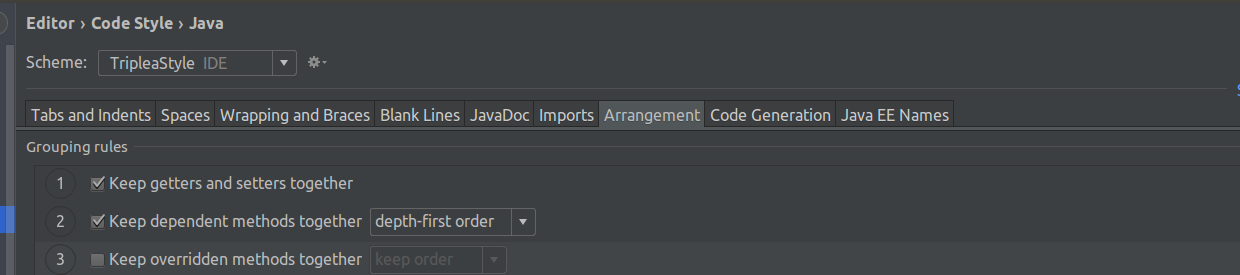
#### Method ordering summary
- private methods are defined as soon as possible after first usage. For example, the constructor as the first
code block will be followed by any private methods that are used in the constructor. Following that we will define
the first public method, and then any private methods that it uses.
Example:
```
public class Foo {
// variables
// constructor
// private methods called by constructor
// first public method
public void firstPublicMethod() {
firstPrivateMethodCalled();
secondPrivateMethodCalled();
}
// private methods called by first public method, in order in which they are called
private void firstPrivateMethodCalled() { }
private void secondPrivateMethodCalled() { }
// second public method
// any new private methods called by second public method
}
```
### Variables
This is similar to methods, they are defined as close to their usage as possible. Rule of thumb, minimize the number
of lines between declaration and first usage. Another way to think of this, do not declare variables all at top,
declare them before usage.
Example:
```
int first = 2;
int firstSquared = first * first;
int second = 3;
int secondSquared = second * second;
double distance = Math.sqrt(firstSquared + secondSquared);
```
Instead of:
```
int first = 2;
int second = 3;
int firstSquared = first * first;
int secondSquared = second * second;
double distance = Math.sqrt(firstSquared + secondSquared);
```
|
